
WHILE THE MONGOL men stayed busy on the battlefield conquering foreign countries, women managed the empire. Among the herding tribes, women traditionally managed the affairs at home while men went off to herd, hunt, or fight, and although the war campaigns now lasted for years rather than months and the home consisted of not merely a collection of ger camps but a vast empire, women continued to rule. Aside from Russia and eastern Europe, where the fighting continued the heaviest during Ogodei’s reign, women assumed administration of all remaining parts of the Mongol Empire. Despite the rivalry with Ogodei Khan, Sorkhokhtani, the widow of Genghis Khan’s youngest son, Tolui, ruled northern China and eastern Mongolia, including the family homeland where Genghis Khan grew up. Ebuskun, the widow of Genghis Khan’s second son, Chaghatai, ruled Central Asia or Turkestan.
While Ogodei reigned as Great Khan, for long periods of time he was too drunk to lead the empire, and he gradually conveyed administrative power to Toregene, the most capable, although not the senior, wife. At his death in 1241, she became the official regent. For the next ten years, until 1251, she and a small group of other women controlled the largest empire in world history. None of the women had been born a Mongol but had instead been married into the family from a conquered steppe tribe, and most of the women were Christians. Neither their gender nor religion hindered their rise to power nor the struggle against one another as each vied to place the whole of the empire in the hands of her own son.
The struggle for power, no matter how fiercely fought, proved relatively peaceful except when it came to the ultimate treatment of the women themselves, who suffered horrendous fates upon losing a battle. Outside of the court struggles, the era brought a needed decade of peace through the empire, an opportunity to consolidate some of the holdings, and a time to recover from the four decades of the First Mongol World War of 1212–1241 and prepare for the next one.
The oldest surviving record of Toregene’s power and prominence in the Mongol court appears in an order to print Taoist texts issued by her as Yeke Khatun, Great Empress, under her own name as well as the seal of Ogodei on April 10, 1240. The text shows clearly not only that she was operating the empire but that while the men fought, she pursued an entirely different line of activities, supporting religion and education and working to build buildings and important social structures on an imperial scale.
Having lost his favorite son and other close relatives in the only marginally successful China campaign, Ogodei generally lost interest in political life, but he nominated one of his grandsons to follow him. Toregene, however, wanted to push the candidacy of her quarrelsome and arrogant son Guyuk, who had been so strongly chastised and apparently disliked by his father. Soon after Ogodei’s death, Toregene summoned a khuriltai to elect Guyuk instead of the grandson nominated by Ogodei, but she could not get a quorum of the Golden Family, which meant that not enough people favored his election. Toregene continued as regent and began five years of meticulous political work to build the support she needed for Guyuk’s election. To pursue her goal, she dismissed her late husband’s ministers and replaced them with her own, the most important of whom was another woman, Fatima, a Tajik or Persian captive from the Khwarizm campaign who had been brought to work in Karakorum. The chronicler Ata-Malik Juvaini, who disliked her, and seemingly all women involved in politics, wrote that Fatima enjoyed constant access to Toregene’s tent, and she “became the sharer of intimate confidences and the depository of hidden secrets.” Fatima played a political role while the older “ministers were debarred from executing business, and she was free to issue commands and prohibitions.”
By 1246, Toregene had tightened her control of the empire and felt confident that she could orchestrate her son’s election. The deliberations and election of Guyuk transpired in private, limited to members of the Golden Family and important functionaries, but Toregene organized his installation as a major affair for foreign dignitaries as well as the Mongol people. Throughout the summer until the ceremony in August, foreign delegates arrived from the distant corners of the empire. Emirs, governors, and grandees jostled along the same roads beside princes and kings. The Seljuk sultan came from Turkey; representatives of the caliph of Baghdad also arrived, as well as two claimants to the throne of Georgia: David, the legitimate son of the late king, and David, the illegitimate son of the same king. The highest-ranking European delegate was Alexander Nevsky’s father, Grand Prince Yaroslav II Vsevolodovich of Vladimir and Suzdal, who died suspiciously just after dining with Toregene Khatun.
By happenstance, on July 22, 1246, in the midst of the massive gathering, the first envoy arrived at the Mongol court from western Europe. Friar Giovanni of Plano Carpini, a sixty-five-year-old cleric, who had been one of the disciples of Saint Francis of Assisi, arrived as the agent and spy for Pope Innocent IV, commissioned to find out as much as possible about these strange people who had threatened Europe. After leaving Lyons, France, at Easter of 1245, Carpini required nearly a year to cross Europe to the Mongol lines at Batu’s camp in Russia. Once in the Mongol transport system, however, Carpini covered approximately three thousand miles in a mere 106 days—an average of more than twenty-five miles on horseback each day for nearly three and a half months.
Because of the success of their military campaigns in Europe, the Mongols eagerly received Carpini in the mistaken belief that he was bringing the submission of the pope and all the people of western Europe, but his letter carried quite a different message. Pope Innocent IV offered the khan a pedantic synopsis of the life of Jesus and the main tenets of Christianity, all of which was probably well known to the khan through his Christian mother and his frequent attendance of religious services with her. Guyuk was likely a Christian himself; if not, he was certainly well disposed toward Christianity and relied heavily on Christian Mongols in his administration. The pope’s letter chastised the Mongols for invading Europe, ordering the khan to “desist entirely from assaults of this kind and especially from the persecution of Christians.” He demanded an explanation from the khan “to make fully known to us . . . what moved you to destroy other nations and what your intentions are for the future.” The letter informed the khan that God had delegated all earthly power to the pope in Rome, who was the only person authorized by God to speak for Him.
After the Mongol officials found out that Carpini brought no tribute and offered no submission, they mostly ignored him, but in a letter of November 1246 that still survives, Guyuk asked Innocent IV the obvious questions: How do you know whom God absolves and to whom He shows mercy? How do you know that God sanctions the words you speak? Guyuk pointed out that God had given the Mongols, not the pope, control of the world from the rising sun to the setting sun. God intended for the Mongols to spread his commandments and his laws through Genghis Khan’s Great Law. He then advised the pope to come to Karakorum with all of his princes in order to pay homage to the Mongol khan.
The first direct diplomatic contact between Europe and the Far East had degenerated into an exchange of comparative theology mixed with religious insults. Despite the extensive spiritual beliefs that the Mongols and Europeans shared in common, the opening relationship had been so negative and misguided that in future years, the entire base of shared religion would eventually erode. The Mongols continued for another generation to foster closer relations with Christian Europe, but in the end, they would have to abandon all such hope, and with it they would, in time, abandon Christianity entirely in favor of Buddhism and Islam.
In the fall of 1246, when Carpini and the other foreign dignitaries departed the royal camp to head home, Guyuk turned attention from public pomp and ceremony to the important political task of solidifying power and making himself the khan in fact, as well as in title. To assert his newly conferred powers, he first attacked Fatima, his mother’s trusted adviser. Using an accusation of witchcraft against her as a pretext, he summoned Fatima from his mother’s court to his own. His mother refused to let her go: “He sent again several times, and each time she refused him in a different way. As a result his relations with his mother became very bad, and he sent [a] man . . . with instruction to bring Fatima by force if his mother should still delay.”
The vague records of what happened next raise more questions than answers. Guyuk won control of Fatima Khatun, and his mother died. Was his mother ill? Killed? Did she die of anger or grief? Most records fall silent. The Persian historian Juzjani wrote that Toregene was sent to join her husband, Ogodei. Since her husband had been dead for six years, the statement appears to be a euphemism for her death, but Juzjani seemed unsure, for he added, “but God knows the truth.” All we know is that Guyuk’s men seized Fatima Khatun and Toregene Khatun was dead.
Instead of quietly disposing of Fatima, Guyuk submitted her to a gruesome public ordeal. At a time when the Mongols ruled an empire across two continents and still had numerous opportunities to expand it even farther, the court seemed fixated not on the empire but on this one woman, what she had done, and what should be done to her. Guyuk ordered his guards to bring Fatima, stripped naked and tightly bound in ropes, before him in open court. There she was kept publicly, “hungry and thirsty for many days and nights; she was plied with all manner of violence, severity, harshness and intimidation.” They beat her and then flogged her with some kind of heated metal rods. Such a public torture may have been appropriate for the treatment of a witch in European society or for a heretic at the hands of the Christian Church, but it violated totally the practices of Genghis Khan, who slew his enemies and ruled with harsh strictness but steadfastly without torture or the infliction of unnecessary pain. It seemed particularly contrary to Mongol tradition since it was directed against a woman; no precedent was known in Mongol history for any comparable spectacle.
The torture of Fatima was perhaps technically legal under the existing code because she was not a Mongol nor married to one, but was instead a war captive of uncertain but unprotected status. When at last the tortured woman confessed to a list of evils, including bewitching Toregene Khatun and other members of the Golden Family, Guyuk imposed on her a punishment of unique cruelty and symbolism. He ordered that all the orifices of her upper and lower body be sewn shut, thereby not permitting any of the essences of her soul to escape from her body, and that she be rolled up inside a felt blanket and drowned in the river. And thus ended the life of Fatima, his mother’s adviser, and one of the most powerful women of the thirteenth century.
In keeping with the tone set by the public torture and execution of Fatima, Guyuk’s short reign was one of horrible revenge. He unleashed a crude campaign to consolidate power and eliminate rivals. He ordered his soldiers to hunt down and kill everyone connected with Fatima. He began legal proceedings against his uncle Temuge Otchigen, the last surviving full brother of Genghis Khan and thus a legal claimant to the throne, who, shortly before Guyuk’s election, had pressed his claim in an abortive attempt to raise an army and invade the lands of Toregene Khatun. Temuge Otchigen had survived his encounter with the shaman Teb Tengeri when he was younger, but he did not survive this confrontation with his grandnephew. In a secret trial closely supervised by Guyuk in a closed ger, the male members of the family condemned him to death for attempting to seize the office of Great Khan by military force rather than election.
Guyuk turned attention to the other women in charge of the imperial Mongol lands. He removed the regent widow ruling over the lands of Chaghatai’s family, and he ordered an inquiry into the affairs of Tolui’s estate, then under the regency of Sorkhokhtani, who had refused to marry Guyuk after her husband’s death. During the investigation, he ordered the surrender of all the warriors assigned to her and her sons. With his eastern front thus secured and under his tight control, he assembled his army to move west on what he claimed was to be a massive hunt. In fact, the move was a pretext for a surprise attack on Batu Khan in Russia. He not only wanted revenge against his cousin for prior insults at the victory dinner in Russia, but of all the khans, Guyuk seemed most convinced of the importance of Europe. He wanted to complete that conquest and add Europe to his own personal territory within the Mongol Empire.
Unwilling to defy him publicly in any way, Sorkhokhtani cautiously moved to ensure that he failed in his surprise attack. She secretly dispatched messengers to warn Batu of Guyuk’s plan. She quite possibly took direct action against Guyuk himself because once he left his family stronghold in the central Mongolian steppe, the forty-three-year-old, seemingly healthy Guyuk suddenly died of mysterious causes after only eighteen months in office. Someone had probably killed him, but the list of suspects who had cause to do so is too long to analyze. No surviving Mongol document records the details of his death, and the suddenly laconic Persian chronicles report merely that “his predestined hour arrived.”
In the continuing political struggles at the center of the empire, the fringes began to unravel. With his great love of metaphors, Juvaini wrote that “the affairs of the world had been diverted from the path of rectitude and the reins of commerce and fair dealing turned aside from the highway of righteousness.” He described the land as being in darkness, “and the cup of the world was filled to the brim with the drink of iniquity.” The Mongol people and their subjects, “dragged now this way, now that, were at their wits’ end, for they had neither the endurance to stay nor did they know of a place to which they might flee.”
After the brief respite of Guyuk’s rule, the battle of the surviving queens resumed, even more intensely, as Guyuk’s widow Oghul Ghaimish stepped forward to take control of the empire just as her mother-in-law Toregene had done when Ogodei died. Oghul Ghaimish lacked the skills of her mother-in-law, and the hour would not belong to her, in great part because her own sons set up rival courts to challenge her right to rule as regent. Sorkhokhtani, with the full support of her four capable sons and a lifetime of preparation and waiting, finally made her move. Rather than wait for Guyuk’s widow to call the khuriltai at the capital of Karakorum, Batu Khan, at the instigation of his secret ally Sorkhokhtani, called it in 1250 for an area near Lake Issykul in the Tian Shan Mountains, outside of Mongolia and more convenient for him to reach. The khuriltai elected Sorkhokhtani’s eldest son Mongke, but the Ogodei family boycotted the election on grounds that a legitimate election had to be held in Mongolia proper, in particular in the capital of Karakorum, which their family controlled.
Undaunted, Sorkhokhtani devised a brilliant plan. She lacked access to the imperial capital, but as the widow of Genghis Khan’s youngest son, she controlled the ancient family homeland where Genghis Khan had been born, elected, and buried. No one could refuse to attend a khuriltai held on this sacred ground. Her ally Batu Khan could not make the long trip from Russia, but he sent her a bodyguard of thirty thousand troops under his brother Berke to protect her and her family through this election and installation process. She organized a second election for this hallowed spot, and on July 1, 1251, the assembled throng proclaimed the forty-three-year-old Mongke Grand Khan of the Mongol Empire. This time, no one could object to the venue.
To celebrate the occasion of his election, Mongke issued an order that for that day each person should rest, and the animals should not be made to work or carry burdens. The earth should not be pierced with tent pegs and water should not be polluted. No one could hunt wild animals, and those animals that were to be killed for feasting should be killed without shedding blood on the sacred earth. After the sacred day, a week of feasting followed. Each day of the festivities, the assembled guests consumed three hundred horses or oxen, three thousand sheep, and two thousand wagons filled with airak, the beloved alcoholic drink made from fermented mare’s milk.
The celebration marked the culmination of Sorkhokhtani’s lifework, and, in one sense, the celebration was more of an honor for her than anyone else. Whereas Genghis Khan himself had produced sons who were relatively weak, prone to drink, and self-centered, she had produced and trained four sons destined to make a major mark in history. Each of her sons was a khan. In the coming years Mongke, Arik Boke, and Khubilai would all carry the title of Great Khan for various lengths of time, and her other son, Hulegu, would become the Il Khan of Persia and the founder of his own dynasty there. Her sons would push the empire to its maximum size by conquering all of Persia, Baghdad, Syria, and Turkey. They would conquer the Chinese Sung dynasty in the south and push into Vietnam, Laos, and Burma. They would destroy the dreaded sect of the Assassins and execute the Muslim caliph.
The family of Ogodei and Guyuk arrived late at the khuriltai, after the election itself but in the middle of the celebration. The three important princes of Ogodei’s family suddenly strode into the tent to announce that they wished to pay obeisance to the new khan. The new khan had them all arrested and put in chains because his spies already reported that their arrival was a ruse to distract the court while other members of the family gathered nearby to prepare a sneak attack on the celebrating, and therefore inebriated, throng. Mongke easily captured the would-be attackers and began another round of trials. He could not torture or shed the blood of any descendant of Genghis Khan, but he had their advisers, mostly Muslims and Chinese, brought in for a torturous whipping with canes until they confessed against their masters. At the end of the trial, the new khan found his cousins guilty of various crimes. Two of the princes had their mouths stuffed with stones and dirt until they died. Some of the advisers committed suicide. In all, Mongke executed seventy-seven people within or close to Ogodei’s lineage.
While Mongke oversaw the trials of the men, his mother tried the women in her court. Sorkhokhtani ordered the arrest of the hapless regent Oghul Ghaimish Khatun, and in an only slightly milder replay of the trial of Fatima, her captors sewed rawhide around her hands and stripped her naked for public ridicule before wrapping her in felt and drowning her and another senior woman from the family. A third woman from their family was wrapped in a blanket and kicked to death.
From his court, Mongke Khan expanded the trials to a grand purge by sending out bands of inquisitors throughout the empire to question, convict, and punish anyone suspected of disloyalty to his branch of the family. The trials took place on a global scale from China and Mongolia in the east to Afghanistan in the south and Persia and Iraq in the west. Even the highest officials, such as the ruler of the Uighurs, were put to death, but the greatest damage was inflicted on the Golden Family itself. Mongke seemed determined to root out all the supporters from the families of his deceased uncles Chaghatai and Ogodei. Mongke seized the city of Karakorum and surrounding territory from Ogodei’s descendants. Across the empire, rulers and high officials lucky enough to escape punishment by the ad hoc tribunals still had to travel to Karakorum and present themselves to the new khan, have their record of loyalty examined, and then face the possible threat of punishment. Those officials who survived the test were then reinstated in their old position by the new khan. After the extensive and bloody purge of the Ogodei lineage, Mongke Khan ordered a general amnesty for other types of nonpolitical prisoners and captives.
Power had clearly passed into the lineage of Tolui. Sorkhokhtani had smashed the last obstacles to power for her sons, and she died knowing that her four sons faced no further threat from any branch of the Golden Family. The best description made of her accomplishment came from the writer Bar Hebraeus, who wrote that “if I were to see among the race of women another woman like this, I should say that the race of women was far superior to men.” No one in the history of the world had been given so large and rich an empire as Sokhokhtani gave to her sons, but within a few years of her death, her four sons would begin to tear it apart.
Sometime near the Mongol New Year festival in February 1252, either in the final days of the Year of the Pig or the first days of the Year of the Rat, Sorkhokhtani died. With her death, the decade of the ruling women that had begun in 1241 ended. Even as they competed against one another, the women had brought much needed outside talent into the inner circle of Mongol rule, and had given the empire a new foundation with their support of monasteries and schools, the printing of books, and the exchange of ideas and knowledge. After the resumption of the Mongol World War by the men, it would, in the end, be the new institutions begun by these women that would have the greatest impact on the world within and beyond the Mongol Empire. But the full flowering of that would have to await one more round of war.
Mongke’s accession to the office of Great Khan of the Mongol Empire in 1251 came nearly a quarter of a century after the death of his grandfather, Genghis Khan, in 1227. In a statement that summarizes his administration and his sober personality as instilled in him by his mother Sorkhokhtani, he said of himself, “I follow the laws of my ancestors; I do not imitate other countries’ ways.” He was a serious man who showed neither the frivolity of Ogodei nor the recklessness of Guyuk and who, almost alone among members of the Golden Family, avoided the destructive bind of alcoholism.
To increase his legitimacy as the Great Khan of the Mongol Empire and to rewrite history to make it more accommodating to his needs, in 1252 he retroactively awarded his father the title of Great Khan. This was given on the legal claim that as the youngest son, and therefore the Otchigen, or Prince of the Hearth, Tolui had been entitled to inherit his deceased father’s titles as well as his homeland.
In staking out his territory, Mongke turned attention to his newly claimed capital city of Karakorum, which for twenty years had served as the center and symbol of the power of Ogodei’s family. Mongke, however, intended to transform the modest city from the family seat of Ogodei’s lineage into an imperial capital of the Mongol Empire. Before Ogodei built Karakorum, the area had belonged to the Kereyid, and in particular to Ong Khan and his family, including Sorkhokhtani, Mongke’s mother and the niece of Ong Khan.
He needed to make his own mark on the capital, and since Ogodei had already used Chinese and Persian architects, Mongke turned to the Christian craftsmen captured in his part of the European campaign. Although he showed no appreciation for European architecture, the technical ability of the metalworkers had impressed him. When his army took the city of Belgrade, they had captured Guillaume Boucher, a Parisian goldsmith. Because of his ability to make Christian religious objects, Boucher had been given to Sorkhokhtani, and on her death he passed to Mongke’s younger brother Arik Boke. Mongke selected Boucher, together with a team of fifty assistant craftsmen, to add an exotic European flair to the Mongol capital, and he did so in an overwhelming but idiosyncratic style that amazed visitors to his courts.
Envoys to Mongke’s court at Karakorum reported the working of an unusual contraption in his palace. A large tree sculpted of silver and other precious metals rose up from the middle of his courtyard and loomed over his palace, with the branches of the tree extending into the building and along the rafters. Silver fruit hung from the limbs, and it had four golden serpents braided around the trunk. At the top of the tree, rose a triumphant angel, also cast in silver, holding a trumpet at his side. An intricate series of pneumatic tubes inside the tree allowed unseen servants to blow into them and manipulate them to produce what seemed to be acts of magic. When the khan wanted to summon drinks for his guests, the mechanical angel raised the trumpet to his lips and sounded the horn, whereupon the mouths of the serpents began to gush out a fountain of alcoholic beverages into large silver basins arranged at the base of the tree. Each pipe discharged a different drink—wine, black airak, rice wine, and mead.
The four serpents on the Silver Tree of Karakorum symbolized the four directions in which the Mongol Empire extended, as did the four alcoholic drinks derived from crops of distant and exotic civilizations: grapes, milk, rice, and honey. Trees were rare on the steppe, but they had a more important role in the homeland and origin of the Mongol family of Genghis Khan. In their oral history, the first ancestor to try to unite the Mongol tribes had been made khan under a tree on the Khorkhonag steppe, and it was in this same area that Temujin and Jamuka had taken the oath asandasafter the Merkid battle. The whole contraption offered a spectacular and pungent reminder of the Mongol origins and of their mission to conquer the entire world in all four directions. Mongke accepted the obligation to bring everything under the rule of the Mongol state that stood like one massive tree at the center of the universe. Mongke Khan took that command as the literal destiny of his nation and as his responsibility to achieve.
As part of his more Western orientation, Christianity temporarily resumed its ascendancy in Mongke’s court, a trend reinforced by the large number of Christian wives in the Golden Family and by the steadfast loyalty shown by Christian nations such as Georgia and Armenia. Near the end of 1253, the Year of the Ox, William of Rubruck, a Franciscan monk, came to the Mongol court as an envoy from the French king. From his writings, an intriguing, although not always detailed, description emerged of the rivalries among the Christians and other religions in the Mongol court. Rubruck had the opportunity to see how the Mongol court celebrated Christmas, although he himself had little role to play other than singing “Veni Sancte Spiritus” for them. Mongke Khan and his wife celebrated mass in church, with the two of them seated on a golden couch across from the altar. In keeping with Assyrian Christian tradition, the inside was void of excessive decoration and imagery, but the rafters of the church were draped with silk to give the building the feeling and appearance of a Mongol ger. After mass, the khan talked about religion for a short while with the priests. When he left, his wife stayed behind to distribute Christmas presents to everyone. She offered gifts of textiles to Rubruck, but he refused to accept them. Apparently the khatun did not notice the intended slight since Rubruck’s interpreter accepted the cloth for himself and later sold it back in Cyprus.
After the distribution of gifts, the Christmas celebration began with goblets of red wine, rice ale, and the ubiquitous Mongol airak. The French envoys had to sing once again for the khatun. Finally, after several more rounds of drinks, the Christmas dinner arrived in the form of large platters of mutton and carp that Rubruck contemptuously noted was served without salt or bread. “I ate a little. In this way they passed the time until evening.” The Christmas mass and celebration ended when “the lady, now drunk, got into a cart, while the priests sang and howled, and she went her way.”
The Mongol Christians emphasized the association of God with light, particularly the Golden Light that was sacred in their mythology, and they associated Jesus with healing and triumph of life over death. Despite the common religion, Rubruck greatly resented the Assyrian, Armenian, and Orthodox Christians at the Mongol court. Since he considered all non-Catholics to be heretics, he contemptuously designated the Mongol congregants of the Assyrian Church as Nestorians in reference to Nestorius, the fifth-century Patriarch of Constantinople who was condemned as a heretic by the Council of Ephesus in 431. Among the Assyrian beliefs that Rubruck held to be heretical was that the Virgin Mary was the mother of Christ, but not the mother of God. They also differed from the Catholics in their steadfast refusal to portray Christ on the cross as a violation of the Mongol taboos on depicting death or blood. Even when they admitted to being Christians, Mongols did not consider their religion as their primary identification. As one of the Mongol generals who was a follower of Christianity explained, he was no Christian—he was a Mongol.
After making the French envoy wait for many months, Mongke finally received him officially in court on May 24, 1254. Rubruck informed the officials that he knew the word of God and had come to spread it. In front of the assembled representatives of the various religions, the khan asked Rubruck to explain to them the word of God. Rubruck stumbled over a few phrases and stressed the importance to Christians of the commandment to love God, whereupon one of the Muslim clerics asked him incredulously, “Is there any man who does not love God?”
Rubruck responded, “Those who do not keep His commandments, do not love Him.”
Another cleric then asked Rubruck, “Have you been in heaven that you know the commandments of God?” He seized upon the implication of what Rubruck was saying to them about God’s commandments and challenged him directly: “By this you mean that Mongke Khan does not observe God’s commandments?”
The discussion continued for some time, and according to Rubruck’s own account, it was obvious that he did not fare well in the sometimes acrimonious arguments. He was unaccustomed to debating with people who did not share his basic assumptions of Catholic Christianity. Evidently, Mongke Khan recognized the problems he was having and suggested that all the scholars present take time to write out their thoughts more clearly and then return for a fuller discussion and debate of the issues.
The Mongols loved competitions of all sorts, and they organized debates among rival religions the same way they organized wrestling matches. It began on a specific date with a panel of judges to oversee it. In this case Mongke Khan ordered them to debate before three judges: a Christian, a Muslim, and a Buddhist. A large audience assembled to watch the affair, which began with great seriousness and formality. An official lay down the strict rules by which Mongke wanted the debate to proceed: on pain of death “no one shall dare to speak words of contention.”
Rubruck and the other Christians joined together in one team with the Muslims in an effort to refute the Buddhist doctrines. As these men gathered together in all their robes and regalia in the tents on the dusty plains of Mongolia, they were doing something that no other set of scholars or theologians had ever done in history. It is doubtful that representatives of so many types of Christianity had come to a single meeting, and certainly they had not debated, as equals, with representatives of the various Muslim and Buddhist faiths. The religious scholars had to compete on the basis of their beliefs and ideas, using no weapons or the authority of any ruler or army behind them. They could use only words and logic to test the ability of their ideas to persuade.
In the initial round, Rubruck faced a Buddhist from North China who began by asking how the world was made and what happened to the soul after death. Rubruck countered that the Buddhist monk was asking the wrong questions; the first issue should be about God from whom all things flow. The umpires awarded the first points to Rubruck.
Their debate ranged back and forth over the topics of evil versus good, God’s nature, what happens to the souls of animals, the existence of reincarnation, and whether God had created evil. As they debated, the clerics formed shifting coalitions among the various religions according to the topic. Between each round of wrestling, Mongol athletes would drink fermented mare’s milk; in keeping with that tradition, after each round of the debate, the learned men paused to drink deeply in preparation for the next match.
No side seemed to convince the other of anything. Finally, as the effects of the alcohol became stronger, the Christians gave up trying to persuade anyone with logical arguments, and resorted to singing. The Muslims, who did not sing, responded by loudly reciting the Koran in an effort to drown out the Christians, and the Buddhists retreated into silent meditation. At the end of the debate, unable to convert or kill one another, they concluded the way most Mongol celebrations concluded, with everyone simply too drunk to continue.
While the clerics debated at Karakorum, their religious brethren were hacking at each other and burning one another alive in other parts of the world outside the Mongol Empire. At almost the same time of Rubruck’s debate in Mongolia, his sponsor, King Louis IX, was busy rounding up all Talmudic texts and other books of the Jews. The devout king had the Hebrew manuscripts heaped into great piles and set afire. During Rubruck’s absence from France, his fellow countrymen burned some twelve thousand handwritten and illuminated Jewish books. For these and other great services to the furtherance of the Gospel of Jesus Christ, his church canonized him as Saint Louis, thereby making him a figure of veneration that good Christians could emulate and to whom they could pray as an intermediary between humans and God.
During the same time in both the Muslim and Christian kingdoms, the rulers made religious intolerance an official policy of the state. Frustrated in the attempts to conquer the Holy Land or to expand into eastern Europe, the Catholic Church moved into a phase of growing intolerance for religious variation at home. In 1255 the church sanctioned the torturing of people suspected of heretical beliefs, and priests, mostly Dominicans, began traveling from city to city to find and torture suspects. Until this time civil authorities used torture to interrogate suspected criminals, traitors, and war prisoners, but priests did not inflict torture for religious purposes.
A few days after the debate at Karakorum, Mongke Khan summoned Rubruck to discharge him and send him back to his home country. He took this occasion to explain to the priest, and through him to the rulers of Europe, that he himself belonged to no single religion, and he lectured Rubruck on Mongol beliefs about tolerance and goodness: “We Mongols believe in one God, by Whom we live and Whom we die and toward Him we have an upright heart.” He then explained, “Just as God gave different fingers to the hand so has He given different ways to men. To you God has given the Scriptures and you Christians do not observe them.” He cited as evidence that the Christians eagerly placed money ahead of justice. He then explained that instead of the Scriptures, God had given the Mongols holy men, their shamans. In daily life, “we do what they tell us, and live in peace” with one another.
Mongke Khan then sent a letter to the French king Louis IX. It had a simple message: In heaven there is but one Eternal God, and on earth there is but one lord Genghis Khan, the Son of God, and his descendants who ruled the Mongol Empire. Aside from this messianic rhetoric, added after Genghis Khan’s death, the main message remained the same as articulated by the founder of the Mongol Empire in his latter years. Once all people submit to the tolerant rule of the Mongols, then “by the power of the eternal God the whole world from the rising of the sun to going down thereof shall be at one in joy and peace.” But Mongke warned the French and all Christians that “if, when you hear and understand the decree of the eternal God, you are unwilling to pay attention and believe it, saying, ‘Our country is far away, our mountains are might, our sea is vast’, and in this confidence you bring an army against us—we know what we can do.”
Despite his theological interrogation of Rubruck, Mongke’s interest in him was primarily diplomatic and commercial, not religious. Under Mongke, the entire energy of the state and the Golden Family was redirected toward the original enterprises that Genghis Khan had left unfinished—the conquest of the Sung dynasty and the Arab states of the Middle East. To get the empire back on track, Mongke ordered a series of censuses to record the number of people and animals as well as the orchards and farms and other assets of the empire. Local officials forwarded the information to Karakorum in great registers that supplied Mongke with a detailed demographic and economic portrait of his massive realm. He used this information to plan his policies, organize taxes, and recruit soldiers and laborers. His centralized control of information gave him heightened power over local areas and provided him with more oversight of local officials.
To renew the war campaigns, Mongke needed to stabilize the economy, control government spending, and confront the massive debts accumulated by Guyuk and other administrators over the prior decade. In his short and disastrous reign, Guyuk had purchased vast amounts of goods and paid for them with paper drafts on the promise that the paper could be converted into gold or silver by the merchant when needed. With Guyuk dead, many local officials and advisers no longer wanted to pay off these bills issued by the late khan. Mongke, however, astutely recognized that if he did not meet the financial obligations of Guyuk, it would make merchants and other foreigners reluctant to continue business with the Mongols. Mongke Khan’s decision to pay those debts prompted Juvaini to ask, “And from what book of history has it been read or heard . . . that a king paid the debt of another king?”
In a commercial world not yet accustomed to dealing with paper currency, Mongke grasped the importance of sustaining faith and purity in the monetary system. Genghis Khan had authorized the use of paper money backed by precious metals and silk shortly before his death in 1227. The practice grew erratically in the coming years, but by the time of Mongke Khan’s reign, it became necessary to limit the paper money supply in ways that it was not necessary to do with gold and silver coins. Mongke recognized the dangers incurred by earlier administrations that issued paper money and debt on an ad hoc basis, and in 1253 he created a Department of Monetary Affairs to control and standardize the issuance of paper money. The superintendent of the agency centralized control to prevent the overissue of paper money and the erosion of its value through inflation.
The Mongols allowed each nation under its control to continue minting coins in the denominations and weight they had traditionally used, but they established a universal measure based on the sukhe, a silver ingot divided into five hundred parts, to which each of the local currencies was tied. This standardization of varied currencies relative to the sukhe eased problems in accounting and currency exchange for both merchants and government administrators. Thus, standardization of currency allowed Mongke Khan to monetize taxes, rather then accepting payment in local goods. In turn, the monetization allowed for standardized budgeting procedures for his imperial administration, since instead of accepting taxes in goods, the Mongols increasingly accepted them in money. Rather than relying on government officials to collect and reallocate tribute of grain, arrows, silk, fur, oil, and other commodities, the government increasingly moved money rather than goods. For the first time, a standardized unit of account could be used from China to Persia. So long as the Mongols maintained control of money, they could let merchants assume responsibility for the movement of goods without any loss of government power.
In Karakorum in the spring of 1253, with the finances of the empire on solid footing, Mongke summoned his siblings and close family to a small khuriltai to plan their new policies and undertakings. Now that they exercised firm control over the core of the Mongol Empire, what should they do with it? The families of two of Genghis Khan’s sons, Ogodei and Chaghatai, had been crushed and deprived of most of their holdings. The third branch, the descendants of Jochi, with whom Sorkhokhtani had made her effective alliance, had been in effect granted their independence to rule over Russia and the European territories as they saw fit. Mongke Khan was ready to resume the expansion of the Mongol Empire, but he sought to do so in a way that primarily benefited himself and his brothers rather than the many cousins, the other grandchildren of Genghis Khan.
Despite his fondness for European contraptions and design, Mongke showed no interest in launching another campaign in that direction. He returned to the dual campaigns of Genghis Khan against the Sung dynasty of South China and the Muslim civilization of the Arabs and Persians. Mongke assigned Hulegu, the brother with the best military training, to take the Army of the Right with the plan to attack the Arab cities of Baghdad, Damascus, and Cairo. Mongke assigned Khubilai, who despite his lack of military experience had a deep knowledge of Chinese culture, to lead the Army of the Left to conquer the Sung dynasty. As Great Khan, Mongke remained at the center in Mongolia, while Arik Boke, their youngest brother and therefore the Prince of the Hearth for their family, stayed behind to assist him in managing the empire. In May 1253, Hulegu and Khubilai headed off to complete the two conquests ordered by their grandfather and now reaffirmed by their eldest brother.
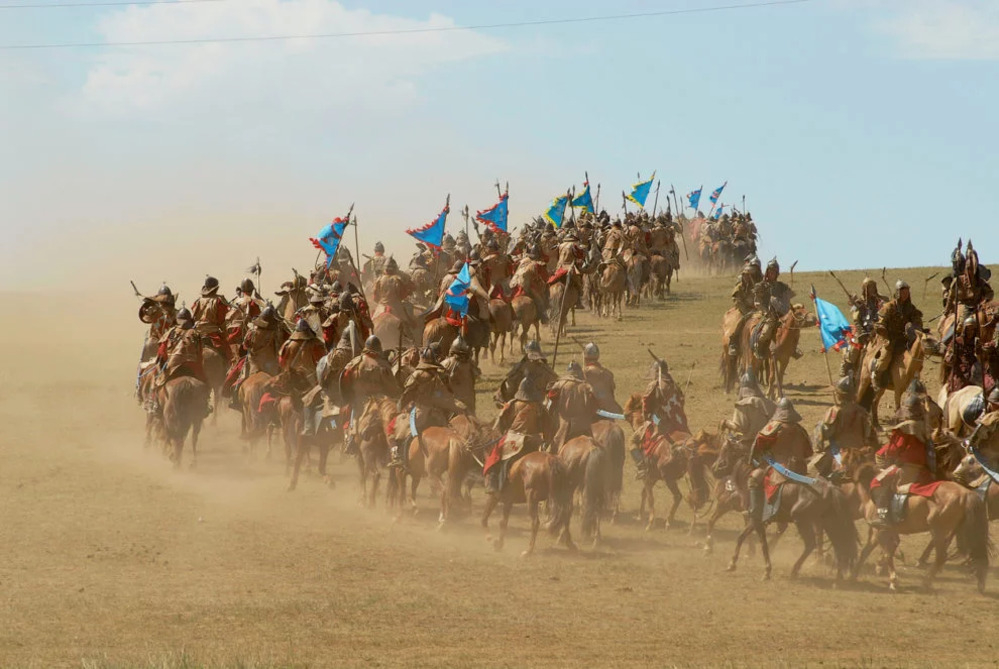
In the customary Mongol preparation for invasion, Hulegu had already dispatched advance troops across central Asia to clear the path of all herds in order to ensure a good supply of pasture when the main army passed through the area. Hulegu allowed his vanguard to probe enemy forces and initiate diplomatic negotiations with potential allies before the threat of his massive army appeared. The main army gathered in the summer to fatten their horses, and in traditional Mongol style would campaign only in winter. Unlike Genghis Khan’s warriors, who moved with lightning speed and approached the Muslim cities from several directions at once, Hulegu deliberately advanced more slowly and ostentatiously. Hulegu moved not just with a nomadic army, but with a nomadic empire. Hulegu had a much larger engineering corps of Chinese, and expanded it with European craftsmen to build bridges, catapults, and other machines of war. He also carried a larger medical corps and many more scribes and clerks to administer the larger army. In contrast to his grandfather’s warriors, who fed themselves as they crossed the land, Hulegu’s caravans included carts laden with wheat, rice, and wine to feed the many different kinds of military men now in his command.
For Hulegu, the ultimate prize was to conquer the Arab cultural and financial capital of Baghdad, but to get there, he had to reassert Mongol authority over several rebellious areas en route. The most difficult of these was to conquer the strongholds of the Nizari Ismailis, a heretical Muslim sect of Shiites more commonly known in the West as the Assassins. They were holed up in perhaps as many as a hundred unconquered mountain fortresses stretching from Afghanistan to Syria, the most important of which was Alamut, the Eagle’s Nest, in northern Persia. Members followed without question the orders of their hereditary leader, who was known by many titles, such as Imam, the Grand Master, or Old Man of the Mountain. Because they believed that God chose the Imam, he was therefore infallible; he needed no education since everything he did, no matter how odd it might appear to mortals, was considered divinely inspired. His followers accepted seemingly irrational acts, frequent changes of the law, and even the reversal of the most sacred precepts as evidence of God’s plan for humanity.
Despite the lack of a conventional army, the Ismaili sect exercised tremendous political power through a highly sophisticated system of terror and assassination, and the secrecy and success of the group bred many myths, making it, still today, difficult to factor out the truth. The cult apparently had one simple and effective political strategy: kill anyone, particularly leaders or powerful people, who opposed them in any way. The cult recruited young men who were willing to die in their attacks with the assurance that they would achieve instant entry into paradise as martyrs of Islam. The Chinese, Persian, and Arabic sources all relate the same account of how young men were lured by ample quantities of hashish and other earthly delights that awaited them in the special gardens of the cult’s castles and fortresses. This was the foretaste of the paradise that awaited them if they died in the Grand Master’s service. He then trained them and controlled them with a steady supply of hashish to keep them obedient and make them fearless. Supposedly, because of the importance of narcotics for the Ismailis, the people around them called them hashshashin, meaning “the hashish users.” Over time, this name became modified into the word assassin. Whether the killers had actually used hashish to inspire them or not, the name spread into many languages as the word for the murderer of high officials.
Earlier, in the time of Genghis Khan’s first invasion of the region, the Grand Master willingly swore obedience to the Mongols. In the following decades, the Assassins flourished in the power vacuum created by Genghis Khan’s defeat of the Turkic sultan of Khwarizm and then the withdrawal of most of the Mongol forces. By the time Mongke Khan ascended the throne, the Assassins feared that the return of a large Mongol army might interfere with their newfound powers. In what may have been only a pretext for Hulegu’s attacks, some chroniclers wrote that the Grand Master sent a delegation to Karakorum ostensibly to offer submission to Mongke Khan, but actually trained to kill him. The Mongols had turned them away and prevented the assassination, but because of it Mongke Khan decided to crush the sect permanently and tear down their fortresses.
Before Hulegu’s army reached the Assassin strongholds, the drunken and debauched Grand Master was murdered by disgruntled members of his own entourage and replaced by his equally incapable son. Hulegu assessed the difficulty of capturing the heavily fortified castles one by one, and he devised a simple and more direct plan. Because of the sacred role of the Grand Master, Hulegu concentrated on capturing him with a combination of massive military might and the offer of clemency if he should surrender. The Mongols bombarded the Ismaili stronghold, and the Mongol warriors proved capable of scaling the steepest escarpments to surprise the defenders of the fortress. The combination of force, firepower, and the offer of mercy worked, and on November 19, 1256, on the first anniversary of his coming to power, the Imam surrendered to the Mongols.
Once Hulegu had control of the Imam, he paraded him from Ismaili castle to Ismaili castle to order his followers to surrender. To encourage the cooperation of the Imam and keep him happy until the end of the campaign, Hulegu indulged his obsessive interest in watching camels fight and mate, and he supplied him with girls. In the spring of 1257, once the Assassins’ castles had been taken, the Imam recognized his loss of usefulness to the Mongols, and he requested permission to travel to Karakorum to meet with the Great Khan Mongke himself, perhaps to work out some plan for his own survival. Hulegu sent him on the long journey to Mongolia, but once the Imam arrived there, Mongke refused to see him. Instead, the Mongol escort took the Imam and his party out to the mountains near Karakorum and stomped them to death.
With the extermination of the Assassins, Hulegu’s army had an open route to Baghdad, the largest and richest city in the Muslim world. Whereas the Ismailis occupied the terrorist fringe of the Muslim world, the grand metropolis of Baghdad on the Tigris River reigned as its center, the Mother of Cities. Mecca, in the middle of Arabia, remained Islam’s sacred city, but it was too isolated from the centers of population to function as an important political or commercial center. With the founding of Baghdad in 762, a little more than a century after the foundation of Islam, the Arab world found its metropolitan focus under the Abbasid dynasty of caliphs, who ruled as the titular head of the entire Muslim world. The present Abbasid leader ruled as the Caliph, the thirty-seventh successor to the Prophet Muhammad, and therefore in addition to being the most powerful secular ruler in the Muslim world, he had the position as the symbolic leader of all Muslims. He served as virtually a combination emperor and pope.
Baghdad was the city of Scheherazade, the legendary teller of the tales know as the Arabian Nights or the Thousand and One Nights, and for five hundred years the wealth of the Muslim world poured into the city where the Caliphs lavished it on palaces, mosques, schools, private gardens, and public fountains. Baghdad was a city of luxurious baths and overflowing bazaars. In addition to meeting the needs of its Muslim majority, the city served as the religious center for many Christians, who erected churches, and a cultural center for Jews, who built numerous synagogues and schools. The metropolis spilled out along both sides of the Tigris River, which were connected by a bridge, while massive walls protected the heart of the city.
In classic Mongol diplomacy, before mounting an attack on the Caliph, Hulegu sent envoys with a list of legal grievances against him. Hulegu accused the Caliph of not sending an army to assist in the suppression of the Ismaili Assassin sect, even though he had once sworn allegiance to Genghis Khan. In Mongol eyes, the Caliph was as much a rebellious vassal as the Imam, and he possibly faced the same fate. If the Caliph did not immediately atone for his misdeeds by surrendering to Mongol rule, Hulegu threatened to conquer his city and capture him. The Caliph seemed as incapable of understanding the danger of the Mongols as the Imam had been, and scoffed at what he felt were the Mongols’ preposterous demands. He defiantly announced that the entire Muslim world would rise up to defend the independence of the Caliph and that they would not permit an infidel nation to occupy the Arab capital of Baghdad. He swore that Muslims as far away as the Maghreb along the Atlantic coast of Morocco, would rush to kill the Mongol invaders if they continued in their campaign. Neither God nor the Muslim people, he defiantly claimed, would allow Baghdad to fall into the hands of nonbelievers.
In November 1257, unconvinced of the Caliph’s power to speak for either God or the entire Muslim population, Hulegu began to march toward Baghdad. He approached more cautiously than his grandfather would have done, but nevertheless with the same set of proven Mongol strategies and tactics. To supplement his own army, Hulegu summoned the armies of the vassal states of Armenia and Georgia, as well as a variety of Turkic tribes. Thus, while the main army approached in a wide arc from the north and the east, the others approached from the north and west. Although the Tigris and Euphrates Rivers had historically served as natural barriers to foreign attacks on Mesopotamia, the Mongols easily moved back and forth across the rivers with a series of pontoon boats. As the invading armies advanced, they set the local population to flight toward the safety of the fortified city. By the final week of January 1258, the invading armies had encircled the city and occupied the extensive suburbs beyond the city walls, filling the city to its maximum with refugees.
Before commencing the attack, Hulegu sought to exploit political, religious, and ethnic divisions within Baghdad by forging secret ties to the Christians within the city. Because his mother and his two wives were Christians, as well as many of his own men, Hulegu cultivated contacts and nourished respect within the Christian communities across the Middle East, and he had maintained good relations with his Christian vassal kingdoms, Georgia and Armenia. Taking advantage of these connections, Christian envoys secretly slipped back and forth between the city and the Mongol camp, bringing vital reconnaissance to Hulegu and carrying back promises of special treatment to the Christians and other minorities in the city. As a sign of the special favor that the Christians would enjoy under his rule, Hulegu exempted Christian priests from kowtowing at court, since they bowed only to God. Hulegu exploited the fears of the Christians of Baghdad as a small minority in a sea of potentially hostile Muslims. He fed the dreams of Christians and Jews of finally freeing themselves from Muslim domination.
The Caliph also tried to use to his own benefit the close ties of the Mongols and the Christians. He summoned the Catholikos Makikha, the patriarch of the Christian church, and dispatched him and a Muslim minister to negotiate with the Mongols. He offered to make a formal submission, pay enormous tribute, and to read Friday prayers in the mosque in the name of the Great Khan, thereby officially acknowledging his subservience to Mongol rule. Hulegu scoffed at the offer. He knew that he was already too close to victory to settle for such trifles—not when all the wealth of the richest city on earth could easily be his.
The Mongols showed their traditional ability to improvise and use whatever material presented itself as a possible weapon. The largest objects in the vicinity were the tall date palm trees that the Arabs had cultivated and nourished for centuries. The Mongols chopped them down, and turned the trunks into lethal missiles that they fired at the city. Lacking sufficient wood to encircle the large city of Baghdad as the Mongols had done with the cities of Russia, Hulegu nevertheless surrounded the city with a deep ditch and a rampart and began the assault with a terrifying bombardment of the city. The Arabs knew of the use of flamethrowers in combat, but until this point had not encountered the military power of gunpowder.
The Mongols had changed the formula of gunpowder to provide enough oxygen to make it ignite in one rapid blast rather than in the traditional slow burn of the firelance or of rockets. Such instantaneous burning produced an explosion rather than a fire, and the Mongols harnessed these explosions to hurl a variety of projectiles. Craftsmen made some of the tubes small enough that a single man could operate them and thus fire out arrowheads or other metal projectiles. The explosion in these tubes required a stronger material than bamboo; so they were made with iron tubes. The Mongols attached the smaller tubes to a wooden handle for ease of handling, and they mounted the larger ones on wheels for ease of mobility. Larger tubes fired ceramic or metal cases filled with shrapnel or more gunpowder that produced a secondary explosion upon impact. In their assault, the Mongols combined all of these forms of bombardment in an assortment of smoke bombs, proto-grenades, simple forms of mortars, and incendiary rockets. They had developed explosive devices able to hurl projectiles with such force that they may as well have been using real cannons; they managed to concentrate their fire on one area of the city defenses and hammer it down.
The bombardment from such a distance confused and frightened the residents of Baghdad and frustrated its defenders, who had never before been attacked by an enemy too far away to be reached by their weapons. In addition to the gunpowder weapons, Mongol engineers had nearly perfected the use of planted explosives to undermine walls. All of these military innovations complied with the strong Mongol preference to stay as far from the actual fighting and killing as possible. Hulegu destroyed the dams and diverted the Tigris to flood the camp of the Caliph’s army and make them take refuge in the city. The wall of water surrounding the city must have had a similar psychological impact on the people of Baghdad as the wooden wall had produced on the people of the Russian cities. On February 5, 1258, the Mongol forces broke through the walls of Baghdad, and after five days, the Caliph capitulated. To prepare the city for looting, Hulegu ordered the people of Baghdad to surrender their weapons, leave all their goods, and march out of the city. Rather than comply with the order, the defending army bolted and tried to escape, but the Mongols gave chase and cut them down.
Hulegu sent his Christian troops into the city to collect the loot, but they found many people had refused the order to evacuate and were still hiding in their homes. For disobeying the order, the invaders killed them. By Mongol order, the churches and Christian property in the city remained secure from plunder, and Hulegu presented one of the Caliph’s palaces to the Catholikos Makikha. The Christians inside Baghdad joined their fellow believers to loot the city and slaughter the Muslims, from whom they felt their salvation had finally come. Centuries of hatred and anger spilled out as they defiled and destroyed mosques, and turned many of them into churches. The Christians celebrated joyously throughout the Abbasid lands and beyond. An Armenian chronicler described the exulting joy: “Five hundred and fifteen years have passed since the founding of the city,” he wrote. “Throughout its supremacy, like an insatiable leech it [Baghdad] had swallowed up the entire world. Now it restored all that had been taken.” Now Baghdad “was punished for the blood it had shed and the evil it had done; the measure of its iniquity was full.” The looting lasted seventeen days. During this time, the invaders, accidentally or deliberately, set the city afire.
Hulegu allowed the Christians to destroy the tombs of the long line of Abbasid Caliphs, and then Hulegu summoned the captive Caliph to his camp outside the city. According to the Armenian chronicler Grigor of Akanc, Hulegu locked up the Caliph for three days without food or water, then brought him out and heaped up his gold and treasure before him. Pointing to the massive piles of wealth looted from the city, Hulegu reportedly ordered the Caliph to eat the gold, and when he could not scolded him for so greedily accumulating wealth instead of building an army to defend himself. He then sentenced the Caliph and his male heirs to death, but as a final gesture of respect for the high status of the condemned, he allowed them the honor of being executed in the Mongol way—without bloodshed. According to the differing but similar accounts, they were either wrapped in carpets or else sewn into sacks and kicked to death by the Mongol warriors or trampled by their horses.
The Mongol army had accomplished in a mere two years what the European Crusaders from the West and the Seljuk Turks from the East had failed to do in two centuries of sustained effort. They had conquered the heart of the Arab world. No other non-Muslim troops would conquer Baghdad or Iraq again until the arrival of the American and British forces in 2003.
While the Mongols defeated the Arabs, the Crusaders, who at this time occupied a series of castles and small cities along the Mediterranean coast, had watched the Mongol approach cautiously. Suddenly, with the fall of Baghdad, they saw an opportunity for themselves to ally with the Mongols and share in their victories. When the Mongols left Baghdad and headed further west toward Damascus, the Crusader knight Bohemond of Antioch came out with his army to attack Damascus from the Mediterranean side, and he brought supplies and food to help the Mongols. Similarly, the Seljuk sultan sent his army from Anatolia to join the Mongol assault.
Damascus surrendered and thereby saved itself from the fate of Baghdad. Soon the Mongol warriors were on the beaches of the Mediterranean Sea for the second time. Eighteen years earlier, in 1241, the Mongols under Batu had reached the Mediterranean via Europe; now, on their second arrival, they approached it via Asia. In the seven years since Hulegu left his brothers at Karakorum, he had conquered or reconquered everything along a distance of some four thousand miles, and he had added millions of Arabs, Turks, Kurds, and Persians to the still-growing empire.
In the six centuries since the birth of Islam, the religion had expanded greatly and lost control of a few border zones, but never had so much of the Muslim world fallen under the rule of pagans. The four decades from Genghis Khan’s attack on Bukhara until the fall of Baghdad and Damascus represented the lowest point in Muslim history. While the Crusaders had only managed to take a toehold in a few ports, the Mongols conquered every Muslim kingdom and city from the Indus River to the Mediterranean. They had conquered almost all of the Muslim lands in Asia; only the Arabian Peninsula and North Africa remained beyond their control.
The gleeful gloating of the Christians could hardly have been greater. An account in the Armenian chronicle related an apocryphal story that illustrated more about Christian contempt for and mockery of Muslims than actual Mongol practice. According to the story, after his victory over the Arabs, Hulegu ordered one hundred thousand piglets from Armenia and dispatched two thousand to each Arab city, where he required the Muslim residents to tend the pigs in the middle of their city, feed them almonds and dates daily, and carefully wash them with soap every Saturday. Just as absurdly, the chronicler added that the Mongols demanded that all Arabs eat pork and that they decapitated every Arab who refused.
Although it seemed at the time that the Mongol Empire threatened to swallow all of the Muslim world, the Mongols had, in fact, reached their limit in the West. The empire would not expand any further in that direction. An army of Mamluk slaves, mostly purchased from Italian merchants who brought them from the Kipchak and Slavic people of Russia and sold them to the sultan of Egypt, moved out from Egypt and encountered a Mongol detachment at Ayn al-Jalut, the Springs of Goliath, near the Sea of Galilee in what is today Israel. On the morning of September 3, 1260, a year after Mongke Khan’s death, the Mamluks defeated the Mongols. The empire had reached its western border.
Compared with Hulegu’s military victories and extensive conquests of land and people across the Middle East, the attempts by his brother Khubilai to similarly overthrow the Sung dynasty and annex its lands in southern China still remained more of a distant dream for the Mongols than a pending reality. Khubilai’s apparent lack of military experience stymied fulfillment of his mission. Unlike his brothers who had fought in Europe and the Middle East, Khubilai had spent most of his life in the Mongol lands south of the Gobi, where he maintained a personal court that was larger and more luxurious than the imperial court at Karakorum in the Mongol heartland. He enjoyed feasting more than fighting. He grew fat and developed gout, which further impaired his ability to be an inspiring military leader on horseback. After receiving the orders from his brother Mongke Khan to move south into China, Khubilai’s army found modest success in a series of limited campaigns against border kingdoms to the west of the Sung kingdom. While openly making elaborate preparations for war against the Sung, Khubilai moved very slowly. Not only did he encounter obstacles to extending the Mongol domains, but within his own administrative territory, sectarian violence flared in a struggle for dominance between Taoist and Buddhist monks, further limiting his control over his lands.
Instead of sending news of victories and dispatching caravans of tribute to Karakorum, Khubilai sent frequent excuses for the delays encountered and unexpected conditions. The generous explanation of scholars sympathetic to Khubilai is that he was a mature and thoughtful leader who wanted to proceed with careful organization and not on impulse, and one who combined the best of Chinese and Mongol military strategies and armies. The less generous explanation is that he lacked the Mongol aptitude for war but managed to avoid failure because of the general momentum of the Mongol conquest and the outstanding martial ability of his generals.
An obviously dissatisfied Mongke Khan dispatched a series of investigators to look into the problems with Khubilai. Finding ample evidence of fraud and corruption in Khubilai’s administration, they executed many of his important administrators and stripped Khubilai of his financial prerogatives and duties. The investigators proceeded in much the same ominous manner that they had done during the purge of Ogedei’s family, and it appeared that not just Khubilai’s power was at stake, but possibly his life as well.
Mongke summoned Khubilai to Karakorum, ostensibly to answer for the fiscal irregularities but probably to account for a variety of issues, most important of which was the lack of military success against the Sung. Rather than resist his brother, as some of his advisers recommended, Khubilai traveled to Karakorum as ordered and threw himself on the mercy of his older brother. Following Khubilai’s degrading display of regret and fawning loyalty, Mongke Khan publicly forgave and reconciled with him, but the incident did little to resolve the underlying cause of the tensions between the two men. Nor did it bring the Mongols any closer to the ultimate goal of victory over the Sung. The frustrated Mongke Khan had to devise a new plan.
In the fall of 1257, while Hulegu’s troops moved against Baghdad, Mongke Khan summoned a small khuriltai to a wooded area of the Khorkhonag Valley on the old family river, the Onon, not far from the sacred mount of Burkhan Khaldun. Here it became clear to him—or at least he made it clear to his court—that he himself would have to lead the campaign against the Sung. Mongke Khan had served extensively in the European campaigns and he had been trained under Subodei, the most accomplished of all Mongol generals, and after the death of his mentor two years earlier, Mongke was probably himself the best general available to lead the campaign against the Sung. For the duration of his absence during the upcoming campaign, Mongke turned over the central administration of the empire at Karakorum, as well as responsibility for his son and heir, to his youngest brother Arik Boke. Mongke Khan ordered Khubilai to return to his territory to end the clerical strife between the warring factions of Taoists and Buddhists, while Mongke took control of the more important military campaign.
Mongke emulated his grandfather’s basic military strategy by first attacking the smaller and weaker areas before moving against the larger target. For Mongke, this meant starting the conquest with a campaign against the adjacent lands of Sichuan to the west and Yunnan to the southwest of the Sung, and then slowly capturing the larger prize in the closing Mongol net. If the Mongols could gain control of these areas, they could attack the Sung from all sides at once. In May 1258, only three months after Hulegu’s sack of Baghdad, Mongke Khan led his army across the Yellow River. Within a year, they had covered the territory from the cold Onon on the Siberian border to the humid and warm south.
After quickly subduing the outlying kingdoms, Mongke began to move against the Sung dynasty itself during the second year of the campaign, but the weather became extremely hot. The climate differed greatly from anything Mongke, and most of his warriors, had experienced in Mongolia or on their European campaigns. Many of the Mongols suffered from bloody diarrhea, probably dysentery, and then other plagues. Mongke Khan became ill but improved—and then, on August 11, 1259, he suddenly died. Every chronicle lists a different cause of death. The Chinese reported that he died of cholera, the Persians that he died of dysentery, and others claimed he died from a battle arrow. The death of Mongke Khan congealed the empire; advancement ceased.
Rather than racing back home to participate in the selection of a new Great Khan as the Mongol leaders had done after the death of the three previous Great Khans, each faction moved to protect the territory it already held. In the Middle East, the newly triumphant Hulegu occupied the richest lands and cities of the empire; he controlled more wealth than the rest of the Mongol Empire combined. He had already taken some of the prized Azerbaijan pastures of his cousins who ruled Russia. For fear of losing yet more land to him, his cousins held their territory and refused to return to Mongolia for an election. Neither Hulegu in the Middle East nor the Golden Horde, as Jochi’s descendants in Russia eventually became known, wanted to risk losing what territory they already controlled in order to haggle over the supreme title of Grand Khan in Mongolia.
The Mongol Empire reached its greatest extent under Mongke Khan, who was the last of Genghis Khan’s descendants to be acknowledged and accepted as Great Khan by the whole of the Mongol Empire. Many khans would continue to rule over the various parts of the empire, and of them, many would claim to be the rightful heirs to Genghis Khan and to the title of Great Khan. But no one of them would be recognized by all the other factions and lineages. Mongke Khan began, but never finished, the Second Mongol World War. It ended with neither victory nor defeat; it merely flickered out.
His brothers pursued episodic campaigns, but they concentrated efforts on each other more than on outside enemies. Khubilai suddenly turned his attention away from the Sung to challenge the youngest brother, Arik Boke, who ruled Mongolia from Karakorum. Each of them summoned a separate khuriltai in his own territory. The choice between the two contestants, and more importantly between their supporters, seemed sharp and clear. As the better educated, Khubilai had been given lands in the agricultural areas where Chinese culture reigned supreme, and he never inspired the full confidence or approval of other members of the Golden Family. Khubilai preferred buildings and cities. He seemed as comfortable in a palace as in a tent, and he may have even spoken some Chinese. This deviance from the traditional Mongol life contributed to an alien aura that always seemed to engulf him.
In contrast to Khubilai’s cosmopolitan persona, Arik Boke lived very much as a man of the steppes, the Mongol who seldom strayed far from his horse. As the youngest son, he was the family Otchigen, Prince of the Hearth, like his father, and he could make the same claim of rights over the office of Great Khan that Mongke had made when he posthumously elevated their father to that rank. In addition, Arik Boke inspired confidence from the other members of the Golden Family by posing less of a threat to their control of their own lands, while Khubilai’s more imperial style invited suspicion. In keeping with Mongol law, Arik Boke held his khuriltai in the homeland of Mongolia. Mongke Khan’s widow and sons supported him as the legitimate and best heir, as did most other members of the family aside from his two brothers, Hulegu and Khubilai. In June 1260, representatives of all the family branches proclaimed Arik Boke as the Great Khan at the khuriltai in Karakorum.
But Khubilai succeeded in pulling off a coup d’état. Following the advice of his Chinese ministers, Khubilai summoned his khuriltai in his own territory. Aside from his followers hardly anyone came, but the small assembly nevertheless proclaimed him Great Khan. In order to win the loyalty of his Chinese subjects, he additionally proclaimed himself emperor in the same year, 1260, and he chose the title of Zhongtong (Chung-t’ung), meaning “central rule.” This title was a Chinese adaptation of the Mongolian designation of the Great Khan as the Central camp and his armies as the Left and Right.
No matter how untraditional his selection may have been by Mongol standards, Khubilai exercised strong control over the Chinese army as well as his own detachment of Mongols; more important, he controlled the flow of food that Karakorum needed to survive. The population of the Mongol steppe city had swollen too much to survive on the local herds alone, and the land around Karakorum, despite sustained efforts to encourage foreign farmers, proved inhospitable to agriculture. Without substantial and continual food shipments from the farmlands controlled by Khubilai, Karakorum had to be evacuated or face starvation.
Khubilai cut off the food and then sent his army to capture Karakorum. Arik Boke fought hard but withdrew steadily against the overwhelming size of his brother’s Chinese army. Karakorum fell quickly to Khubilai, but in 1261 Arik Boke temporarily took it again. The armies of the dueling khans met two more times, but gradually Arik Boke Khan’s army weakened and began to atrophy as it faced desertions of allies who saw that the younger khan would never prevail against his older, better-equipped, and probably more intelligent elder brother. Arik Boke also faced the worst threat to the Mongols: zud, or animal famine. From 1250 to 1270, Mongolia suffered a lowering of temperatures. In a fragile ecological zone such as Mongolia, a change of only a few degrees in annual temperature severely reduces the small amount of precipitation, restricts the growth of the grass, and thereby weakens or kills the animals. Without strong horses or ample food, the supporters of Arik Boke, already cut off from the agricultural largesse of Khubilai Khan’s territory, proved too weak to mount a sustained war. The winter of 1263 proved particularly cruel, and by the following spring, Arik Boke no longer had a viable power base. Unable to feed his followers, Arik Boke proceeded to Shangdu, where he surrendered to Khubilai in 1264.
When the brothers met at the end of the protracted struggle, Khubilai forced Arik Boke to perform a public ceremony of obeisance. Before the assembled court, Khubilai interrogated his brother, demanding to know which of the two sides in the struggle for the office of Great Khan was the correct one. Arik Boke’s answer showed the strength of his pride even in the face of defeat. “We were then, and you are today.” Other members of the family, including the distant brother, Hulegu, reacted so bitterly to Khubilai’s public shaming of his younger brother that they complained to him. Khubilai summoned another khuriltai on Mongolian territory to decide the fate of Arik Boke and to ratify himself as the legitimate khan without the taint of his earlier election on Chinese soil. Despite the overwhelming military might of Khubilai’s army, the Golden Family refused to attend. They recognized the reality of Khubilai’s rule, but none of them proved willing to participate in a criminal trial of Arik Boke, whom they had supported as Great Khan. None of them trusted Khubilai enough to take the chance of leaving their homelands and perhaps never returning. In the absence of a quorum for a khuriltai, Khubilai forgave his brother. Khubilai tried and executed many of his brother’s supporters, but his only punishment of Arik Boke, at least publicly, was banning him from court. Shortly thereafter, in 1266, mysteriously but conveniently for Khubilai, Arik Boke, still in the prime of life, suddenly sickened and died. He had almost certainly been poisoned.
Khubilai now held the office of Great Khan. He had the world’s largest army under his control, and he ruled one of the most populous nations on earth. The victories had come at a steep price; some of the Mongol royal family and their followers refused to recognize his legitimacy, or, at most, they gave symbolic recognition but ignored him and continued to wage intermittent border wars for another generation.
Like the four fountains of the Silver Tree, the Mongol Empire now divided into four primary zones of political administration. Khubilai ruled China, Tibet, Manchuria, Korea, and eastern Mongolia, but he faced constant problems in enforcing his rule over Mongolia and Manchuria. The Golden Horde ruled the Slavic countries of eastern Europe, and they consistently refused to recognize Khubilai as the Great Khan. The lands ruled by Hulegu and his descendants from Afghanistan to Turkey became known as the Ilkhanate, meaning “vassal empire.” It was here that Persian culture reemerged from centuries of Arab domination to build the foundation for modern Iran. The most traditional Mongols occupied the central steppes, which became known as Moghulistan and encompassed the modern areas from Kazakhstan and Siberia in the north and across Turkistan in central Asia to Afghanistan in the south. For a while, they had some unity under Ogodei’s and Toregene’s grandson Khaidu, who ruled from Bukhara and served as a counterpoint to the power of Khubilai Khan, but the area fragmented repeatedly in the centuries ahead.
For a mere three decades, Karakorum had served as capital of the Mongol Empire before the Mongols themselves, under the command of Khubilai, looted and virtually destroyed it. In that short time it had been the center, the pivot of the world. As part of the looting of Karakorum, the Silver Tree was disassembled and carted away.