
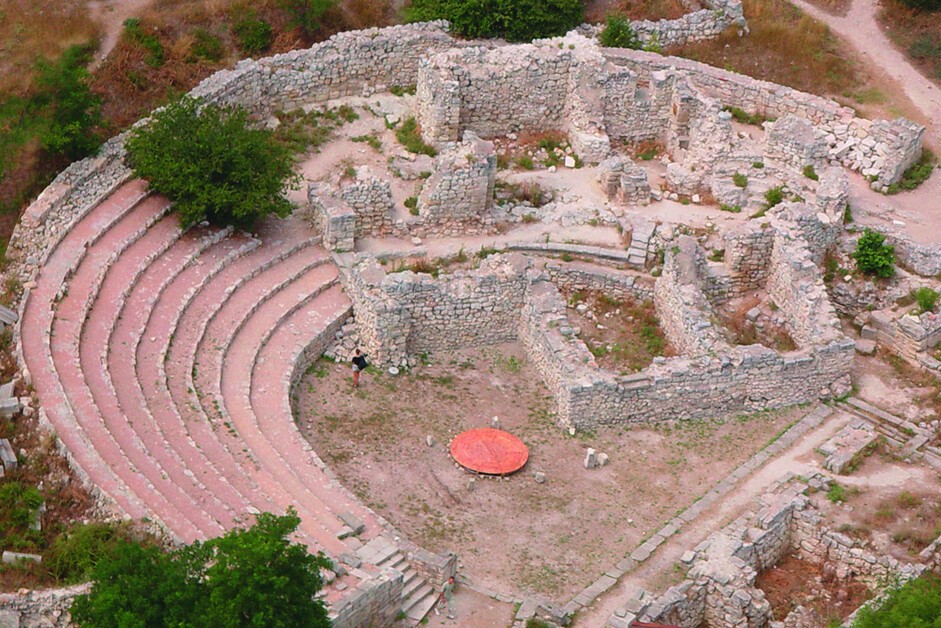
The site features the remains of a city founded by Dorian Greeks in the 5th century BC on the northern shores of the Black Sea. It encompasses six component sites with urban remains and agricultural lands divided into several hundreds of chora, rectangular plots of equal size. The plots supported vineyards whose production was exported by the city which thrived until the 15th century. The site features several public building complexes and residential neighbourhoods, as well as early Christian monuments alongside remains from Stone and Bronze Age settlements; Roman and medieval tower fortifications and water supply systems; and exceptionally well-preserved examples of vineyard planting and dividing walls. In the 3rd century AD, the site was known as the most productive wine centre of the Black Sea and remained a hub of exchange between the Greek, Roman and Byzantine Empires and populations north of the Black Sea. It is an outstanding example of democratic land organization linked to an ancient polis, reflecting the city’s social organization.
Brief synthesis
Tauric Chersonese and its chora are the remains of an ancient city, founded in the 5th century BCE as a colonial settlement of the Dorian Greeks, located on the Heraclean Peninsula in south-west Crimea. The polis and extended chora of Tauric Chersonese form an outstanding example of an ancient cultural landscape, consisting of a Greek polis and its agricultural hinterland established as part of colonist activities in the 4th and 3rd century BCE. The significant archaeological ruins of the city retain physical remains constructed between the 5th century BCE and the 13th century AD laid out on an orthogonal grid system. The basic orientation of this orthogonal grid continues into the wider landscape where fragments of a vast land demarcation system of 400 equal allotments in an area of 10,000 hectares have been preserved.
The Ancient City of Tauric Chersonese and its chora is an exceptional example of a peripheral centre of movement of people which acted as an important gateway to the north-eastern parts of the Greek trade influence, including the Crimea and the Scythian state. The city maintained its strategic role over almost two millennia and provides a unique example for the continuity and longevity of a mercantile outpost connecting the different Black Sea trade routes.
Criterion (ii): Tauric Chersonese provides an outstanding physical testimony to the exchange that took place between the Greek, Roman and Byzantine Empires and the populations north of the Black Sea. The polis and its chora stand out for having retained this role as a centre of exchange of influences and cross-fertilization between these cultures for a very long time and with continuity over millennia.
Criterion (v): Tauric Chersonese and its Chora represents a relict agricultural landscape of a vast and, at locations, well-preserved land allotment system, of formerly over 400 equal allotments connected to a preserved polis. The remains of the division walls, fortifications, farmsteads and the characteristic grid layout embodied the lifestyles of the city’s inhabitants and illustrate the agricultural use and continuity of the landscape despite later changes in production.
Integrity
The six property components include the complete ancient polis of Tauric Chersonese as well as fragments of its chora. About half of the chora has been lost due to urban development and yet, only small parts of what remains have been inscribed. This selection provides a sufficient fragment of the chora landscape, but a future expansion of the property to include further chora segments would be desirable and would further strengthen the integrity of the property.
The impact of urban development on the chora setting is significant and the integrity of the wider landscape is fragile and requires decisive and consistent protection and planning mechanisms to prevent further negative impacts by insensitive urban or infrastructure developments. Likewise, the city of Tauric Chersonese has experienced significant developments of intrusive character, some of which have been committed to be relocated.
Authenticity
The condition of authenticity in material, design and substance is good for the archaeological remains of the polis and the chora. About 10 of the 40 hectares of the site of Tauric Chersonese have been excavated leading to a good understanding of the history and development of the town. Less excavations have taken place in the chora but its structure and layout is nevertheless well understood. No major restoration or conservation projects were carried out with the exception of a few cases of anastylosis. This has retained high degrees of authenticity in material and substance. Authenticity in form and design is well retained in its relations to the urban layout and chora plot division.
The authenticity in setting and location is partly affected, predominantly by the 20th century constructions which destroyed parts of the ancient city but also by urban encroachments and infrastructure projects close to the chora sites. Their impact could be reduced to the extent possible by removing the yacht club and associated structures from its present location and better integrating the cathedral within the archaeological site.
Management and protection requirements
The property enjoys the highest level of national protection according to the Law of Ukraine on Cultural Heritage Protection (No. 2518-VI of 9 September 2010). This status prohibits any activities within the boundaries that may have any negative impact on the state of preservation, or use of any cultural heritage sites and designated monuments. A recently launched project entitled “Boundaries and land use regimes for the protected areas of the monuments of the Tauric Chersonese National Preserve located on the territory of the Heraclean Peninsula in the City of Sevastopol” aims at integrating a more sophisticated zoning and protection concept in the Master Development Plan, which would strengthen the protection status of the extended chora landscape. The official adoption of the draft plan should be given priority.
The authority responsible for the property is the Tauric Chersonese National Preserve which was mandated as the management agency by the Ministry of Culture. Key protection challenges of the property are erosion, in particular shore erosion, the establishment of adequate security measures on all site components and urban development. Urban development has in the past been and will continue to be a key risk as the city of Sevastopol is located at very close distance to the archaeological sites and continues to grow. Inappropriate urban expansions will negatively impact the already fragile integrity of the archaeological landscape. Important works are underway to integrate the archaeological landscape into the wider land-use and protection system. These have to be finalized to cover a wider area beyond the presently designated protected areas and landscape protection zones. Future inclusion of these features through boundary extensions of the property would ensure that the relict landscape of the Chersonese chora could be protected in its larger context.
A revised management plan which is to be finalized in mid 2013 should be officially adopted and management priority should be given to conservation needs. In view of the critical state of conservation of the ruins in the city of Tauric Chersonese, some of which are highly dilapidated or even close to collapse, budgetary resources need to be increased to respond to the urgent conservation and security challenges. Clear budgetary priority needs to be given to conservation and visitor security rather than interpretation and other tourism projects.

Oreopithecus is a paradox as while it is amongst the best known of fossil apes, there is still much confusion over how this primate lived and was related to other primates. This confusion is down to how Oreopithecus displays features that both suggest an arboreal life where it swung through the tree canopy, to other features that show development towards a bipedal locomotion.
The arms of Oreopithecus were long and with high degrees of motion that are seen to have been well adapted for brachiation (swinging from branch to branch). The hands however possessed a very high level of dexterity closer to that of humans. The pelvis is also short which when combined with the legs is seen as being better for walking on the ground. Oreopithecus is still not thought to have been totally bipedal, and rather than being directly related to other bipedal apes, it’s probable that these features are a case of convergent evolution. The feet are still like those of monkeys which further suggest that while Oreopithecus was better on the ground than other primates, it was not on the ground all the time.
It’s quite possible that the mix of features seen in Oreopithecus were actually born out of its environment, after while many of the fossil locations of Oreopithecus are connected to the mainland today, they would have been isolated by sea during the Miocene. This immediately cuts down upon the potential food which can result in a species either becoming smaller so that it does not need so much to keep its body going, or reducing in population so that there are fewer mouths to feed. A third survival strategy is available however, but only to those creatures with the intelligence and capability to implement it.
By living in the tree canopy, Oreopithecus could reach foods that were unavailable to other creatures that were unable to reach up to them. By also being better able on on the ground however, with the addition of more dextrous hands for manipulating things, Oreopithecus could also search for and exploit other food sources, thereby diversifying in its foraging behaviour. This would allow Oreopithecus to pick and switch how it would forage depending upon which area was more abundant in food.
Ultimately however this diversification may be what cost Oreopithecus in the survival stakes. For most of its existence, Oreopithecus faced no real threats because of the absence of large predators, therefore it only had to adapt to the physical conditions of the habitat. Again this adaptation was to learn how to live on the ground and in the trees but to the point of being energy efficient, remembering that even though Oreopithecus could adapt its foraging, the total biomass available for food would have still been limited because of reduced space on an island ecosystem. When places like Tuscany became connected to the mainland however, this brought about an influx of new creatures, particularly large predators such as sabre toothed cats such as Machairodus. Predators such as these were perfectly adapted for ambush hunting with reasonable speculation being that they could have also ventured into the lower tree canopy. With Oreopithecus adapted for energy efficient locomotion rather than speed (something that was not a survival concern before the arrival of big predators) it was at an immediate disadvantage to these new predators. Further competition for the same food resources from other new forms would have increased pressure even further upon the genus.
Oreopithecus was once considered to be an early hominid because of the short pelvis and potential bipedalism; however the features and possible bipedalism are now considered a case of convergent evolution. Oreopithecus is today often regarded as being closely related to Dryopithecus.
When it comes to making a new post, I’ve been considering two choices. I can make a post about what I have, what I’ve seen, what I know, and what I’ve read. Or I can make a post about the conflict in Ukraine, which began on February 24 of this year. In addition, there’s also the fact that I didn’t want to make a post of my own this early. As I’ve pointed out in one of my earlier posts, I am not running a propaganda blog and I don’t make many posts. Still, since some people have been urging me to post something about the situation in Ukraine, I think that now is not a bad time to finally provide some of my thoughts and knowledge about the conflict. Frankly, what’s going on in Ukraine or in the Russian Federation doesn’t really interest me much. These two states, especially Ukraine, have become embarrassments after the collapse of the Soviet Union. They don’t make or do anything of worth. They are poverty-stricken. Masterpieces did get made in the Soviet Union. Masterpieces don’t get made in the Russian Federation or in Ukraine. But I’m also not completely insensitive to what’s going on in these states. Some people think that I hate the regime in Russia and that I don’t like Vladimir Putin. This is not the case. I don’t have any strong feelings about Putin. I like some of the things that he has said. I don’t like other things that he has said. It’s just that I don’t care about the regime in Russia. I mean, what’s there to care about? Obviously, under Putin’s leadership, the situation in Russia has improved, after the disaster that was Boris Yeltsin’s rule. But it hasn’t improved much, and I won’t be clapping, jumping up and down, and praising what’s happening in Russia. Under the circumstances, Putin has done pretty much everything that he can do. Putin obviously can’t bring back the days of the Russian Empire because Russia doesn’t have an instrument of expansion anymore, like the Russian autocracy did. He also can’t bring back the days of the Soviet Union because Russia has a right-wing, oligarchical regime and because Russia doesn’t have an empire, like the Bolsheviks did. Putin is simply stuck leading an oligarchical regime that has appeared after the collapse of the Soviet Union. This oligarchical regime, like any other oligarchical regime, resists and puts down any real progress and growth because real progress goes against its interests and position. Therefore, Putin has done the only things that he can do in his position. Under the circumstances, he has done whatever he can do to boost economic growth, though this hasn’t amounted to much because there can’t be any serious economic growth or progress under an oligarchical regime. At least the territory of the Russian Federation is rich with natural resources, and this fact has certainly been a blessing for the regime in Russia. The regime and the oligarchy in Russia have made profits by exploiting these resources in a crude manner, mostly by exporting them to the rich and industrially-advanced Western states. And Putin has revived the army in Russia, though, for obvious reasons, this army doesn’t have the effectiveness of the Red Army. This army also hasn’t been put to any good use so far because Putin can’t begin a war against NATO and the USA, which has taken advantage of the collapse of the Soviet Union and surrounded Russia with military bases and with hostile states. Sure, Putin has demonstrated that, under his rule, Russia won’t be a pushover, like it was under Yeltsin’s rule. For example, he put down the rebellion in Chechnya, which lasted from 1994 to 2009. He also reacted to Georgian aggression in the Russo-Georgian War of 2008. But, so far, he hasn’t engaged in any real aggression or imperialism, at least in my broad view. He has only reacted to American aggression and imperialism. Therefore, the fact that some leftists in the West, mostly controlled opposition figures, call Russia an empire amuses me. A real empire conquers and occupies territories. The Russian Federation hasn’t done this. The taking of Crimea doesn’t count, in my opinion, because the taking over of this small territory, where most people speak Russian, was a reaction to the coup d’etat in Kiev and to the establishment of an anti-Russian regime there.
Although I’ve already made at least one post about what will eventually happen in Russia (and consequently in Ukraine), I think that I can add more facts. Here’s an entry about Ukraine from one of the best books in my collection, which is ‘Encyclopedia of the World’ (in Colour) by Hamlyn Publishing Group Limited, published in 1978. “Ukraine is the third largest Soviet Republic, with an area of 230,000 square miles or 600,000 sq km (population 48.6 million). Its capital is Kiev. It is largely a lowland steppe, extending from the Pripet Marshes to the Black Sea and from the eastern Carpathians to the Don River. Rich black soils (chernozem) yield wheat, rye, sugar beet, sunflowers, maize and cotton. The Ukraine also contains the Crimea, with its fruit and wine production, and the Donbas, with its coal, iron ore, and other mineral deposits. The Ukrainians (meaning ‘border people’) are Slavs of Orthodox faith, with a Russian culture and traditions, but also some Polish influences, for Ukraine belonged to Poland until the 17th century, and the land west of the Dnieper until 1793. The 1938 boundaries of the Ukraine did not correspond with the distribution of Ukrainian speech, and territory was added in 1945 from some countries of Eastern Europe. The Ukraine is the most densely peopled and economically developed part of the Soviet Union.”
After the collapse of the Soviet Union, Ukraine has become an important state for American imperialism. Since the early-1990s, and even before that, the Americans have been working on creating an anti-Russian Ukraine so that it can be used as a tool against the much larger Russian state. I must say that the Americans have achieved what they wanted. But this isn’t really surprising because the USA is a very powerful empire, which dominates the world. The USA can overthrow governments in states around the world, like it did in Iran in 1953 or in Indonesia in 1967. The Soviet Union, which was also considered to be a superpower, couldn’t really do this. Moreover, the USA isn’t simply an empire. It dominates Western Civilization, and this civilization, with its immense wealth and power, continues to dominate the world and treat almost all the other states in the world as its economic and cultural colonies. So, the USA doesn’t act alone when it acts, for example, against Russia. It has the support of other NATO members in the West. Because of American influence, many people in Ukraine, even those that speak Russian as a first language, have become anti-Russian and even fanatically anti-Russian in the last three decades. With Western (primarily American) support, and with the support of the anti-communist Ukrainian government and oligarchy, Ukrainians have been taught the fiction that their history is a history of struggle against Russian domination and oppression. Anti-communist and anti-Russian fictions are widely promoted not only in Ukraine but also in other post-Soviet states, including in the Russian Federation. The widespread poverty and misery that have appeared in Ukraine and in other post-Soviet states after the collapse of the Soviet Union are blamed not on the appearance of capitalism and of right-wing, oligarchical regimes in these states but on communism and on Russian domination. So, it’s not like the Americans, the Canadians, the British, the French, the Swedes, and other Westerners are the only people that dislike communism and Russia. The Americans and Western capital have quickly turned the Ukrainians, the Poles, the Georgians, the Germans, the Romanians, and other peoples into haters of Russia and of communism as well after the disintegration of the Soviet Union. This rooted dislike and distrust of Russia certainly becomes useful at a time when the USA decides to stir up a conflict against Russia. As far as I know, the overwhelming majority of people in Western states believe the fictions that they’ve been told about the conflict in Ukraine and they believe that Russia is the villain. In 2004, the Americans succeeded in bringing to power an anti-Russian politician, Viktor Yushchenko, during the so-called Orange Revolution in Ukraine. But, in 2014, the Americans succeeded in overthrowing the Ukrainian president, Viktor Yanukovych, and in installing a fanatically anti-Russian regime. The new anti-Russian Ukrainian regime continued to be oligarchical, but it was now openly being sustained by the extreme nationalists and neo-Nazis from Western Ukraine that were instrumental in violently overthrowing the government of Yanukovych during the so-called Euromaidan. The Americans have attempted to make their new anti-Russian Ukrainian puppet regime look democratic, but the presence of ultranationalists and of neo-Nazis was still obvious to anyone who bothered to look. Although this new Ukrainian regime has been called nationalist or fascist by some people, I think that it’s not unfair to call it a Nazi regime because its supporters and functionaries display Nazi symbols and frequently commit crimes against people that oppose the regime and against people that speak Russian, especially now that this regime is in an armed conflict against the Russian Federation. This new pro-American regime in Ukraine, like pro-American regimes in other states around the world, quickly got down to the business of cracking down against leftist parties and of implementing neoliberal policies that are beneficial for the profits of Western capital. For example, the Communist Party of Ukraine got banned in 2015 and communist symbols began to be banned and erased. So, clearly, the new Ukrainian regime isn’t in any way democratic. It’s a brutal, oligarchical, right-wing regime that’s propped up by the USA and by obvious neo-Nazis. The new president of Ukraine, Volodymyr Zelenskyy, is a puppet of the USA, and he’s used by the Americans as a mouthpiece for supporting anti-Russian actions, somewhat similar to how the psychotic Mikheil Saakashvili had been used by the Americans as a mouthpiece for supporting anti-Russian actions. So, after 8 years of conflict in the east of Ukraine, where over 10,000 people have been killed by the Ukrainian Ground Forces, Russia has finally intervened in the conflict. To be honest, I didn’t expect such a large scale intervention to be carried out by Russia. Sure, Russia had already reacted to Georgian aggression in 2008 by doing something similar, but Georgia is a much smaller state than Ukraine. However, I suppose that Russia couldn’t let the conflict in the east of Ukraine to go on indefinitely. Of course, the Russians aren’t as crafty or as capable as the Americans. Therefore, they’ve had to send armed forces to Ukraine in order to put an end to the conflict in the east of Ukraine and perhaps to overthrow the anti-Russian regime in Kiev. It seems that the Americans have specially provoked this intervention by the Russians in order to create difficulties for Putin and the Russian government. The Americans, the oligarchical backers behind Joe Biden, want the barbarian chieftain known as Putin gone because he has been creating difficulties on the borders of the American Empire for quite some time already. Therefore, they’ve organized a campaign to place even more sanctions on Russia soon after the so-called invasion began in February in order to cripple the economy of the Russian Federation. At the beginning of 2021, soon after Biden became president, Andrei Fursov said that he expects the Americans to make a blow in Ukraine sometime in the autumn of 2021. Well, he wasn’t far off the mark because the Americans did make a blow, but they did this in the winter of 2022, by making the Ukrainian Ground Forces attack the Donetsk People’s Republic. Fursov also said that the current intervention in Ukraine marks the end of the shameful era in Russian history that began with Mikhail Gorbachev’s rule. The regime in Kiev, the Ukrainian Ground Forces, and the S&M neo-Nazis fighting for the regime in Kiev have carried out numerous war crimes and provocations since the conflict began in February, but, for obvious reasons, these crimes are not reported by the Western media and instead Russia is painted as the culprit. In other words, it’s clear that the USA and other NATO members are waging a proxy war against Russia in Ukraine and doing everything short of actually going to war against Russia.

Extending over 72,000 ha in north-western Colombia, Los Katios National Park comprises low hills, forests and humid plains. An exceptional biological diversity is found in the park, which is home to many threatened animal species, as well as many endemic plants.
Brief synthesis
Los Katíos National Park has great biological wealth and a privileged role in the South American continent’s biogeographical history. Contiguous to the much larger Darién National Park of Panama which is also a World Heritage Site, these two areas together protect a representative sample of one of the world’s most species-rich areas of moist lowland and highland rainforest, with exceptional endemism. Extending over 72,000 hectares in north-western Colombia, the park is located in the Colombian mountain zone up to an elevation of 600m and encompasses significant wetland areas, including the extensive Ciénagas de Tumaradó. It is the only place in South America where a large number of Central American species occur, including threatened species such as the American Crocodile, Giant Anteater and Central American Tapir.
Criterion (ix): Los Katíos played a major role in the biogeographical history of the Americas, a role which continues today. Its geographic location in northern Colombia made it a filter or barrier to the interchange of fauna between the Americas during the Tertiary. It is thought to be the site of a Pleistocene refuge, a hypothesis supported by the high proportion of endemic plants.
Criterion (x): The park is home to around 450 species of birds, some 25% and 50% respectively of the avifaunas of Colombia and Panama. Los Katíos is unique in South America for the large number of typically Central American species found in the park. It is the only protected area in this region of Colombia and is therefore the last refuge for many species which would otherwise become extinct. The park is also home to several threatened species. Around 20% of plant species occurring in the park are endemic to the Chocó-Darien region.
Integrity
Los Katíos was declared a National Park in 1973 and its boundaries were increased in 1979 to reach its current extent of 72,000 ha today. Inscribed on the World Heritage list in 1994, it was said to be one of the best conserved parks in the country. The entire area is State-owned and although 5% of the park’s area was compromised during 70 years by a sugar cane plantation and a cattle ranch, the area has now been recovered and and no settlements occur in the park. The remaining 95% of the park is still a pristine environment, encompassing undisturbed on- going ecological and biological processes. Since 1990 some visitor facilities and trails have been built. At time of inscription some civil disturbance in the region, commercial fishing and heavy boat traffic on the Atrato River which bisects the park was recorded, but management activities have since significantly improved the situation. Los Katios has effective legal protection and an up-to-date management plan for the property. The government has provided human and financial resources, with significant international support, to ensure adequate management of the area. Coordinated actions with the Panamanian authorities of the Darién National Park are essential for long-term conservation success.
Protection and management requirements
Even though the property has legal protection and in general is in good condition, management needs to be strengthened in order to deal with current threats which include increasing deforestation, human settlements, proposed infrastructure projects and illegal hunting and fishing. These activities reduce ecological connectivity within the park, and agriculture, hunting and fishing impact negatively on its values.
These challenges, as well as Illegal extraction of timber both within and at the periphery of the park; over-fishing (including the use of illegal poisonous substances which affects wetlands); reduction of natural habitats by conversion to shifting agriculture and cattle raising; intentional forest fires which significantly impact the extent and quality of natural forests; pollution to wetlands and water bodies; and the possible extension of the Pan American highway in proximity to the park all need to be addressed in order to effectively protect the Outstanding Universal Value of the property.
The potential impacts of these threats need to be closely monitored and minimized by enhancing the capacity of the National Park Unit for developing and implementing assessment, monitoring, control and surveillance programmes; effectively addressing illegal activities; developing and implementing effective processes of community involvement; and active coordination of planning activities between government authorities. Mega-projects may cause irreparable damage, and a process aimed at identifying viable alternatives in order to maintain the outstanding values of the property is essential. Financial resources also need to be secured in order to ensure the long-term conservation and management of the property.


Tverskaya Street (Russian: Тверская улица), known as Gorky Street (Russian: улица Горького) between 1935 and 1990, is the main and probably best-known radial street in Moscow. The street runs Northwest from the central Manege Square in the direction of Saint Petersburg and terminates at the Garden Ring, giving the name to Tverskoy District. The route continues further as First Tverskaya-Yamskaya Street, Leningradsky Avenue and Leningradskoye Highway.

Brutalist buildings around the world are in danger of demolition due to attacks from right-wing politicians, according to architecture historians.
Tim Verlaan, an assistant professor at the Amsterdam Centre for Urban History, said that an association between brutalism and left-leaning social policies has caused opposition to the architectural style from the right.
“Today, criticism on brutalism and modernism is mostly voiced by those on the far-right side of the political spectrum, precisely because of the association between modernism and the post-war welfare state,” he told Dezeen.
Historian and author Barnabas Calder said the demonisation of brutalism is part of a broader, politically motivated shift towards more traditional styles of architecture.
“The Trump programme was explicitly attacking brutalism and seeking a kind of stage-set fascism,” he said, referring to an executive order issued by the former president.
“There are some very, very visible manifestations of the welfare state in brutalist architecture,” Calder said, pointing to iconic structures including Trellick Tower, a social housing tower in London designed by Erno Goldfinger, and the Southbank Centre, a public art complex on the Thames.
Calder, who is the author of new book Raw Concrete and Architecture: From Prehistory to Climate Emergency, added that many brutalist buildings were built by private developers rather than the state. However, right-wing attempts to link the style to socialist ideals date back to the seventies and eighties.
In the UK at that time there was “a successful bashing of it in those terms under the Thatcher period by the right because, by that stage, these buildings were in a sorry state in many cases”.
“There were lots of social housing built in that style, which was being deliberately run down and badly maintained,” Calder added.
Brutalism criticism linked to “advent of neoliberal policies”
“There is a connection to be made between the advent of neoliberal policies and the attack on the welfare state from the 1970s onwards and the mounting criticism of brutalism,” agreed Verlaan, who is also a former editor of online magazine Failed Architecture.
“To many critics, [brutalism] also came to stand for big government and the alienation of mass society,” he explained.
“The association between brutalism and the left is not a true one historically, but I think it is a true one in people’s minds today,” added Calder. “So historically, an awful lot of the architecture that the economic right now dislikes was originally built by the economic right.”
The purge of buildings built in the brutalist style is accelerating today. In 2018, the Robin Hood Gardens housing estate by British architects Peter and Alison Smithson was demolished, while buildings including the Derby Assembly Rooms by Casson, Conder & Partners and Swansea Civic Centre by CW Quick are under threat.
In the USA, brutalist buildings such as Paul Rudolph’s Burroughs Wellcome building and Shoreline Apartments have fallen victim to the wrecking ball.
Elsewhere, landmarks such as Kenzo Tange’s Kuwait embassy in Japan, the Hôtel du Lac by Raffaele Contigiani in Tunisia and Gerd Hänska’s former animal research laboratory in Germany called Mäusebunker, have been scheduled for demolition.
Brutalist buildings in need of refurbishment
This wave of demolition is not always driven by political ideology. Brutalist buildings were often cheaply built and many are in need of refurbishment.
“In the natural cycle of building maintenance, [brutalist buildings] will be needing a complete redoing of all their services,” said Catherine Croft, director of the Twentieth Century Society.
“In most cases, brutalist buildings are demolished because developers think they can put something bigger and more lucrative on the site,” she explained. “The nature of the building on the site is really of not much relevance to them.”
Brutalism, characterised by bold monolithic forms cast from exposed concrete, is one of the 20th century’s most controversial architectural styles. It soared in popularity in the 1950s during the post-war rebuilding of the UK, reaching its peak internationally in the mid-1970s.
Its name, which was coined by Alison and Peter Smithson, is a play on béton brut, the French term for raw concrete. But the negative connotations of the term helped make it easy to demonise.
“Brutalism is a relatively easy target, starting with the conflation of the term Brutalism with the adjective ‘brutal’, which many opponents of the style use in describing its buildings,” said Deane Madsen, the founder of online brutalism appreciation society Brutalist DC.
Politicians advocating “return of traditional forms”
In place of brutalism, some populist politicians are today advocating a return to traditional styles of architecture, Calder said.
The UK government’s Building Better, Building Beautiful Commission favours traditional architecture and is a “fetishisation of Georgian architecture,” he said.
In America, former president Donald Trump’s Making Federal Buildings Beautiful Again executive order condemned brutalism and called for classical architecture to become the style for new federal courthouses. The order has since been overturned by incoming president Joe Biden.
Similar moves are afoot in other countries, Verlaan said. “Right-wing critics, some of whom now have seats in parliament as in the case of Thierry Baudet in the Netherlands or are even in control of government as in the case of Viktor Orbán as in the case of Hungary, advocate a return of traditional forms and styles predating the twentieth century,” he explained.
However, he added: “It should be noted that they rarely distinguish between brutalism, modernism and structuralism. All things modern are bad.”

Although this post won’t be primarily about YouTube, I will point out that a few of the functions on YouTube can be valuable. Some people have asked me why I prefer to read books by using Google Books. Well, I don’t prefer to read books in this way, but it is a convenient way to read books, and I do most of my reading on Google Books. The other apps for reading books and documents that I have installed on my smartphone are ReadEra and Adobe Acrobat. The thing is that I can easily change the covers of the books that I upload to Google Books. The website where this can be done is https://www.onlineconverter.com/change-epub-cover. I can save any picture that I want on my computer and then change the cover of a file that I upload to Google Books. I’ve also organized my books in Google Books by shelves. All the covers of the files that I have in Google Books are the same size and they’re the covers that I want to see (like original covers that aren’t printed anymore). Because of this, all of my books in Google Books are neatly organized and they look splendid. Anyway, I’m not someone who spends a lot of time online. Therefore, I don’t regularly search for videos that I might like. Still, since I’ve been using YouTube for years, I’ve discovered several dozen channels that I’ve subscribed to. Some of the people running these channels no longer post videos because they don’t have the time to make videos anymore. Others don’t make videos because they no longer want to. And there are those that still make videos, but their videos are no longer interesting because they’ve lost the passion for making inspired videos. Still, a few dozen channels that I’ve subscribed to continue to make worthy videos. Over the years, for example, I’ve subscribed to over a dozen channels that are run by young women, and also by not so young women, that make ASMR videos. Interestingly, the young women that do get into the business of making ASMR videos are usually well-behaved and quite well-educated. They are usually from the middle class or at least from the lower middle class. I don’t exactly remember how I found each one of these channels, but I can say that I discovered at least a few of them thanks to the recommended videos section on my YouTube homepage. So, this section can actually be useful once in a while. A few months ago, I discovered a few channels in this way that have since become my new favorites. One of the videos that caught my attention in December of 2021 is titled ‘Reset Routine: a productive sunday spent getting ready for a new week’. It’s fortunate that the thumbnail of this video made me notice it. Thanks to this video, I’ve discovered a channel that has become one of my favorites. I’ve already seen about two dozen videos on this channel, and this find even made me make several of my own videos earlier than I initially planned. I suppose that it’s nice to find someone with similar interests. Several of the people whose channels I follow also get donations from me on Patreon every month. I don’t donate a lot. The most that I donate to any one person is $2 a month. I think that this is fair since I read, watch, or repost their content. In this way, I spend about $10 on Patreon donations every month. I got into the habit of making donations every month several years ago, when I found Scott Creighton’s website. It was actually because of Webster Tarpley that I was able to find his American Everyman website. Nowadays, Scott uses the monicker Nomadic Everyman. When I was searching for some information about Tarpley on Google, I came across an article written by Scott. In those days, before Google seriously got into the matter of censorship, it was still possible to find articles by someone like Scott by using Google search. In his article, Scott wrote about how Tarpley plays the role of controlled opposition. Scott is easily the most right-wing left-winger that I know. In fact, he may as well call himself a right-winger because he thinks and acts like a right-wing reactionary. But does this bother me? Heck no. He’s one of my favorite people online. After looking at Scott’s other articles, I realized that his website is something special, and I began donating $5 to him every month by using PayPal. Since then, I’ve reduced my donation to Scott to $1 every month. I did this not because I dislike his work now but because I’ve discovered other channels on YouTube since then that interest me just as much or even more. At this time, I don’t want to spend more than $10 on Patreon donations every month. Therefore, a few people don’t receive as much from me now as they used to. I’m not someone who donates a lot, and there was even a time in 2020 or in 2021 when I ceased to donate for three months. This happened because Patreon automatically withdrew money from my account at a time when there was no money in my account. The problem with Patreon is that it doesn’t charge you on the exact same day every month. Therefore, I ended up with a $50 insufficient funds fee in my bank account. Because of this, I stopped donating for three months. I’ve already mentioned in one of my posts that Scott’s website on WordPress got deleted after the 2016 United States presidential election. And, like Alex Jones, he also got sued by someone because of an article that he wrote about the Sandy Hook Elementary School shooting. It’s clear that he was specially targeted because of his opinion and because of the research that he had done and posted. He got a slap lawsuit. I actually found out about the fact that his website got deleted earlier than he did. It seems that he checked his website in the morning. But, unusually, I checked his website at night on that day, right after it was deleted. The termination of his website came as somewhat of a shock to me. I checked his website almost every day before it was terminated. I’m glad that he has continued to make content, although he rarely posts articles now. He only makes videos. Perhaps he does this out of caution, in order not to get persecuted again. His WordPress website, his PayPal account, and his YouTube account all got deleted at almost the same time. I prefer to repost his articles, however, and not his videos. Fortunately, there are still some articles on his new blog that I can use. Webster Tarpley has also changed after Donald Trump got elected in 2016. I stopped seriously following Tarpley even before the election. I’ve always suspected that he plays the role of so-called controlled opposition, but, for a few years, this didn’t bother me because I found some of what he had to say to be interesting. I didn’t repost much of his content anyway. Because I grew up in a Russian family, I’m a very suspicious person. I’m not like one of those gullible Americans. Yes, if you have a vile Russian barbarian as your father, you naturally grow up to be suspicious. Carroll Quigley was right when he said that Russians are not Western people. They’re quite different. I’ve had the misfortune of spending a lot of time with my so-called father. Therefore, I’ve had plenty of time to observe him. I’ve also had the displeasure of meeting other Russians. Quigley was right when he wrote that Russians are extreme in their thinking. Russians are treacherous. They dislike authority. They like to break rules. They are not reliable. They are sadistic. They don’t have the humanitarianism that Western people have. Russians have little or no respect for individual rights, for privacy, or for private property. And they don’t have the same sense of honor as Western people have. Anyway, I eventually stopped listening to Mr. Tarpley because what he had to say no longer interested me. He pretty much always sounded like an American nationalist, though he pretended to be a leftist, and he later began to attack China. From time to time, like every other controlled opposition figure in the USA, he attacked, lied about, and criticized the Soviet Union. And, of course, he viciously attacked Trump before the election in 2016, just like other Democrats. Since then, I’ve checked his website only a few times, and only out of curiosity. When I did this, I almost started laughing because he now openly and viciously attacks the Russian Federation and any other state that resists American imperialism. In fact, nowadays, it’s tempting to call him Mad Tarpley.

