Less than a decade after the American release of Pokémon Red and Blue, Nintendo released Game Boy Advance remakes of these beloved RPGs. Entitled FireRed and LeafGreen (in Japan, Blue was called Green), the remakes promised updated graphics, additional content, and extended multiplayer capabilities. As with any remake, a potential buyer wonders at the necessity of the transition. While not startlingly different from their predecessors, the remakes make minor changes throughout and add new locations. Despite contrived and unnecessary additions, FireRed and LeafGreen make the original Pokémon journey more accessible and convenient than ever before.
Story
The trademark story returns: the player begins in modest Pallet Town with the ambition to become a Pokémon trainer. Kindly Professor Oak offers up one of his last three Pokémon to begin the player’s collection of the quirky beasts, and his grandson becomes an instant rival. The player obtains a Pokédex shortly after and the mission to catch them all becomes clear, along with the goal to collect all eight Gym Leader badges and eliminate the Elite Four.
Every aspect of the plot from Red and Blue returns in the remakes, though there aren’t many aspects to carry over. Typical for a monster collecting RPG, the story serves only to provide a purpose for the countless battles, obsessive critter gathering, and long walks in tall grass. Those returning to the series will feel considerable nostalgia concerning the characters, but Gary is still a lame rival, Professor Oak is still boring, and Team Rocket is still mindlessly evil. Untouched from Red and Blue, the new storyline and characters are generic, but faithful to the Pokémon tradition.
Gameplay
The formulaic, addictive gameplay common to the Pokémon franchise remains intact in FireRed and LeafGreen, but the remakes make numerous changes with varying degrees of effect. Many changes are made for convenience, such as the short recap of what the player accomplished during the previous session when continuing a saved game. The Pokédex was also redone for accessibility. Pokémon can be sorted in more ways than ever before. Furthermore, the game includes equippable items for Pokémon, passive abilities, and two on two battles. These changes never diminish the quality of the experience, though I found some of them unnecessary.
Larger additions include multiplayer options and all-new locations. Packaged with the cartridge, the wireless adapter is the center of many new gameplay opportunities. Trading and battling are standard, but the new Union room allows for up to forty players to interact. The player will also need friends to take part in some of the new mini-games. Unfortunately, those without a wireless adaptor, or friends, are left out of these additions.
The remakes also include a series of islands that didn’t appear in Red and Blue. Mostly open after beating the Elite Four, these nine islands give the player access to new Pokémon, items, and dungeons. The new Pokémon cover those found beyond the original 150. This will excite many players, but possibly disappoint others due to excess tampering with the original formula. Although the islands provide further exploration and gameplay, they’re carelessly tacked on. At the mention of the islands’ unimaginative names — “one,” “two,” “three,” etc. — players will undoubtedly cringe. FireRed and LeafGreen preserve the traditional monster collecting gameplay and add plenty of minor additions, but the major changes are shallow.
Graphics
One of the best updates to the old formula is the graphics. Entirely revamped from the original Game Boy versions, the new graphical palette is vibrant and colorful. In battle, Pokémon no longer appear hideously distorted; instead, their designs are closer to the iconic images found in other mediums. Attacks are more lively and varied than before, but the Pokémon themselves still don’t animate. Outside of battle, environments have been upgraded for clarity, and the menus have undergone evolution. Conveniently laid out and full of life, the menus feature unique thumbnail portraits for every Pokémon species in place of the generic blobs found in Red and Blue. FireRed and LeafGreen preserve the originals’ feel, but provide a necessary graphical update.
Sound
Much of the music from the original games returns in the remakes. While some tracks were remixed, the soundtrack retains the simplistic lightheartedness of the Pokémon universe. Every track conjures appropriate moods for any given situation. Battle themes are exciting and fast-paced, route themes are adventurous, and town themes are upbeat and catchy. Sound effects are directly transferred from the original games, down to every Pokémon’s cry. Fortunately, the developers didn’t venture far from the blissful tunes of Pokémon Red and Blue for the remakes.
Overall
FireRed and LeafGreen should appeal to those who wish to relive the original Red/Blue experience with updated graphics and conveniences. They should also appeal to those new to the franchise, however few may exist, who wish to enjoy the first 150 Pokémon in their traditional habitat. Those wishing to augment the Red/Blue experience can play through new material, and for purists, the optional side quests exist without harm to the original game. Considering the vast number of Pokémon games, fans may consider FireRed and LeafGreen to be heartless moneymakers. Less cynical fans, however, will find the second iteration of the first entry in the series just as entertaining, addictive, and endearing.
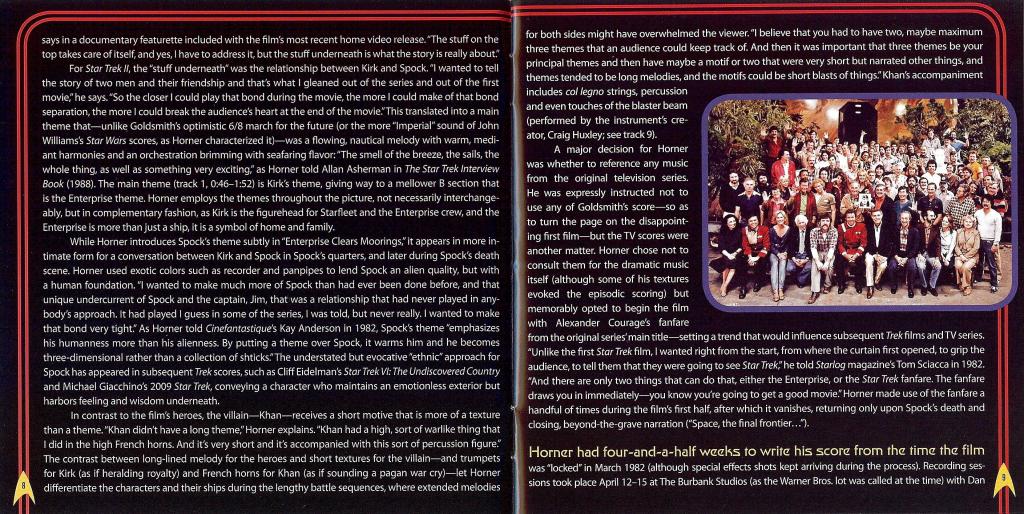
TrekMovie is excited to announce some big news, especially for Star Trek soundtrack aficionados. Film Score Monthly and Screen Archives Entertainment are releasing the complete soundtrack to James Horner’s classic Star Trek II: The Wrath of Khan score. We have all the details.
Originally released in 1982, and owing to the limitations of space on cassettes and LPs at the time, the TWOK soundtrack featured about 44:50 minutes of music. As they have done with previous releases such as the amazing 8CD Superman box set, Film Score Monthly/Screen Archives Entertainment have now greatly enhanced the TWOK music offering with an expanded edition of the score. With 23 tracks, the expanded edition of TWOK includes 76:58 minutes of music, featuring all the previously unreleased music available. Fans will be able to hear some of Horner’s beautiful music (made all the amazing considering he was only 28 years old at the time) for the first time on CD.
The filmscoremonthly.com website has this description:
Star Trek II was released on LP by Atlantic Records in a 45-minute program issued on CD by GNP/Crescendo (long out of print). Although the album program featured the score’s highlights, fans have long clamored for a complete-score presentation—adding such important cues as the mind-control sequences involving Chekov and Capt. Terrell being possessed by alien eels, the revelation of the Genesis Cave, the final battle between the Enterprise and Reliant, and Spock’s death and funeral (“Amazing Grace”). FSM delivers in cooperation with Rhino Entertainment (who administer the Atlantic Records catalog) and Paramount Pictures (owners of the Star Trek film franchise)—remastering the complete score from Dan Wallin’s 1982 three-track film mixes, stored in the Paramount vaults in sterling sound quality.
Rare music from a Trek classic
Two of the more exciting offerings are the music from the scene where Spock sacrifices himself for the crew (“Spock (dies)”) and the amazing battle music of “Enterprise Attacks Reliant.” The expanded edition also includes the one selection not composed by Horner. The music for “The Genesis Project” was actually composed by Craig Huxley. Astute fans may remember that Huxley, now a Grammy and Emmy award winning musician, played Peter Kirk (nephew to Captain Kirk in “Operation Annihilate!”) and Tommy Starnes (“And the Children Shall Lead”). He is also the inventor of the “blaster beam” instrument which was the voice of V’Ger in Jerry Goldsmith’s music for Star Trek: The Motion Picture. There are also bonus tracks, including “Amazing Grace” and the original epilogue and end credits music. As many fans know, the scene with Spock’s photon casing on Genesis was added to the film after completion. This necessitated new music and reediting of the film. The TWOK bonus track includes the version of the music as it originally would have played if this scene was not added to the feature film.
The soundtrack also includes an extensive and detailed 28-page program booklet, with many rare photos (some supplied by myself, with director Meyer’s permission, from my collection of photos from the amazing “The Papers of Nicholas Meyer Collection” from the University of Iowa) and liner notes from Jeff Bond, Lukas Kendall, and Alexander Kaplan. The soundtrack costs $19.95 is available now, online only. You can purchase (and listen to clips) at filmscoremonthly.com. [note: this Soundtrack is not a ‘limited edition’ so if you have trouble getting to their site today, don’t worry]
On the campaign trail, Joe Biden boasted of his role in transforming Colombia and Central America through ambitious economic and security programs. Colombians and Hondurans tell The Grayzone about the damage his plans did to their societies.
While campaigning for the Democratic Party’s presidential nomination, former Senator and Vice President Joseph Biden has touted the crucial role he played in designing US mega-development and drug war campaigns that transformed the socio-political landscape of large swaths of Latin America.
“I was one of the architects of Plan Colombia,” Biden boasted in a July 5 interview with CNN, referring to the multibillion-dollar US effort to end Colombia’s civil war with a massive surge of support for the country’s military. According to Biden, the plan was a panacea for Colombia’s problems, from “crooked cops” to civil strife.
But Biden’s plan for Colombia has contributed directly to the country’s transformation into a hyper-militarized bastion of right-wing rule, enhancing the power and presence of the notoriously brutal armed forces while failing miserably in its anti-narcotic and reformist objectives.
More than 50 human rights defenders were killed in Colombia in the first four months of 2019, while coca production is close to record levels. And as Colombian peace activists lamented in interviews with The Grayzone, the US is still in complete control of Bogotá’s failed anti-drug policy, thanks largely to Plan Colombia.
Biden has also pumped up his role in an initiative called the Alliance for Prosperity, which was applied to the Northern Triangle of Central America. The former vice president was so central to the program’s genesis that it was informally known as “Plan Biden.”
Marketed as an answer to the crisis of child migration, Biden’s brainchild channeled $750 million through a right-wing government installed by a US-orchestrated military coup to spur mega-development projects and privatize social services.
The Grayzone visited Honduras in July and documented, through interviews with human rights defenders, students, indigenous activists, and citizens from all walks of life, how the Alliance for Prosperity helped set the stage for a national rebellion.
In recent months, teachers, doctors, students, and rural campesinos have been in the streets protesting the privatization plans imposed on their country under the watch of Biden and his successors.
The gutting of public health services, teacher layoffs, staggering hikes in electricity prices, and environmentally destructive mega-development projects are critical factors in mass migration from Honduras. And indeed, they are immediate byproducts of the so-called “Biden plan.”
“Biden is taking credit for doing something constructive to stop the migration crisis and blaming the concentration camps [on the US-Mexico border] on Trump. But it’s Biden’s policies that are driving more people out of Central America and making human rights defenders lives more precarious by defending entities that have no interest in human rights,” explained Adrienne Pine, a professor of anthropology at American University and leading researcher of the social crisis in Honduras, in an interview with The Grayzone.
“So $750 million US taxpayer dollars that were allocated to supposedly address child migration are actually making things worse,” Pine added. “It started with unaccompanied minors and now you have children in cages. Largely thanks to Biden.” ‘I was one of the architects of Plan Colombia’
In an interview with CNN on July 5, Biden was asked if he favored decriminalizing the entry of Latin American migrants to the United States. Responding with a definitive “no,” Joe Biden stated that he would be “surging folks to the border to make those concrete decisions” about who receives asylum.
Biden argued that he had the best record of addressing the root causes of the migration crisis, recalling how he imposed a solution on Central America’s migration crisis. “You do the following things to make your country better so people don’t leave, and we will help you do that, just like we did in Colombia,” he said.
“What did we do in Colombia? We went down and said, okay, and I was one of the architects of Plan Colombia,” Biden continued. “I said, here’s the deal. If you have all these crooked cops, all these federal police, we’re sending our FBI down, you let us put them through a lie detector test, let us tell you who you should fire and tell you the kind of people you should hire. They did and began to change. We can do so much if we’re committed.”
With the arrogance of a pith-helmeted high colonial official meting out instructions on who to hire and fire to his docile subjects, Biden presided over a plan that failed miserably in its stated goals, while transforming Colombia into a hyper-militarized bastion of US regional influence. Plan Colombia: ‘They come and ask for bread, and you give them stones’
Plan Colombia was originally conceived by Colombian President Andrés Pastrana in 1999, as an alternative development and conflict resolution plan for his war-torn country. He considered calling it the “Plan for Colombia’s Peace.”
The proposal was quickly hijacked by the Bill Clinton administration, with Joe Biden lobbying in the Senate for an iron-fisted militarization plan. “We have an obligation, in the interests of our children and the interests of the hemisphere, to keep the oldest democracy in place, to give them a fighting chance to keep from becoming a narcostate,” Biden said in a June 2000 floor speech.
When Plan Colombia’s first formal draft was published, it was done so in English, not Spanish. The original spirit of peace-building was completely sapped from the document by Biden, whose vigorous wheeling-and-dealing ensured that almost 80 percent of the $7.5 billion plan went to the Colombian military. 500 US military personnel were promptly dispatched to Bogota to train the country’s military.
“If you read the original Plan Colombia, not the one that was written in Washington but the original Plan Colombia, there’s no mention of military drives against the FARC rebels,” Robert White, the former number two at the US embassy in Bogota, complained in 2000. “Quite the contrary. [Pastrana] says the FARC is part of the history of Colombia and a historical phenomenon, he says, and they must be treated as Colombians.”
White lamented how Washington had abused the trust of the Colombians: “They come and ask for bread, and you give them stones.”
Plan Colombia was largely implemented under the watch of the hardline right-wing President Álvaro Uribe. In 1991, Uribe was placed on a US Drug Enforcement Agency list of “important Colombian narco-traffickers,” in part due to his role in helping drug kingpin Pablo Escobar’s obtain licenses for landing strips while Uribe was the head of Colombia’s Civil Aeronautics Department.
Under Uribe’s watch, toxic chemicals were sprayed by military forces across the Colombian countryside, poisoning the crops of impoverished farmers and displacing millions.
Six years after Bill Clinton initiated Plan Colombia, however, even US drug czar John Walters was forced to quietly admit in a letter to the Senate that the price of cocaine in the US had declined, the flow of the drug into the US had risen, and its purity had increased.
Meanwhile, a UN Office of Drugs and Crime report found that coca cultivation reached record levels in Colombia in 2018. In other words, billions of dollars have been squandered, and a society already in turmoil has been laid to waste.
For the military and right-wing paramilitary forces that have shored up the rule of leaders like Uribe and the current ultra-conservative Colombian president, Ivan Duque, Plan Colombia offered a sense of near-total impunity.
The depravity of the country’s military was put on bold display when the so-called “false positives” scandal was exposed in 2008. The incident began when army officers lured 22 rural laborers to a far-away location, massacred them, and then dressed them in uniforms of the leftist FARC guerrillas.
It was an overt attempt to raise the FARC body count and justify the counter-insurgency aid flowing from the US under Plan Colombia. The officers who oversaw the slaughter were paid bounties and given promotions.
Colombian academics Omar Eduardo Rojas Bolaños and Fabián Leonardo Benavides demonstrated in a meticulous study that the “false positives” killings reflected “a systematic practice that implicates the commanders of brigades, battalions and tactical units” in the deaths of more than 10,000 civilians. Indeed, under Plan Colombia, the incident was far from an isolated atrocity.
Forfeiting Colombia’s national sovereignty
In an interview in Bogotá this May, The Grayzone’s Ben Norton asked Colombian social leader Santiago Salinas if there was any hope for progressive political transformation since the ratification of Plan Colombia.
An organizer of the peace group Congreso de los Pueblos, Salinas shrugged and exclaimed, “I wish.” He lamented that many of Colombia’s most pivotal decisions were made in Washington.
Salinas pointed to drug policy as an example. “It seems like the drug decisions about what to do with the drugs, it has nothing to do with Colombia.
“There was no sovereign decision on this issue. Colombia does not have a decision,” he continued. It was the Washington that wrote the script for Bogota. And the drug trade is in fact a key part of the global financial system, Salinas pointed out.
But Biden was not finished. After 15 years of human misery and billions of wasted dollars in Colombia, he set out on a personal mission to export his pet program to Central America’s crime and corruption-ravaged Northern Triangle. Biden eyes Central America, selling mass privatization
In his July sit-down with CNN, Joe Biden trumpeted his Plan Colombia as the inspiration for the Alliance for Prosperity he imposed on Central America. Channeling the spirit of colonial times once again, he bragged of imposing Washington’s policies on the governments of El Salvador, Guatemala, and Honduras.
“We’ll make a deal with you,” Biden recalled telling the leaders of these countries. “You do the following things to make your country better so people don’t leave, and we will help you do that.”
Biden announced his bold plan on the editorial pages of the New York Times in January 2015. He called it “a joint plan for economic and political reforms, an alliance for prosperity.” Sold by the vice president as a panacea to a worsening migration crisis, the Alliance for Prosperity was a boon for international financial institutions which promised to deepen the economic grief of the region’s poor.
The Alliance for Prosperity “treated the Honduran government as if it were a crystal-clear, pure vessel into which gold could be poured and prosperity would flow outward,” explained Dana Frank, a professor of history at the University of California, Santa Cruz, and the author of the book, The Long Honduran Night.
“In reality, the Plan would further enrich and strengthen the political power of the very same elites whose green, deliberate subversion of the rule of law, and destruction of natural resources and of Indigenous and campesino land rights, were responsible for the dire conditions the proposal ostensibly addressed,” Frank added.
In Honduras, the government had no capacity or will to resist Biden’s plan. That is because the country’s elected president, Juan Manuel Zelaya, had been removed in 2009 in a coup orchestrated by the United States.
As Zelaya told The Grayzone’s Anya Parampil, the Obama administration was infuriated by his participation in ALBA, a regional economic development program put forward by Venezuela’s then-President Hugo Chavez that provided an alternative to neoliberal formulas like the so-called “Biden Plan.”
Following the military coup, a corporate-friendly administration was installed to advance the interests of international financial institutions, and US trainers arrived in town to hone the new regime’s mechanisms of repression.
Under the auspices of the Central American Regional Security Initiative, the FBI was dispatched to oversee the training of FUSINA, the main operational arm of the Honduran army and the base of the Military Police for Public Order (PMOP) that patrols cities like an occupation force.
In an October 2014 cable, the US embassy in Tegucigalpa acknowledged that the PMOP was riven with corruption and prone to abuse, and attempted to distance itself from the outfit, even though it operated under the umbrella of FUSINA.
This June, the PMOP invaded the Autonomous University of Honduras, attacking students protesting the privatization of their school and wounding six.
The creation by the US embassy in Honduras of a special forces unit known as the Tigres has added an additional layer of repressive muscle. Besides arresting activists, the Tigres reportedly helped a drug kingpin escape after he was detained during a US investigation.
While violent crime surged across Honduras, unemployment more than doubled. Extreme poverty surged, and so too did the government’s security spending.
To beef up his military, President Juan Orlando Hernández dipped into the social programs that kept a mostly poor population from tumbling into destitution.
As Alex Rubinstein reported for The Grayzone, the instability of post-coup Honduras has been particularly harsh on LGTTBI (Lesbian, Gay, Trans, Travesti, Bisexual, and Intersex) Hondurans. More than 300 of them have been killed since 2009, a dramatic spike in hate crimes reinforced by the homophobic rhetoric of the right-wing Evangelical Confraternity that represents the civil-society wing of the ultra-conservative Hernandez government.
As the social chaos enveloped Honduran society, migration to the US-Mexico border began to surge to catastrophic levels. Unable to make ends meet, some Hondurans sent their children alone to the border, hoping that they would temporary protective or refugee status.
By 2014, the blowback of the Obama administration’s coup had caused a national emergency. Thousands of Hondurans were winding up in cages in detention camps run by the US Department of Homeland Security, and many of them were not even 16 years old.
That summer, Obama went to Congress for $3.7 billion in emergency funds to ramp up border militarization and deport as many unaccompanied Central American minors as possible.
Biden used the opportunity to rustle up an additional billion dollars, exploiting the crisis to fund a massive neoliberal project that saw Honduras as a base for international financial opportunity. His plan was quickly ratified, and the first phase of the Alliance for Prosperity began.
Energy industry rush dooms indigenous communities and human rights defenders
The implementation of the Alliance for Prosperity was overseen by the Inter-American Development Bank (IADB), a US-dominated international financial institution based in Washington, DC that supports corporate investment in Latin America and the Caribbean.
A graphic on the IADB’s website outlined the plan’s objectives in anodyne language that concealed its aggressively neoliberal agenda.
For instance, the IADB promised the “fostering [of] regional energy integration.” This was a clear reference to Plan Pueblo Panama, a region-wide neoliberal development blueprint that was conceived as a boon to the energy industry. Under the plan, the IADB would raise money from Latin American taxpayers to pay for the expansion of power lines that would carry electricity from Mexico all the way to Panama.
Honduras, with its rivers and natural resources, provided the project with a major hub of energy production. In order for the country’s energy to be traded and transmitted to other countries, however, the International Monetary Fund mandated that its national electricity company be privatized.
Since the implementation of that component of “Plan Biden,” energy costs have begun to surge for residential Honduran consumers. In a country with a 66 percent poverty rate, electricity privatization has turned life from precarious to practically impossible.
Rather than languish in darkness for long hours with unpaid bills piling up, many desperate citizens have journeyed north towards the US border.
As intended, the Alliance for Prosperity’s regional energy integration plan has spurred an influx of multi-national energy companies to Honduras. Hydro-electric dams and power plants began rising up in the midst of the lush pine forests and winding rivers that define the Honduran biosphere, pushing many rural indigenous communities into a life-and-death struggle.
This July, The Grayzone traveled to Reitoca, a remote farming community located in the heart of the Honduran “dry sector.” The indigenous Lenca residents of this town depend on their local river for fish, recreation, and most importantly, water to irrigate the crops that provide them with a livelihood. But the rush on energy investment brought an Italian-Chilean firm called Progelsa to the area to build a massive hydro-electric dam just upstream.
Wilmer Alonso, a member of the Lenca Indigenous Council of Reitoca, spoke with The Grayzone, shaking with emotion as he described the consequences of the dam for his community.
“The entire village is involved in this struggle,” Alonso said. “Everyone knows the catastrophe that the construction of this hydro-electric plant would create.”
He explained that, like so many foreign multi-nationals in Honduras, Progelsa employs an army of private thugs to intimidate protesters: “The private company uses the army and the police to repress us. They accuse us of being trespassers, but they are the ones trespassing on our land.” US reinforces ‘factors that generate violence the most in our society’
The Alliance for Progress also provided the backdrop for the assassination of the renowned Honduran environmentalist and feminist organizer Berta Cáceres.
On March 3, 2016, Cáceres was gunned down in her home in rural Honduras. A towering figure in her community with a presence on the international stage, Cáceres had been leading the fight against a local dam project overseen by DESA, a powerful Honduran energy company backed by the United States Agency for International Development (USAID) and run by powerful former military officers.
The representative that DESA sent to sign its deal with USAID, Sergio Rodríguez, was later accused of masterminding Cáceres’ murder, alongside military officials and former company employees.
In March 2018, the Honduran police arrested DESA’s executive president, Roberto David Castillo Mejía, accusing him of “providing logistics and other resources to one of the material authors” of the assassination. Castillo was a West Point graduate who worked in the energy industry while serving as a Honduran intelligence officer.
This July, The Grayzone visited the family of Berta Cáceres in La Esperanza, a town nestled in the verdant mountains of Intibucá. Cáceres’ mother, Doña Berta, lives there under 24-hour police guard paid for by human rights groups.
The Cáceres household is bristling with security cameras, and family members get around in armored cars. In her living room, we met Laura Zúñiga Cáceres of the Civic Council of Indigenous and Popular Organizations of Honduras (COPINH), the human rights group that her mother Berta founded.
“The violence in Honduras generates migrant caravans, which tears apart society, and it all has to do with all of this extractivism, this violence,” Zúñiga Caceres told The Grayzone. “And the response from the US government is to send more soldiers to our land; it is to reinforce one of the factors that generates violence the most in our society.”
“We are receiving reports from our comrades that there is a US military presence in indigenous Lenca territory,” she added. “For what? Humanitarian aid? With weapons. It’s violence. It’s persecution.” Gutting public healthcare, driving more migration
The Alliance for Prosperity also commissioned the privatization of health services through a deceptively named program called the Social Protection Framework Law, or la Ley Marco de Protección Social.
Promoted by Honduran President Juan Orlando Hernández as a needed reform, the scheme was advanced through a classic shock doctrine-style episode: In 2015, close associates of Hernández siphoned some $300 million from the Honduran Institute for Social Services (IHSS) into private businesses, starving hospitals of supplies and causing several thousand excess deaths, mostly among the poor.
With the medical sector in shambles, Hondurans were then forced to seek healthcare from the private companies that were to provide services under Hernandez’s “Social Protection” plan.
“The money that was robbed [in the IHSS scandal] was used to justify the Ley Marco Proteccion Social,” Karen Spring, a researcher and coordinator for the Honduras Solidarity Network, told The Grayzone. “The hospitals were left in horrible conditions with no human capital and they were left to farm out to private hospitals.”
“When Hondurans go to hospitals, they will be told they need to go to a private company, and through the deductions in their jobs they will have to pay a lot out of pocket,” Spring said. “Through the old universal system you would be covered no matter what you had, from a broken arm to cancer. No more.”
In response, Hondurans poured out into the streets, launching the March of Torches – the first major wave of continuous protests against Hernandez and his corrupt administration.
In March 2015, in the middle of the crisis, Joe Biden rushed down to Guatemala City to embrace Hernández and restore confidence in the Alliance for Prosperity.
“I come from a state that, in fact, is the corporate capital of America. More corporations are headquartered there than anyplace else,” Biden boasted, with Hernández and the presidents of Guatemala and El Salvador standing by his side. “They want to come here. Corporate America wants to come.”
Emphasizing the need for more anti-corruption and security measures to attract international financial investment, Biden pointed to Plan Colombia as a shining model – and to himself as its architect. “Today Colombia is a nation transformed, just as you hope to be 10 to 15 years from now,” the vice president proclaimed.
Following Biden’s visit, the privatization of the Honduran economy continued apace — and so did the corruption, the repression, and the unflinching support from Washington. Hondurans take to the streets, wind up in US-style supermax prisons
By 2017, the movement in Honduras that had galvanized against the US-orchestrated 2009 coup saw its most immediate opportunity for political transformation at the ballot box. President Hernández was running for re-election, violating a constitutional provision on term limits. His opponent, Salvador Nasrallah, was a popular broadcast personality who provided a centrist consensus choice for the varied elements that opposed the country’s coup regime.
When voting ended on November 26, Nasrallah’s victory appeared certain, with exit polls showing him comfortably ahead by several points. But suddenly, the government announced that a power outage required the suspension of vote counting. Days later, Hernández was declared the victor by about 1 percent.
The fraud was so transparent that the Organization of American States (OAS), normally an arm of US interests in Latin America, declared in a preliminary report that “errors, irregularities and systemic problems,” as well as “extreme statistical improbability,” rendered the election invalid.
But the United States recognized the results anyway, leaving disenfranchised Hondurans with protest as their only recourse.
“Hondurans tried to change what happened in their country through the 2017 elections, not just Hernández but all the implementation of all these policies that the Biden plan had funded and implemented all these years since the coup,” explained Karen Spring, of the Honduras Solidarity Network.
“They tried to change that reality through votes and when the elections turned out to be a fraud, tons of people had no choice but to take to the streets.”
At the front lines of the protests in 2017 was Spring’s longtime partner, the Honduran activist Edwin Espinal. Following a protest in November of that year where property damage took place, Espinal was arrested at gunpoint at his home and accused of setting fire to the front door of a hotel. He fervently denied all charges, accusing the government of persecuting him for his political activism.
In fact, the Inter-American Commission on Human Rights had placed a protective measure on Espinal in 2010 in response to previous attempts to legally railroad him.
The government placed Espinal in pre-trial detention in La Tolva, a US-style maximum security prison normally reserved for violent criminals and narco-traffickers. Last October, Espinal and Spring were married in the jail while surrounded by masked guards.
“Since the Biden plan, contractors have been coming down to build these US-style maximum security prisons,” Spring said. “That’s where my husband Edwin Espinal is being held.”
“They say the company is Honduran but there’s no way Hondurans could have built that without US architects or US construction firms giving them the plans,” she added. “I’ve been in the prison and it’s like they dumped a US prison in the middle of Honduras.”
Reflecting on her husband’s persecution, Spring explained, “Edwin wanted to stay in his country to change the reality that caused mass migration. He’s one of the people who’s faced consequences because he went to the streets. And he’s faced persecution for years because he’s one of the Hondurans who wanted to change the country by staying and fighting. Berta Caceres was another.”
“Hondurans wanted to use their votes to change the country and now they’re voting with their feet,” she continued. “So if Biden’s plan really addressed the root causes of the migrant crisis, why aren’t people asking why migration is getting worse? Hondurans are voting on the Biden plan by fleeing and saying your plan didn’t work and it made our situation worse by fleeing to the border.”
This is a Media Converter, which helps you Convert Media file from one format to another one. Support any source format with relevant DirectShow decoder, supported destination format includes: asf,wmv,wma,avi,mp3,wav,mkv,mka,ogg,APE(monkey’s audio) etc.
MMConvert is a free software application from the Other subcategory, part of the System Utilities category. The app is currently available in English and it was last updated on 2007-04-19. The program can be installed on 32-bit MS Windows (NT/2000/XP) Microsoft Windows Server 2003.
MMConvert (version 1.0.5.236) is available for download from our website. Just click the green Download button above to start. Until now the program was downloaded 175 times. We already checked that the download link to be safe, however for your own protection we recommend that you scan the downloaded software with your antivirus.
Konami may have cancelled Silent Hills but GameCentral takes a look back at one of the best survival horrors of all time.
When starting our new series of retro reviews we picked on Gradius V for our first example, since it happened to be being re-released on PSN at the time. But by coincidence it also happened to be a Konami game, and it’s now obvious that Gradius is far from the only franchise at risk of obsolescence from the once beloved publisher…
The sad, strange saga behind Silent Hills’ cancellation comes only weeks after the equally bizarre treatment of Metal Gear creator Hideo Kojima, who was working on the Silent Hill reboot with movie maker Guillermo del Toro. With the P.T. demo now removed from PSN it seems as if every trace of Silent Hills has been purposefully removed, and so now we have only the older Silent Hill games to remember it by. So it’s a good job the first three are amongst the best survival horrors ever made.
Although we still have a fondness for the PS one original, Silent Hill 2 in particular is one of the best video games of the entire PlayStation 2 era, and a game well ahead of its time in terms of its presentation and storytelling. The difficult question for this re-review though is how to actually play it.
There is the Silent Hill HD Collection, which contains Silent Hill 2 and 3, but it is without exaggeration one of the worst HD remakes of all time. So much so that rather than even try to fix all the problems Konami ended up giving refunds to Xbox 360 owners, after it was revealed they’d lost the source code to the original games and had just bodged together the remasters from what was left. So this review is based on the original PlayStation 2 version.
Even 14 years after its release we’re still reticent to talk about Silent Hill 2’s plot in detail, lest we spoil anyone’s chances of properly enjoying the game for the first time. Its set-up is very simple though, as you take the role of one James Sunderland – who has come to the fog-enshrouded town of Silent Hill after receiving a letter from his wife Mary. Which he’s understandably puzzled about because Mary died of an illness three years before.
Hints as to the backstories and motivations of all of Silent Hill 2’s characters can be pieced together from the clues available, but the game leaves the pursuit of these entirely up to you. On the first playthrough most people will take the scenario at face value, that Silent Hill is some kind of gateway to a hellish otherworld. But not just in the sense that it’s full of monsters, but that everyone present is there because of some act from their past that has damned them to what may or may not be eternal torment.
Although it is most definitely a survival horror game there’s a world of different between Silent Hill 2 and a shlock adventure like Resident Evil. Although there’s a few jump scares there’s very little real gore (the game is only rated 16) and combat is clumsy and of very little interest in its own right. Which is not to disparage Resident Evil in anyway, but Silent Hill is a very different kind of game.
Exploring Silent Hill is disturbing enough at the best of times but whenever it switches to the ‘other world’ the atmosphere becomes almost a physical presence, as if the real world of your living room has changed along with it. Like the best horror movies it’s not what you see that scares you but what you think you saw, and what you fear might be coming next. The sense of claustrophobia, loneliness, and a terrible, inescapable, doom is palpable, and made even more real because you know that this is not some random torture but a personalised version of hell designed specifically for the game’s hapless protagonist.
The true nature of iconic villain Pyramid Head is as complex as all the other characters’ backstories, but what makes him so terrifying is simply how bizarre and unknowable he is. In his opening appearance he seems to sexually assault one of the other monsters – two pairs of mannequin legs on top of each other – but like everything else in the game this has a symbolism and meaning that traces back to very human origins.
Although not always visible from the surface Silent Hill 2 is fearless in some of the issues it tackles, including suicide and sexual abuse. Even today there are very few games that would ever touch such subjects, especially not a major retail release from an established publisher. But Silent Hill 2 doesn’t include these elements for the sake of controversy or titillation, they’re simply organic parts of a very adult and, from a psychological point of view, believable storyline.
In terms of gameplay and basic structure Silent Hill 2 can be viewed as little more than a remake of the first game, and indeed that was the primary reason why at the time we were initially a little disappointed in it. It completely does away with the weird logic puzzles at the end of the first game (which surprisingly did make a reappearance in P.T.) but in terms of setting and gameplay all three of the first games are very similar.
But it’s the added depth of Silent Hill 2’s backstory that make it the jewel in the series’ crown. Rather than a mumbo-jumbo explanation of the town itself the slow realisation of why James is so unreconcilable over his wife’s death is amazingly well handled in terms of its subtlety, and how in hindsight it explains much of what he has seen and heard during the game.
Using the same logic you’re able to infer the stories of the other characters, although understating the complexities of Maria – who looks exactly like Mary but, at first at least, claims no knowledge of her – depends on also playing the Born From A Wish side story, which was added to the Director’s Cuts of the game released a year later.
Silent Hill 2 isn’t perfect, with its greatest moments so well hidden many will have never guessed they even exist – and even then most of them occur right at the end of the game. But any complaint that the controls and combat are clumsy and awkward are missing the point. James is just an ordinary guy with no combat training, and he’s not meant to be roll dodging all of the place. Even the amateurish voiceovers have a charm and honesty that works perfectly well in context.
A good video game can be scarier than any movie, but that’s often simply because the sense of immersion is greater. But although Silent Hill 2’s visuals still stand up remarkably well today it’s the psychological depth of the game that makes it a true classic. The oppressive, dream-like nature of the game doesn’t make you worry simply for your virtual life, but for your soul and your sanity. And with the cancellation of Silent Hills there’s sadly every reason to assume there’ll never be anything like it again.
A still from the science fiction horror film Alien: Covenant (2017)
Originally posted on May 17, 2019:
I don’t review films often, but I think that Avengers: Endgame (2019) is worth talking about. First of all, I saw Captain Marvel (2019) for the second time recently, and this time I paid for the ticket. I now think that it’s one of the best MCU films, if I’m being honest. I’ve never been a Marvel fan because I don’t like to be a fan of anything, really. But Marvel films, for example, are worth seeing because they’ve become what people call event movies. They’re enjoyable to watch. I’m not one of those people that dislike Brie Larson because of something that she said. She plays the role of Carol Danvers in Captain Marvel. I’ve got better things to do than hating some actress. I mean, what do people expect at this point? I guess that they need an outlet for their anger or frustration, and there are things to be angry about these days, but picking Hollywood as the object of hatred seems silly to me. Hollywood is one of the industries that have been feeding them propaganda for most of their lives, but now, all of a sudden, they’re angry because an actress stated an agenda in a somewhat obvious way. I don’t mean to insult them because I understand their situation, but I think that they should pick up a book and read once in a while. They’ll be more informed. This is one of the problems with people now. People hardly read anymore. Instead of reading, they watch television or see films. Nowadays, there’s a new distraction, which is playing video games. Therefore, because of their lack of knowledge and lack of critical thinking, they can be so easily manipulated by the authorities. Anyway, Captain Marvel, the character, doesn’t play an important role in Avengers: Endgame, as it turns out. I did find Larson’s acting to be fine in the film. Carol Danvers is important in her own film, but, in Avengers: Endgame, her importance in the story has been much overblown before the release of the film. Avengers: Endgame is kind of a mess. It’s not a piece of garbage because there are still many enjoyable things in it, but the script wasn’t written very well, in my opinion, and the film ended up being one of the worst MCU films. Honest reviewers on IMDb have already pointed out the flaws in this film. There’s fat, pathetic Thor. There are the inconsistencies with time travel. There’s the silly humor. There’s the poorly thought out final battle. There are the continuity problems. This film is a kind of a stinker. Still, I did find it to be entertaining. It didn’t make me feel bored. I think that out of the two most recent Avengers films, Avengers: Infinity War (2018) was much more important for Marvel and the filmmakers than Avengers: Endgame. Therefore, Avengers: Infinity War contains the exciting action and the messages that the filmmakers wanted people to see. Avengers: Endgame, on the other hand, turned out to be a film with leftovers. Thanos revealed his reasoning and his agenda in Avengers: Infinity War. He succeeded in wiping out half of all life in the universe with the “snappening”. Naturally, Marvel couldn’t let this be the end of the story. People would have been outraged at such a depressing finale. Therefore, Avengers: Endgame had to be made so that the Avengers could defeat Thanos and undo his doings, though Thanos does have a few more things to say this time as well. This time he makes a little speech about rewriting history and brainwashing people. In addition, Iron Man and Captain America had to be killed off because Robert Downey Jr. and Chris Evans had been playing these roles for long enough. In addition, the writers and the filmmakers saw an opportunity to patch up some of the inconsistencies from previous MCU films. Rene Russo came back to better develop the character of Frigga because of a lack of development in Thor: The Dark World (2013). Hawkeye gets more screen time as well because people complained about his lack of screen time in previous films. So, the filmmakers wanted to service the fans, and the fans sure did get serviced with Avengers: Endgame. In my opinion, Avengers: Endgame turned out to be a leftovers and patch up film after the main event that was Avengers: Infinity War. And, of course, Avengers: Endgame sets up the next phase of the MCU. Funnily enough, the directors, Anthony Russo and Joe Russo, are now responsible not only for some of the best MCU films but also for the worst and most ridiculous MCU film. In my opinion, that is.
I finished reading the book ‘Factories of Death: Japanese Biological Warfare, 1932 – 1945, and the American Cover-Up’ by Sheldon H. Harris. I think that it’s good reading for those who are interested in World War II. It’s about a rarely covered incident that happened before and during World War II. It seems that the history that this book covers has been suppressed in the USA because Japan is a close ally of the USA. In the book, there’s information about what happened to the American POWs that were captured by the Japanese after the capture of the Philippines. Japan, as it turns out, had the largest biological weapons program in the world at that time. The author also wrote about post-war Japan and about the domination of conservatives and reactionaries in Japanese government. I haven’t yet finished reading Nikolay Danilevsky’s ‘Russia and Europe: A Look at the Cultural and Political Relations of the Slavic World to the Romano-German World’ (1895). But I have come across more interesting information in the book that is worth mentioning. Danilevsky pointed out that there have been three periods of development and growth in the history of Western civilization. This is probably where Carroll Quigley got the idea that there were three separate ages of expansion in Western history. I know that Danilevsky’s book was influential for Quigley because he mentioned it in two of his books. Moreover, Danilevsky even wrote the rough dates of these periods of development, though Danilevsky didn’t go into them in detail and he didn’t explain why they took place. At this time, I’m also reading Immanuel Velikovsky’s ‘Worlds in Collision’ (1950), Oswald Spengler’s ‘The Decline of the West’ (1918), and Quigley’s ‘Weapons Systems and Political Stability: A History’ (1983), which is the only book by Quigley that I haven’t read yet. I’m often reading these books on my smartphone while I take trips on a ferry, on my way to and from work. Since I haven’t yet finished reading these books, I can’t comment on them much. I have been enjoying reading them so far, and I will probably tell what I think about them after I’m done reading them.
Originally posted on September 9, 2017:
Is Alien: Covenant (2017) really that bad? I did say that it’s a somewhat disappointing film. What I meant by this is that it’s just disappointing and not terrible. In my view, Covenant is a slightly better film than Prometheus (2012) because it makes a little more sense. A few people said to me that they kind of like Covenant. I can understand why they think that. Covenant is an entertaining film, in my opinion, and it does make more sense than Prometheus, but it also has some of the same problems. Because Covenant is a film by director Ridley Scott, it’s a given that it looks very good, though not as good as Prometheus. And, honestly, I’d like for him to make a sequel to Covenant. I’m a little interested in what he might be able to do with a sequel. I’ve been enjoying listening to the music scores by the composer Jerry Goldsmith to the first three Rambo films. First Blood (1982) is a standout film of the 1980s, and it’s easily the best of the Rambo films. What surprised me, however, is that Goldsmith’s scores for the Rambo sequel films didn’t drop in quality. The sequels themselves certainly dropped in quality, but this isn’t the case with the music. The scores for Rambo: First Blood Part II (1985) and Rambo III (1988) are rousing as well, and they’re enjoyable to listen to. What I noticed about films starring Sylvester Stallone is that they usually have good music scores and soundtracks. I wonder if Stallone himself made it a priority to have good music in his films, especially in the 1970s and the 1980s. The biggest disappointment of this year at the cinema for me was the film It, which was directed by Andy Muschietti. It didn’t even seem like a film to me when I was watching it. More like a collection of nonsense. I can’t believe that so many people are praising this film. Sure, it’s kind of entertaining, the acting is fine, and there’s some humor, but this is where the good stuff ends. And, unfortunately, I fell for the hype. I had a good feeling that I’d be somewhat disappointed by this film because films are usually disappointing nowadays, and it’s hard to adapt Stephen King’s thick novel to film, but I didn’t think that it would be such a mess. What made my viewing experience worse is the fact that I finished reading the novel just several days earlier. It was still fresh in my mind, and I remembered pretty much everything that happened in the novel. While I was watching the film, I couldn’t believe what I was seeing. There’s plenty of swearing that isn’t in the novel. There’s no explanation of who Pennywise is. The film is set in 1989, but the filmmakers still decided to make the characters act like they’re in 1958. This doesn’t seem to work. I can’t really imagine children, and even grownups, behaving like this in the 1980s. Therefore, seeing It (2017) seems like a waste of my money.
So, I finally finished listening to the audiobook of Stephen King’s It (1986). It took quite some time because it’s about 45 hours long. I didn’t quite get as much enjoyment out of listening to the novel as I did when I read it years ago because I know what happens in the plot. I still enjoyed listening to most of it, however, especially the first half, in which King reveals the history of Derry. It’s when the reader doesn’t yet know what It is. I don’t think that the novel is a masterpiece, and I don’t like a few aspects of King’s writing, but it still seems good to me after all these years, and it’s so much better than the novels that get written nowadays. Now that I’m done with It, I’m listening to Fyodor Dostoyevsky’s The Idiot (1868), which is a novel that I’ve wanted to read for quite some time. Instead of reading The Idiot, I decided to listen to the audiobook since I had a few credits to spend. What’s also worth noting is that I’ve noticed a rather interesting trend in American fiction of the 1980s. I’m now reading a few American science-fiction novels from the 1980s, and something that pops up even in the genre of science-fiction of this period is anti-Soviet propaganda. I’m sure that many people know about the writer Tom Clancy, about the fact that his novels are pretty much anti-Soviet, pro-American military propaganda. Well, all of this isn’t a coincidence. The fact that Ronald Reagan praised Clancy’s propaganda novel The Hunt for Red October (1984) wasn’t a coincidence either. As historian Andrei Fursov pointed out, the Americans, when Reagan was the president of the USA, intentionally raised tensions with the Soviet Union. The Americans released a lot of offensive anti-Soviet propaganda in the 1980s. But this propaganda now seems mild if it’s compared to the anti-Russian and anti-Soviet propaganda that began to be released in the West in the 2000s. The fact that Hollywood released many action films in the 1980s also wasn’t a coincidence, in my view. The Americans were intentionally trying to create an atmosphere of tension, violence, and confrontation. They did this because they had a strategy of trying to weaken the positions of the Soviet Union. It’s because they saw this as one of two ways of getting out of the economic crisis that was affecting the West since the early-1970s. The other way for them was war. In the end, we know that the Americans succeeded, thanks to people like Mikhail Gorbachev, whom Fursov described as one of the two biggest traitors in Russian history. The other one is Boris Yeltsin.