
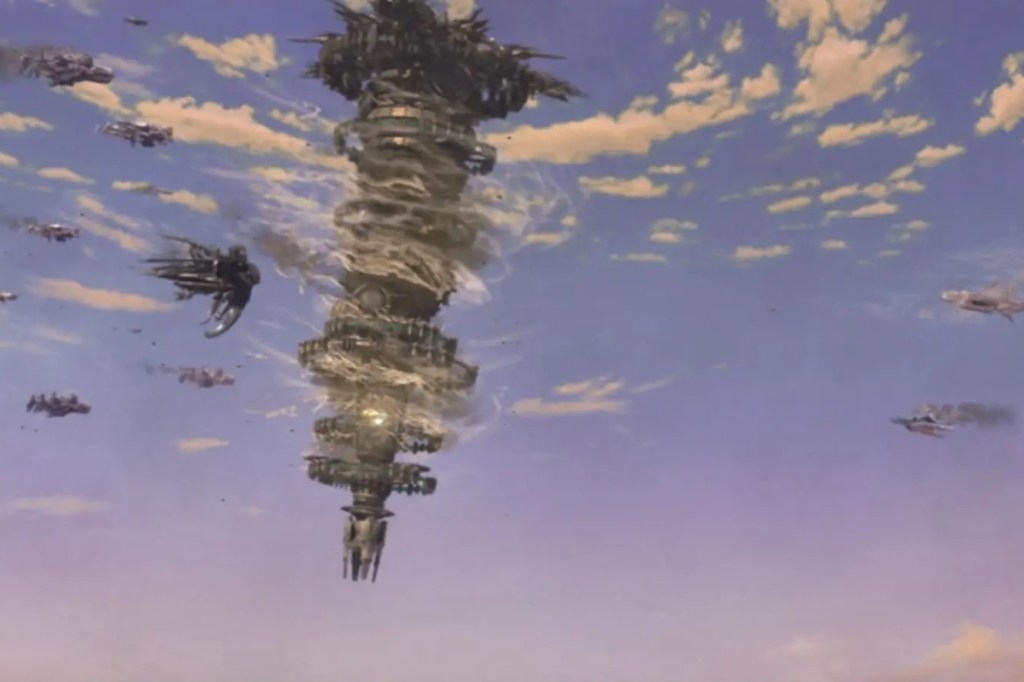
Since I recently finished playing Final Fantasy XII for the third time, I think that it’s worth reviewing it and explaining why it’s one of my favorite video games. The PlayStation 2 is the first home video game console that I bought, and Final Fantasy XII is one of the first video games that I acquired and played. This was over a decade ago. So, the fact that I completed the game for the third time recently isn’t surprising. Final Fantasy X, which is one of the best PS2 games and also one of my favorite video games, was released in 2001. But Final Fantasy XII was released in 2006. The development of Final Fantasy X lasted for two years. The development of Final Fantasy XII lasted for five years, which was a very long game development period for that time. Many video game critics on the internet, of which there is a big number, like to praise the works of notable video game designers like Fumito Ueda or Hidetaka Miyazaki, who has become perhaps the most admired video game designer in the last decade or so. I like their video games too, but I think that my favorite designer would be Yasumi Matsuno, if I had to pick a favorite. I think that his fictional stories and design ideas are my favorite. He’s responsible for not one but several engrossing and high-quality video games. The stories in the games on which he has worked are some of the most complex and sophisticated in all of gaming. One of the reasons why Final Fantasy Tactics (1997) is a great game is because it features a detailed and epic story written by Matsuno. So, in this video game, the protagonist Ramza Beoulve and his friends, who are normal people and mortals, come into conflict with not only other mortals and their schemes but also with beings of great power (the Lucavi demons) who were thought to be just a legend. I must say that story moments like when Cardinal Delacroix of the Glabados Church uses one of the Zodiac stones to transform into Cuchulainn, when Marach Galthena gets revived from death by the Scorpio auracite on the roof of a castle, or when Ramza confronts Confessor Zalmour Lucianada are very memorable. Similar story elements are fortunately also present in Final Fantasy XII. The heroes of the story have to battle not only against the judges of the Archadian Empire but also against the Occuria, who are actual gods. What Final Fantasy XII has that Final Fantasy Tactics doesn’t is the ability for players to revisit the well-designed locations in the game. So, if you want to go to the game’s typically beautiful 3D locations again you can do that in most cases. These locations are even more detailed than the locations in Final Fantasy X, and you have the freedom of rotating the camera. I already pointed out on my blog that The Legend of Zelda: Breath of the Wild (2017) is a game that features a big map and many beautiful 3D locations, but Final Fantasy XII offers this too with a world full of grand sights. Moreover, every location in Final Fantasy XII has its own music theme. Some of my favorite locations in the game are Rabanastre, Archades, Phon Coast, Necrohol of Nabudis, Nabreus Deadlands, Bhujerba, Lhusu Mines, Salikawood, Zertinan Caverns, Ridorana Cataract, and Stilshrine of Miriam. Final Fantasy XII is one of the most visually impressive video games for the PS2. One of the reasons for this is that the game was made when Square Enix was still in its heyday. Another reason for this is the involvement of Matsuno, who I suspect is a perfectionist and not only a great video game designer. The cutscenes are of a high quality. Another aspect that’s worth praising is the English localization, which I think is superb. Would Final Fantasy XII have been an even more impressive game if Matsuno hadn’t left development a year before the game’s release. Perhaps. But I’m not complaining about the final product. I can’t compare the original game to The Zodiac Age, which is a remaster that got released in 2017, because I haven’t played it. I already gave my opinion about video game remakes and remasters in an earlier post. Since the original game is closer to Matsuno’s vision, I don’t even feel like purchasing The Zodiac Age and checking how good it is and how it compares to the original. I can simply say that The Zodiac Age probably “stinks”, but I don’t like to talk about something that I know little or nothing about. This is why, for example, I haven’t said anything about the remake of Silent Hill 2 (2024). Since I haven’t played it myself, I don’t know how good it really is or if it has any positive aspects. However, I have posted a few reviews of this remake by people who have played it and who are passionate about the original game from 2001. The original is one of the greatest video games of all time, but it’s not a particularly special game for me. I’ve played it two times already, but I didn’t play it for the first time when I was a teenager. When I was a teenager, I didn’t get to play video games. Perhaps this is a good thing in a way because all I had was a wish to play some PC and PlayStation games, but I didn’t own a Nintendo console and Nintendo games. Many people did grow up owning a Nintendo console or another console, and now some of them are making videos on YouTube about how Nintendo games gave them unforgettable memories when they played these games as children and teenagers. Well, the demand is huge not only for new video games but also for retro video games. Some of them are brainy enough to disagree with Nintendo’s detestable policies, but they still talk about Nintendo with reverence. This sickens me somewhat, and I’m glad that I didn’t grow up playing Nintendo games. Therefore, I don’t think that Nintendo is the greatest video game company that has ever existed or that will ever exist. Sure, I like Nintendo games from the past, but I won’t talk about this company with reverence. When it comes to Matsuno, I am disappointed by the fact that Final Fantasy XII, which has received universal acclaim from video game critics, was his last great video game and that he didn’t get to make more great games. Apparently, Final Fantasy XII was released several months after it could have been released in order to not take away sales from Tetsuya Nomura’s Kingdom Hearts II, which is another great video game from an era full of great video games. The golden age of gaming lasted until the beginning of the eighth generation in 2012, but Matsuno’s last great game got released in 2006. Well, at least he got to make several great games before burning out or not getting the opportunity to lead another big project the way he wanted.
Now that I’m done praising Final Fantasy XII, I will get back to the book ‘Michelangelo: His Life, His Times, His Era’ (1921) by Georg Brandes. I recently finished reading it. The author had to say the following in the book. “The picture we have so far been able to form of Michelangelo’s temperament is quite incomplete. We have noted his zeal, his capacity for learning swiftly, his love of his family – even though those closest to him scarcely understood him – his vaulting ambition, his almost innate sense of self-assertion and, finally, the arrogance and predilection for taunting his teachers and fellows to which it gave rise. Yet the immense power that slumbered within him was offset by an equally conspicuous weakness. He was necessarily sensitive – in the meaning of receptivity to a wealth of sensory impressions – and this led to sudden attacks of anxiety and embitterment, leading in turn to ill-considered actions that demanded and usually found indulgence. The sculptors of the thirteenth century, who represented the Passion or the death of martyrs in the churches, conceived of suffering as a reflection of divine bliss. All pain was outshone by the gentleness and lovingkindness, the innocence and love here manifested. Christianity, familiar as an article of faith, was triumphant. The early fifteenth century brought a change in sentiment. The somber and tragic elements in Christianity asserted themselves in the representation of suffering, at the expense of faith triumphant. In Italy the theme of the Mother’s reunion with her crucified son had originally attracted painters rather than sculptors. Giotto had projected his quiet inwardness, Giovanni Bellini his lofty dignity and grave sentiment into the Madonna’s torment. Botticelli, finally, could scarcely outdo himself in expressing her despair. With him Mary falls in a dead faint, while the others present sob uncontrollably. Moving from such representations to the calm of Michelangelo’s Pieta, we find our souls deeply touched by the quiet sublimity of overwhelming but muted sorrow that speaks without words and does with a minimum of gesture. This Madonna, composed despite her deep agony, is the noblest expression of an elementary sense that something incomprehensible has happened here, doing violence to nature, senseless in its outrageous horror. Whoever has immersed himself in Michelangelo’s first quit relief, the Madonna of the Stairs, knows how austere and melancholy was his emotional cast. But it is not until we confront this wondrous work, the Pieta, that we fathom the full depths of his soul in its unique grandeur. At the age of twenty-four he had plumbed the abyss of sorrow in a single human soul. He had probed it in the soul of a mother who has lost her all, her most precious treasure on earth, the being she not only loved but encompassed with complete devotion. The son whom she had given life in mysterious fashion, whom she worshipped in obscure veneration – his dead body here rests upon her lap, his life wantonly destroyed. Youthfully shy and tender was the sentiment that rendered this lifeless male body so airy and sublime, so delicate and free of the dross of earthly life. And the Madonna herself is treated with the same tender awe. She is intentionally represented as young, scarcely older than her son; for in these mysterious reaches we are not subject to the laws of everyday life. In his old age Michelangelo offered a theologic explanation for this conspicuous youthfulness: the Virgin had never known the life of the senses, which ages and corrodes. Chaste as was her nature, she had kept young by a divine though humanly motivated miracle. The serenity that marks her features would appear supernatural but for the eloquent gesture of the left hand, which reveals that composure has been achieved only at the cost of inward struggle. She suffers as only a higher being suffers. The misfortune that has befallen her fails to disrupt the nobility of her features, does not cloud the purity of her brow, its height emphasized by the form and fall of her kerchief. Despite her desolation, her face remains harmonious, with its fine straight nose, the beautiful closed mouth, the firm strong chin, the inclination of the head – all underlined by the ruffled hem of the robe at her throat. As though enthroned she sits upon the flagstones of Golgatha, at the foot of the cross, shrouded in mourning weeds like the love that carefully enfolds the body on her lap. He lies stretched across her knee, resting in the folds of her cloak, supported by her right hand which reaches under his shoulder, almost reverently shielded with a corner of the cloak, as though the slack body must not be desecrated by any rude contact. Just as none of Michelangelo’s Madonnas look straight at the proud or playing child, so the Mother of God in the Pieta does not direct her gaze to the face of her grown and lifeless son. Her eyes are downcast, lost in deep feelings of her own and even deeper thoughts. In the spring of 1501, probably in May, the artist was back home, after an absence of four years. He returned as one who, with a single masterpiece, had proved that at the age of twenty-six he could lay claim to being the foremost sculptor of his country and age, even though at the time a superman like Leonardo was still living and working. Michelangelo’s mind was preoccupied with another matter – his encounter with the greatest artist of the age, Leonardo da Vinci, who had returned to Florence after an absence of seventeen years. Leonardo had arrived in the spring of 1501, when Michelangelo was still in Rome. In 1502, as military engineer in the service of Cesare Borgia, he had inspected the strongholds in the Romagna, returning in 1503. The story of his fame pervaded the city. Leonardo, accounted as handsome as he was versatile even as a youth, was now in his fifties, an impressive figure of a man. He dressed unorthodoxly though in exquisite taste, wore, in contrast to the long Florentine robes, a rose-colored cloak that came only to his knees, let his curly and well-tended beard grow down over his chest. Magnificent in appearance, he was an artist of rarest hue, a universal genius, a legend in his own time. His demeanor was courtly, his mastery undisputed, but both his character and circumstances had made him a stranger wherever he went. Under Ludovico Sforza, dubbed Il Moro, he had worked and trained disciples in Milan. His main lesson to them was that art had for its object the totality of the works of nature and man. In this respect he was sharply at odds with Michelangelo’s highly personal and instinctive creed that only the human body was a worthy object of art. Leonardo insisted that the variety of things, living and dead, challenged the painter to reproduce the peculiar and the ugly as well as the beautiful and the graceful. In Leonardo’s view the artist had to make his soul a mirror reflecting all things, doing justice to all things. Whoever mastered but one field was a poor artist (uno tristo maestro). One senses, in Leonardo’s later exposition of his views in his Treatise on Painting, a covert polemic against Michelangelo’s diametrically opposite approach. Michelangelo, who all his life maintained that sculpture rather than painting was his profession, insisted in his conversations with Vittoria Colonna, which have come down to us fairly accurately through Francisco de Hollanda, that the art that takes something away, that is to say sculpture, is superior to the art that adds something, to wit painting. These two titanic figures, separated by an age gap of twenty-three years, found it difficult to appreciate, one the other, as is not uncommon in contemporary geniuses of such different stripe, especially when circumstances place them in a state of rivalry. There can be little doubt, however, that Leonardo, whose urbanity and poise were far above envy and jealousy, would have met the rising young genius more than half way, had his willingness to pave the way to an understanding met a response. The fiery spirit that burned within Michelangelo made that impossible. Even outwardly he sensed the contrast he formed to the stately and exemplary figure Leonardo cut. He was ugly, or so he thought, his face disfigured by Torrigiano’s blow, uncouth and awkward, indifferent to dress and appearance, inured to wield his strong hands in passionate combat with marble. All his life his arrogance, served by a sharp tongue, made him see only a rival in every genius, junior or senior, who crossed his path. A rival – in his eyes that meant an enemy, to be outshone. He hated Leonardo from the beginning, as ten years later he hated Raphael. His relationships to these two, however, were quite different. In Leonardo Michelangelo encountered the artist in his prime, one from whom he could not help but learn many things, perhaps unconsciously, even as he sought to surpass him. In Raphael Michelangelo, then himself in his prime, saw the aspiring beginner, his character even more alien than that of Leonardo, who zealously and airily appropriated for his own use all that Michelangelo had pioneered in art.”