V [1983-1984]: Mini-Series Review

https://horrorcultfilms.co.uk/2019/09/v-1983-1984-mini-series-review/

The Visitors arrive from another world in 50 huge flying saucers. They look human, and want our help in obtaining chemicals and minerals needed to aid their dying world, for which in return they will share their advanced technology. The governments of Earth accept this, but are the Visitors really our friends? Curious scientists become the objects of public hostility, experience restrictions on their activities, and even begin to disappear – before sometimes reappearing to confess to subversive activities or exhibit other unusual behaviour such as suddenly demonstrating hand preference opposite to the one they were known to have. TV journalist cameraman Michael Donovan covertly boards one of their ships and discovers the truth about the Visitors and even films some evidence – but what chance does he have when the Visitors take control of the media and declare martial law?….

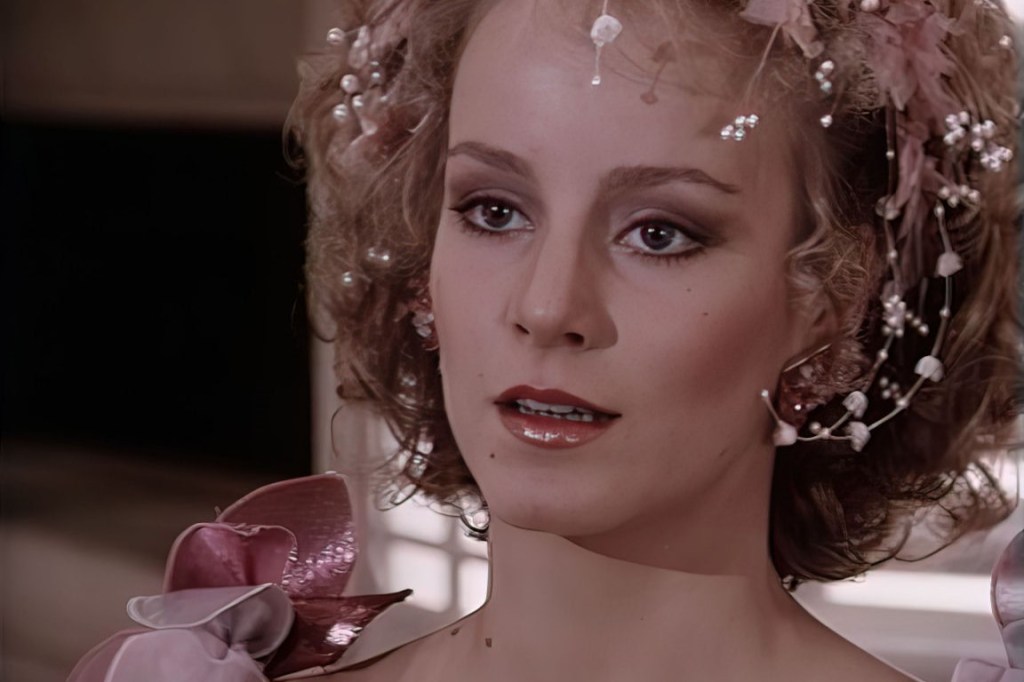
We all have strong memories of films and TV programmes that terrified us as youngsters. Youthful vampire Ralphie Glick paying a nighttime visit to his brother in the original mini-series of Salem’s Lot haunted me and many others from my generation for a great many years thereafter. Viewings of both the first versions of Invasion Of The Body Snatchers, Invaders From Mars and I Married A Monster From Outer Space, when I can’t have been much older than 8, really made me wonder if my family and friends weren’t really alien impostors, or had been taken over by extra-terresterials. And then there was V. It contains two moments which were real shockers at the time – Visitor leader Diana eating a live guinea pig, her face horribly stretching as she does [truth be told, the effect looks a bit naff now], and the birth of a reptilian baby after a traumatic build-up. But what did it for me was a scene where the Visitors have captured Julie the leader of the Resistance, and Diana tries to “convert” her by inflicting hallucinations on Julie’s mind, basing them on a childhood fear of being abandoned and chased, the idea being that she’ll beg Diana to stop and submit to her. Seeing this poor woman standing in this chamber [and wearing a spandex flesh coloured suit which makes it all a bit sexual] and being totally terrified and tortured while we see images of her running down corridors menaced by reptile-like monsters really got to me – and then just when you think it’s over, we return to the scene and Diana increases the intensity of the process further so that Julie has lights flashing on her face and she’s throbbing in the most horrible way. Despite being so scared that I didn’t even want to leave the lounge where I was on my own [mum and stepdad had decided that V wasn’t really their thing which was probably just as well], to go upstairs to bed, I know that I would have still raised the mother of all tantrums if I couldn’t see the next part the following night!

Said scene is still quite harrowing, aided immensely by Faye Grant’s very convincing performance. But aside from such highlights, how well does V hold up in general? I’m going to admit that I’d only watched it once between that 1983 and the last few evenings, that being on video. I wonder if the reason I didn’t buy it on DVD until a few weeks ago was that a new viewing would result in disappointment. But I needn’t have worried. While it certainly retains a strong cult following to this day, I feel that it deserves more attention and praise as a striking piece of television, and one that was pretty ambitious in its day. Like much of the best science fiction, it uses its premise to examine us. Even though I was quite up on history, I’m not sure that the really blatantly obvious parallels with Nazi Germany were apparent to me in 1984, but of course there'[s no doubt now that creator/director and producer Kenneth Johnson was not just simply telling a tale of a rather too easy Fascist takeover. He was examining how people would react to it, beginning with showing how easily people can be made to believe the lies that are told [need I say more?], then going on to portraying how folk can be lured in to help and support Fascism even when they know its true nature, while others will attempt to fight back. Of course we still have our totally good protagonists to root for and our totally evil ones to hiss at [relevant pun totally intended!], but nothing is simple. We see human nature at both its best and its worst, and we also have some friendly Visitors too. The series is constantly asking us what we would do in similar circumstances, and even dares to ask whether resisting is always the best choice. Moral dilemma is really the overriding thing, and this just doesn’t apply to the main premise. Of course if you haven’t seen V then I don’t want it to sound too heavy because it’s still a piece of exciting entertainment with lizard-like aliens disguised as humans, space ships, laser guns etc.

It actually wasn’t originally intended to be about aliens at all. Inspired by Sinclair Lewis’s 1935 and very timely novel It Can’t Happen Here, about a Fascist takeover of America, Johnson wrote an adaptation called Storm Warning in 1982 and presented it to NBC for production as a miniseries. However, the NBC executives decided that it was too “cerebral”, and that American viewers would never believe that another country could conquer them. Science fiction is popular though, so how about re-casting the US fascists as extraterrestrials? A few days into filming, Poltergeist‘s Dominique Dunne, who’d been signed to play the role of Robin Maxwell, was at her house with co-star David Packer going over lines for the next day’s filming, when her boyfriend John Sweeney suddenly arrived and choked Dunne into a coma. Five days later, she died. Blair Tefkin was cast to replace her and re-shoots were done, though if you look closely you can still make out Dunne in one early group scene when the Visitors arrive on Earth. The two-part miniseries drew huge viewing figures and turned NBC’s dwindling fortunes around. V: The Final Battle followed the next year, though Johnson left during production due to disagreements with NBC over the budget which he felt was too small to do his story justice. With him not around, his script was rewritten by six others and supposedly little of his material remains. A weekly TV series came after and one season, and I could never understand why, in the UK, ITV dumped it into a 10:30 pm time slot. In 2008, Johnson wrote his own sequel to V in novel form called V: The Second Generation, and tried to get Warner Bros. who now owned the rights, to make it. Warner instead opted for a remake series – and I gave up on it after the first episode with its rushed storytelling and near lack of older characters. Since then, Johnson has been trying to get a three-part big-screen remake off the ground.

We all raved about V at school, though of course the main debate between us boys was who was “fittest” out of the several babes in it. For me, it was and still is Jane Balder [who was actually the last person to be cast] as Diana, who likes to shoot others in the arm first so their deaths are drawn out and they feel more pain. She plays the part with great conviction without hamming it up, and even manages to make us feel some of this monster’s irritation when others try to usurp her. Of course this being 1984, her lesbian leanings are just a way to make her seem more villainous. Out of her cohorts good and bad, the one who stands out is a certain Robert Englund as the friendly, sweet but goofy Willie, a nicely judged comic performance by the guy who would go on to play an iconic horror villain who also has a humorous side. The leader of the fight against the Visitors might be the afore-mentioned Julie Parrish, but top billed is Marc Singer as Mike Donovan A daredevil cameraman who always putting himself in danger, is handy in a fight but is also liked by the ladies, he seemed to us the epitomy of cool back in 1984 but actually looks a bit of a t*** now the way he walks around with his shirts open to show off a bit of his chest. He has an on and off relationship with Kristine Walsh, a journalist who becomes the Visitor’s spokesperson. Donovan’s mother Eleanor seems to quickly go even further over to the Visitor’s side. You could say that with those two cases it’s a matter of fame and status respectively, but how about Daniel Bernstein, who is perhaps the most interesting character in the whole thing? He’s a teenage boy who joins a movement called the Friends of the Visitors akin to the Hitler Youth. Very well played by David Parker as exactly the kind of lonely, disaffected youth susceptible to getting involved with dodgy organisations, he features in some of the most powerful moments when he lords it over his parents and guns down characters we like in cold blood.

The cast is large and very racially diverse for the time, enhancing the scale of the show even if some of the characters are stock and shots of other countries are clearly stock footage. Most people, many of whom are later shown to be related to each other, are given quick, to the point introductions, but things take quite a while to really kick off even if we open with a cracking action sequence that introduces Mike escaping from soldiers in El Salvador, a scene shot in the same location as that terrible accident that took place a year before when Vic Morrow and two kids were decapitated by a helicopter rotor blade during the making of Twilight Zone: The Movie. I imagine that some now may find the first part too slow, but I can’t say that I did back in 1984. Right from the offset there’s a feeling that something could be off, and I feel that it had to be quite leisurely to show how comfortably the Visitors ease their way into power and to build up the suspense until Donovan boards that ship and gets into a fight which ends with him tearing the side off his opponents face revealing scaly, reptilian skin underneath, then seeing Diana eat that mouse while she discusses takeover with others. Of course the whole reptile thing is a bit daft really because there’s no way those faces could be properly disguised by human masks. Donovan now has to go on the run because he’s been declared a fugitive by the media. Media control is another important theme, it’s returned to throughout and is yet another thing which ensures that V doesn’t really date that much aside from the obvious things like no mobile phones, and remains timely. Donovan eventually finds himself with some other hunted folk and a motley resistance movement begins to form, possibly one of many throughout the world, but it seems that their efforts could be in vain even when Micheal Ironside, in typically formidable form as demolitions expert Ham Tyler, the arrogant hard man who you know is also the real deal, joins their ranks.

The way that Donovan is able to continually sneak on and off the same spaceship gets laughable as does his immediate ability to fly an alien craft, and the socio/political commentary does lessen as the focus becomes more on gun battles, chases, fifth columnists on both sides, and poor teenager Robin Maxwell, seduced by a Visitor as one of Diana’s experiments and about to give birth to – something. This subplot is powerfully handled and both heartbreakingly and harrowingly acted by Blair Tefkin. In both my previous viewings, it never occurred to me that parts three, four and five comprised a different series written and directed by other people despite certain minor details like Diana’s new hair style, some different music, and the total disappearance of what seemed to be the beginning of an important subplot right at the end of part two involving humans trying to contact the other alien race that the Visitors are battling. Watching again with this knowledge, there are a few other noticeable things. The matte work during spaceships flying isn’t quite as good and there are more repeated shots, indicating a lower budget. The writing isn’t often as strong, there being nothing as good as the brilliantly scripted scenes earlier where Daniel’s grandfather, Holocaust survivor Abraham, reminds his son Stanley that people have to stay with them or “we haven’t learned a thing”, and when Abraham’s wife Lynn reads out his impassioned, inspirational letter that he left before he was captured by the Visitors. One potentially powerful subplot of Donovan’s son Sean being a spy fails to give us the confrontation you expect. Things still generally look and feel similar though, and we’re still given issues to think about such as whether it’s worth sacrificing thousands for millions, along with plenty of great moments. They even get away with a device borrowed from The War Of The Worlds – I mean how many other believable ways to get rid of aliens can there be?

The ball is only really dropped in the very last episode where it’s clear that they didn’t know what to do with the “starchild” character, leading to a silly deux ex machina finale – did they have no ending and use the first idea that somebody came up with? However, up to then, V remains a considerable achievement, and it’s not total and utter seriousness either, with several amusing touches like one of these space invaders playing space invaders. I love the human Harmony Moore’s sweet and honest simple declaration of love to the Visitor Willie, who’s been used as a guinea pit by the resistance. She’s seen his “true colours”, yet isn’t put off, saying to him “I didn’t fall in love with you for your looks”. Even if there are some shots that couldn’t be completed on time, and the mother ship isn’t even a model it’s a matte painting, the special effects overall are comparable to many theatrically released films of the period, and there are so many strong performances – I haven’t yet, for example, mentioned Rafael Campos as Sancho Gomez, the Mexican gardener whose expertise in smuggling people in his truck becomes handy. The scoring is usually fairly good despite the using of motifs from Beethoven and Wagner, while the low amount of close-ups and the variety of shots along with the widescreen filming helps it to feel quite cinematic. On TV it was of course shown open matte where apparently boom mikes were visible – though I can’t say that I remember. I’m sure that this planned movie trilogy of V could be amazing, while of course some of the issues it looks at are still important but, like the TV version of It, this V still has a great deal to recommend it and will probably be more beloved by some. It manages very well the difficult task of balancing considerable escapism with having a lot to make you think about – and worry.

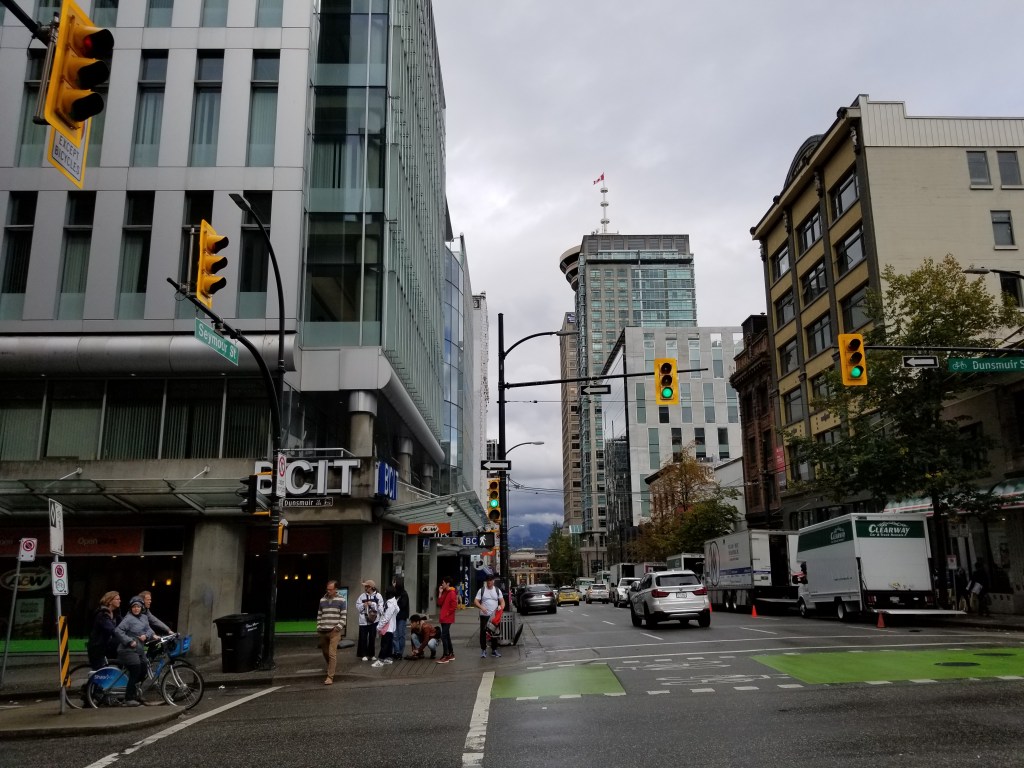
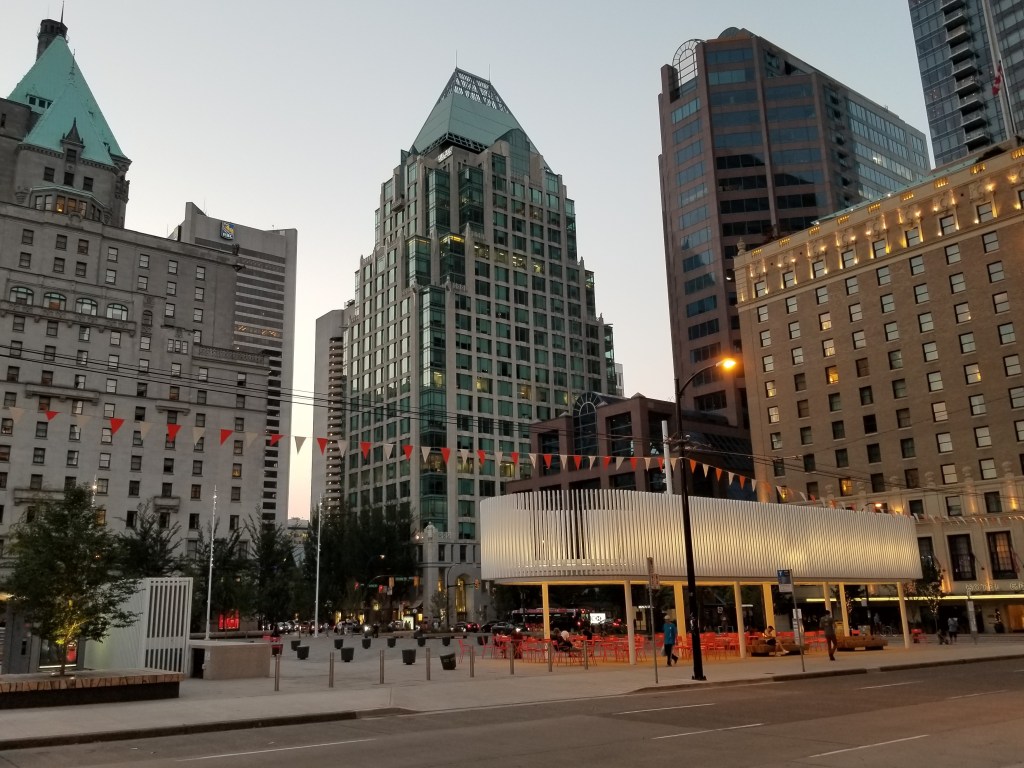
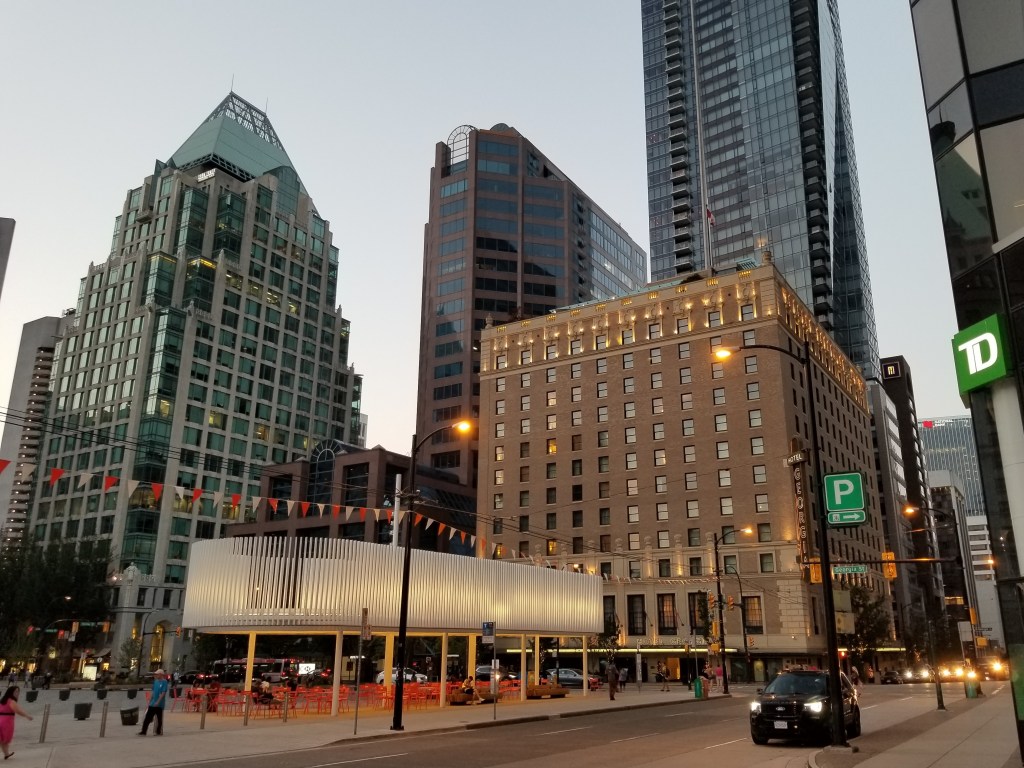
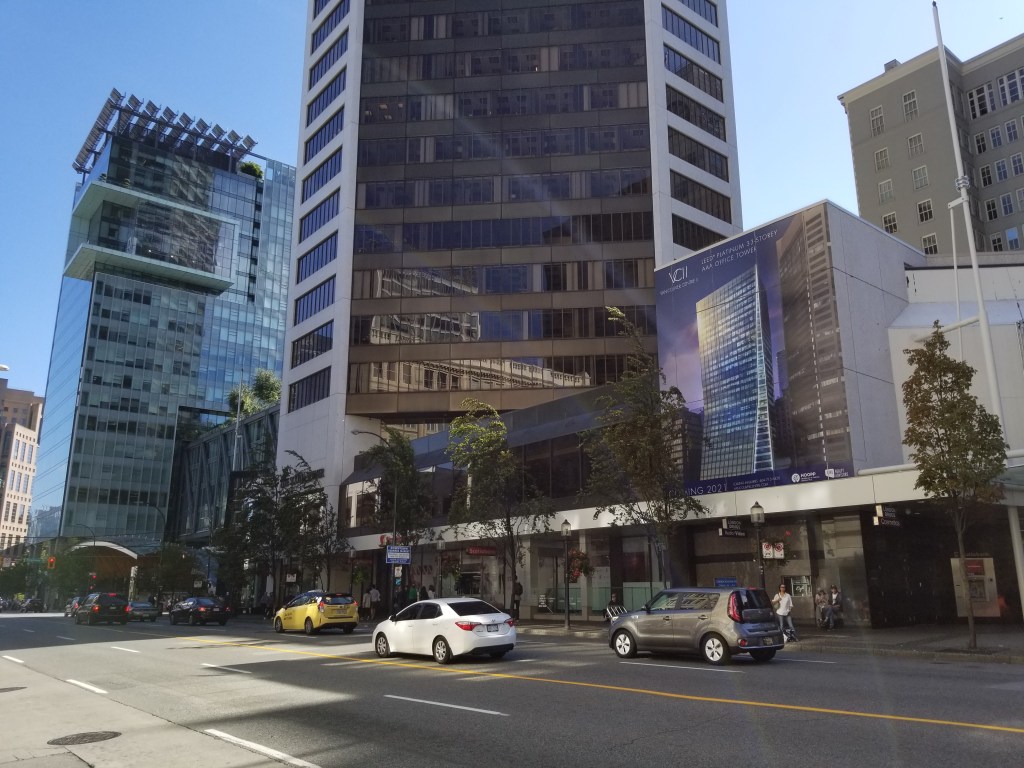
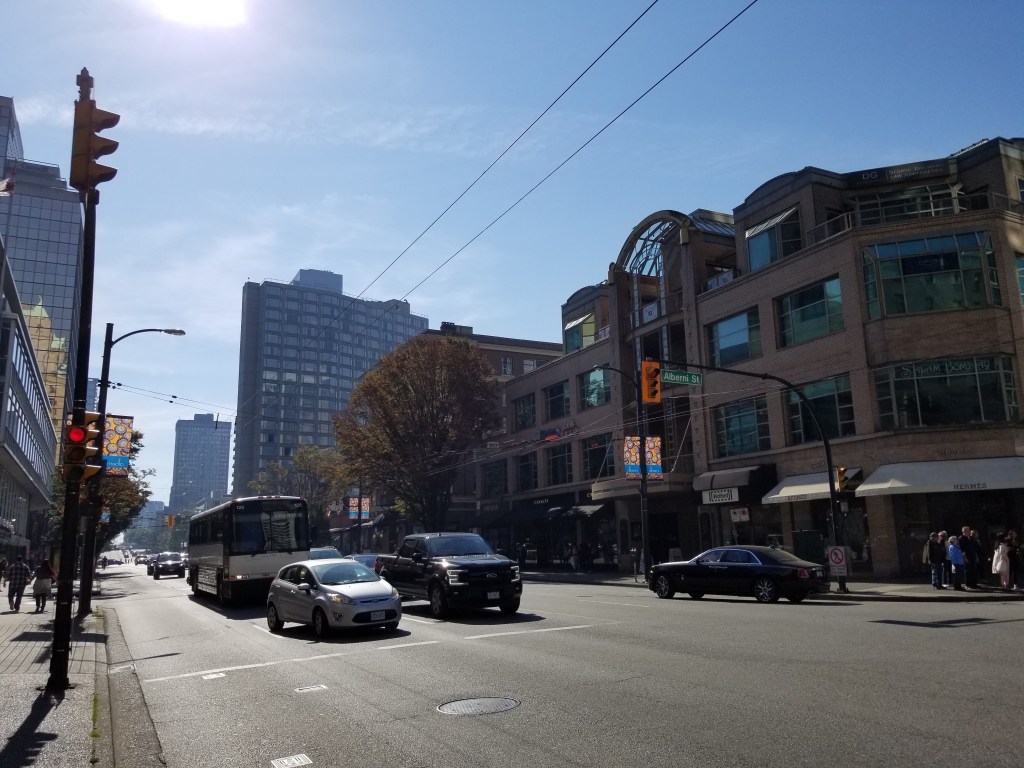
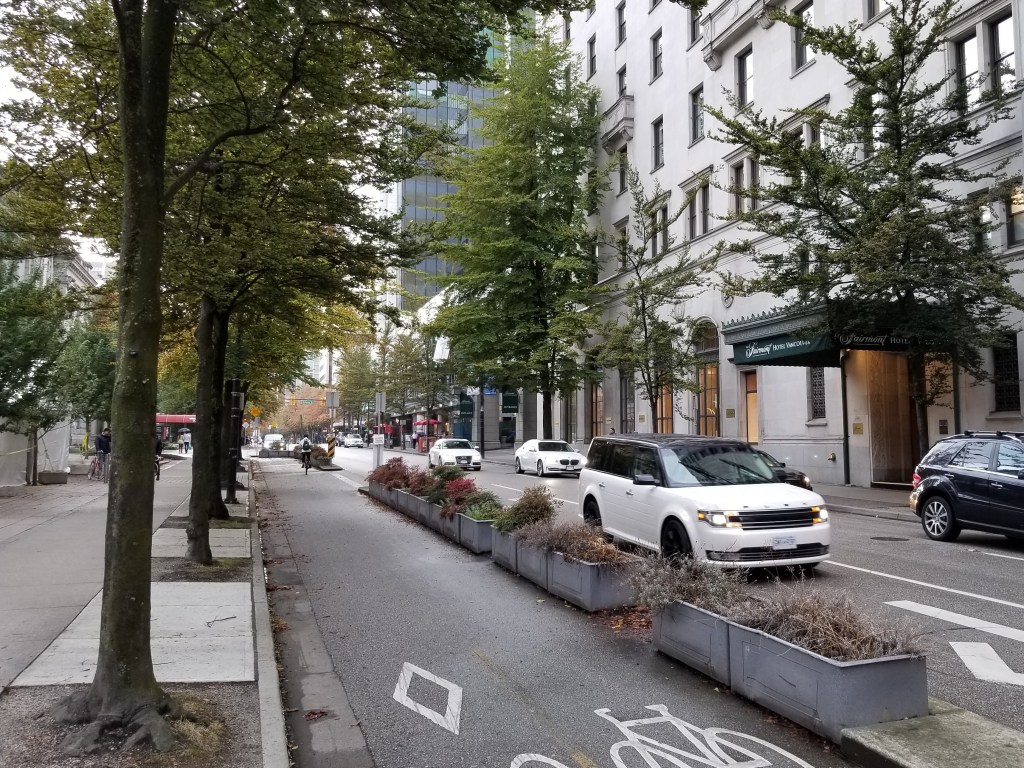
On Dunsmuir Street in Downtown Vancouver. Summer of 2018.

Dunsmuir Street is a major east-west street in downtown Vancouver, British Columbia, running through the heart of the city’s central business district. It stretches from Burrard Street in the west to Cambie Street in the east, where it transitions into Dunsmuir Viaduct, connecting to Prior Street and the Georgia Viaduct. Dunsmuir Street is a key arterial route, parallel to other prominent downtown streets like Georgia Street to the north and Robson Street to the south.

Dunsmuir Street is named after Robert Dunsmuir, a prominent 19th-century Scottish-Canadian coal magnate and politician who played a significant role in British Columbia’s industrial history, particularly through his development of coal mines on Vancouver Island and his involvement in the construction of the Esquimalt and Nanaimo Railway.

Dunsmuir Street was established as part of Vancouver’s early grid system in the late 19th century, a period when the city was rapidly growing due to the arrival of the Canadian Pacific Railway (CPR) in 1887. The street’s naming reflects the influence of figures like Robert Dunsmuir, whose wealth and political clout shaped much of BC’s early economic landscape.

Over the decades, Dunsmuir Street evolved from a relatively modest thoroughfare into a central artery in Vancouver’s downtown core. By the mid-20th century, it was surrounded by commercial buildings, and by the late 20th century, it became a hub for office towers, cultural institutions, and transit connections, reflecting Vancouver’s growth into a major metropolitan center.

The City of Vancouver has been working on a project to improve Dunsmuir and Melville Streets, focusing on the stretch between Hornby Street and the Coal Harbour Seawall. This initiative, part of the Downtown Bike Network Expansion, aims to make the area safer and more accessible for walking, biking, and rolling (e.g., using wheelchairs or scooters). Public engagement for this project concluded on October 6, 2024, with the city collecting feedback through surveys and in-person events. An engagement summary was expected to be released in late 2024 or early 2025, which should now be available as of May 2025. Construction is slated to begin in 2026, indicating that preparatory work, such as final design approvals, might be underway now. The upgrades will enhance connectivity between key routes, improving access to the Coal Harbour Seawall, a popular recreational area along the waterfront.

Dunsmuir Street is home to several notable buildings, including Bentall Centre (near Burrard Street). It’s a complex of office towers that houses major corporations and is a focal point for business activity. 500 Dunsmuir Street is associated with the Holborn Group of Companies, a real estate firm. The building itself is likely a commercial property, reflecting the street’s role in Vancouver’s business district. Dunsmuir Street is close to cultural landmarks like the Vancouver Art Gallery (on Georgia Street, just north of Dunsmuir) and public spaces like Robson Square, accessible via nearby streets. The Hyatt Regency Hotel is located near Burrard and Dunsmuir, making the area a hub for tourists as well as locals. Retail options, such as those at The Bay store on Granville Street (accessible via Dunsmuir), also contribute to the street’s vibrancy.

Dunsmuir Street is a busy route for vehicular traffic, particularly during rush hours, as it serves as a primary east-west corridor for commuters heading to or from the central business district. The ongoing Dunsmuir/Melville Street upgrades highlight the city’s focus on improving cycling infrastructure. Dunsmuir Street already has a protected bike lane for much of its length, a feature introduced in 2010 as part of Vancouver’s push to become a bike-friendly city. The 2026 upgrades will likely enhance these facilities further. In addition to SkyTrain stations, Dunsmuir Street is served by multiple bus routes, and its proximity to the Granville transit mall (on Granville Street) makes it a key node for public transit users.

The planned upgrades starting in 2026 will likely cause temporary disruptions on Dunsmuir Street, such as lane closures or detours, but the long-term benefits include improved safety and accessibility for all users. Vancouver’s focus on sustainable transit and walkable streets suggests that Dunsmuir Street will continue to evolve into a more eco-friendly corridor, potentially with features like expanded bike lanes, more greenery, and better integration with public transit. As downtown Vancouver grows, Dunsmuir Street may see increased development, such as new high-rises or mixed-use projects, though the city’s emphasis on preserving views and public spaces will likely temper this growth.

Dunsmuir Street’s viaduct section, the Dunsmuir Viaduct, has been a point of contention in Vancouver’s urban planning debates. Some city planners and residents have advocated for its removal (along with the Georgia Viaduct) to reclaim land for parks or housing, a proposal that gained traction in the 2010s and 2020s. As of May 2025, no final decision has been widely publicized, but this could be a future change to watch for.

Dunsmuir Street is a vital part of Vancouver’s downtown core, blending historical significance with modern urban functionality. It’s a hub for business, transit, and cultural activity, and the ongoing upgrades (set to begin in 2026) will enhance its role as a pedestrian- and cyclist-friendly corridor. Its proximity to landmarks like the Bentall Centre, SkyTrain stations, and the Coal Harbour Seawall makes it a central artery in the city’s daily life.

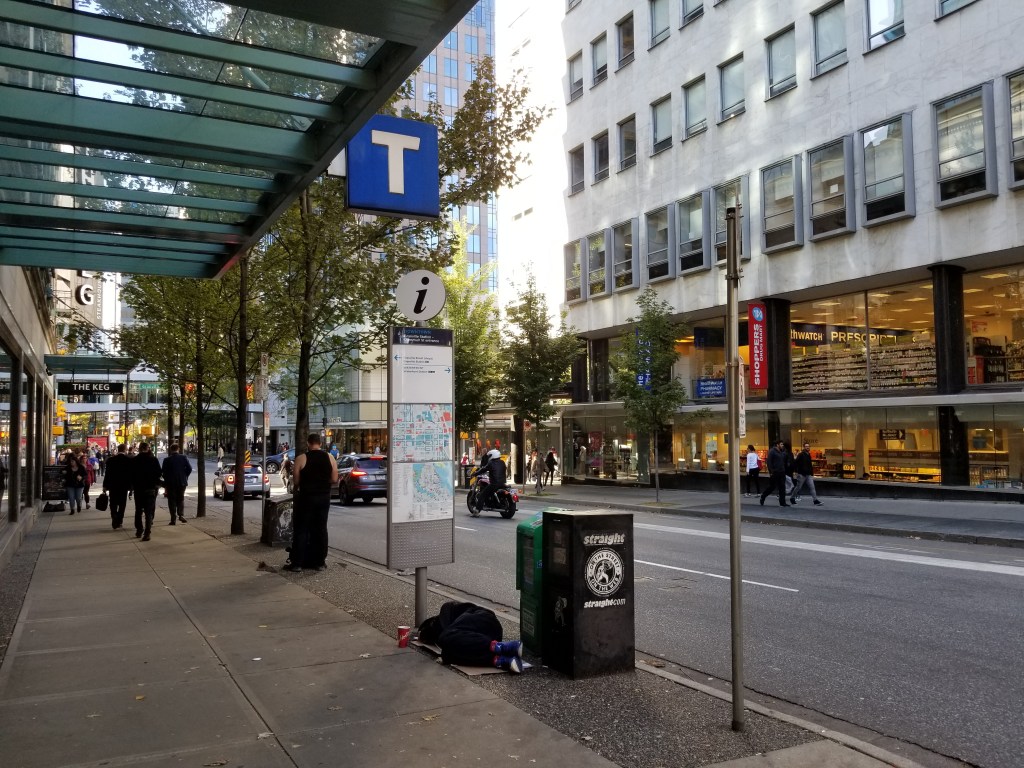
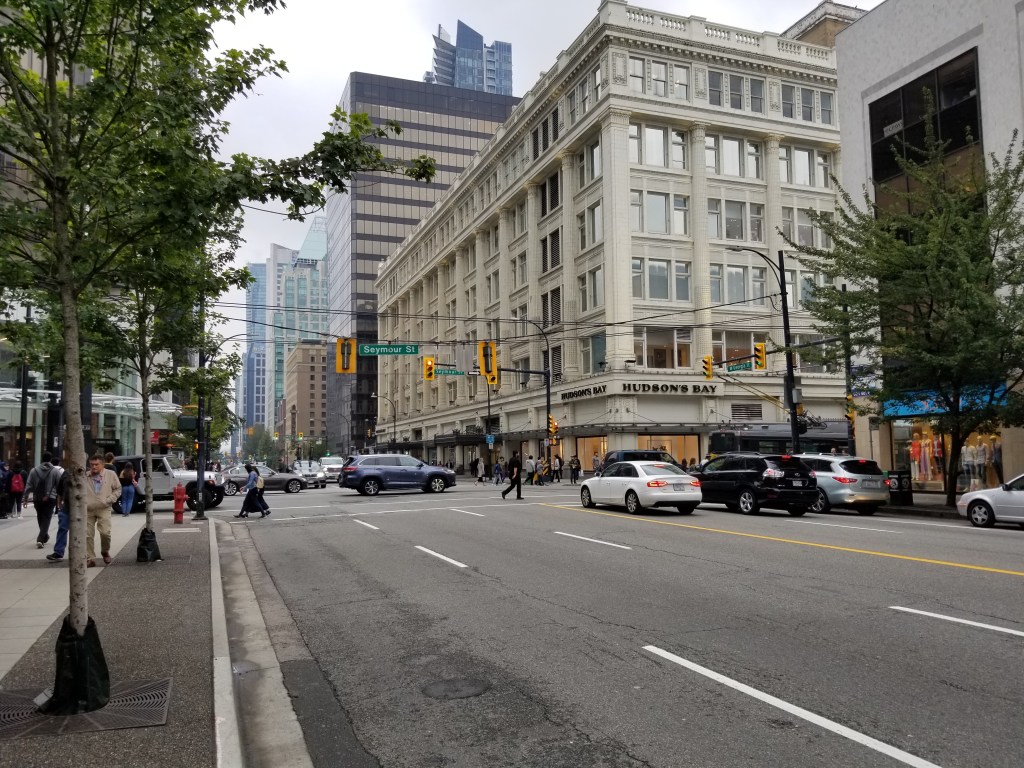
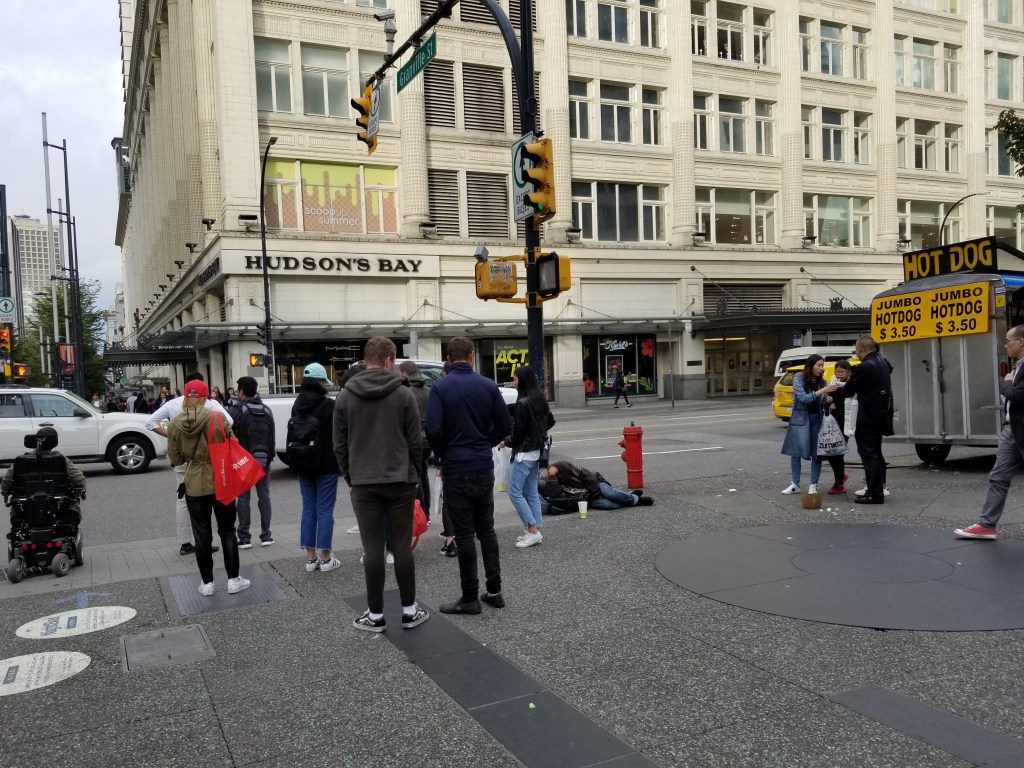
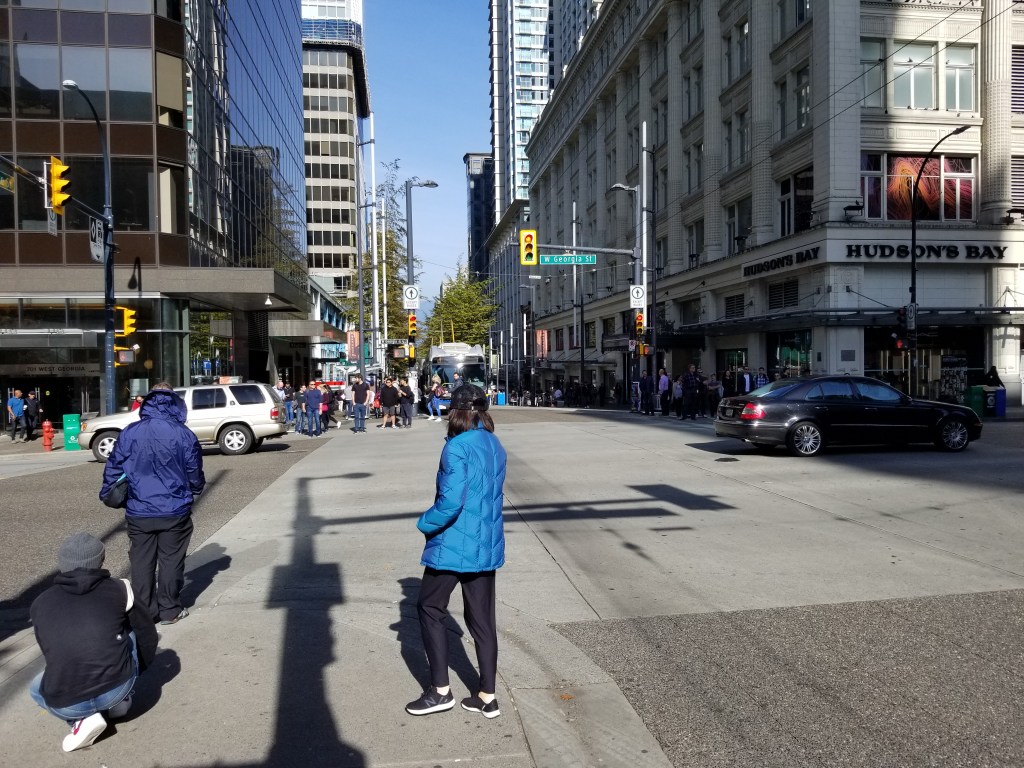
On Georgia Street in Downtown Vancouver. Summer of 2018.

Georgia Street is an east–west street in the cities of Vancouver and Burnaby, British Columbia, Canada. Its section in Downtown Vancouver, designated West Georgia Street, serves as one of the primary streets for the financial and central business districts, and is the major transportation corridor connecting downtown Vancouver with the North Shore (and eventually Whistler) by way of the Lions Gate Bridge. The remainder of the street, known as East Georgia Street between Main Street and Boundary Road and simply Georgia Street within Burnaby, is more residential in character, and is discontinuous at several points.

West of Seymour Street, the thoroughfare is part of Highway 99. The entire section west of Main Street was previously designated part of Highway 1A, and markers for the ‘1A’ designation can still be seen at certain points.

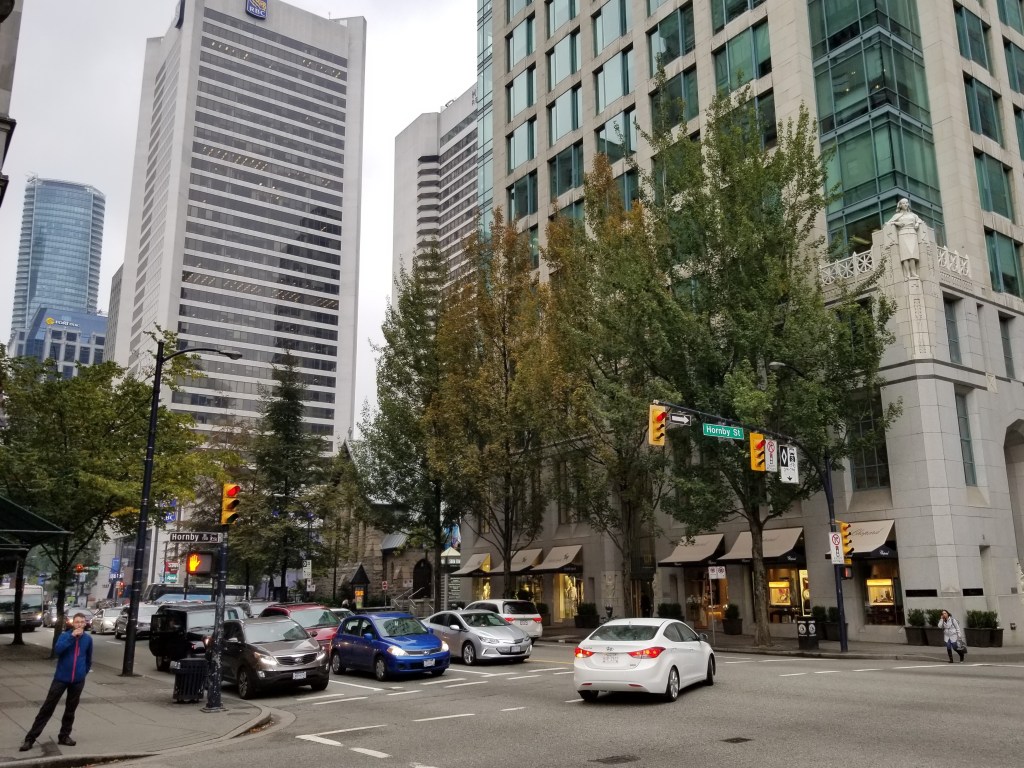
Starting from its western terminus at Chilco Street by the edge of Stanley Park, Georgia Street runs southeast, separating the West End from the Coal Harbour neighbourhood. It then runs through the Financial District; landmarks and major skyscrapers along the way include Living Shangri-La (the city’s tallest building), Trump International Hotel and Tower, Royal Centre, 666 Burrard tower, Hotel Vancouver and upscale shops, the HSBC Canada Building, the Vancouver Art Gallery, Georgia Hotel, Four Seasons Hotel, Pacific Centre, the Granville Entertainment District, Scotia Tower, and the Canada Post headquarters. The eastern portion of West Georgia features the Theatre District (including Queen Elizabeth Theatre and the Centre in Vancouver for the Performing Arts), Library Square (the central branch of the Vancouver Public Library), Rogers Arena, and BC Place. West Georgia’s centre lane between Pender Street and Stanley Park is used as a counterflow lane.

East of Cambie Street, Georgia Street becomes a one-way street for eastbound traffic, and connects to the Georgia Viaduct for eastbound travellers only; westbound traffic is handled by Dunsmuir Street and the Dunsmuir Viaduct, located one block to the north.

East Georgia Street begins at the intersection with Main Street in Vancouver’s Chinatown, then runs eastwards through Strathcona, Grandview–Woodland and Hastings–Sunrise to Boundary Road. East of the municipal boundary, Georgia Street continues eastwards through Burnaby until its terminus at Grove Avenue in the Lochdale neighbourhood. This portion of Georgia Street is interrupted at several locations, such as Templeton Secondary School, Highway 1 and Kensington Park.

Georgia Street was named in 1886 after the Strait of Georgia, and ran between Chilco and Beatty Streets. After the first Georgia Viaduct opened in 1915, the street’s eastern end was connected to Harris Street, and Harris Street was subsequently renamed East Georgia Street.

The second Georgia Viaduct, opened in 1972, connects to Prior Street at its eastern end instead. As a result, East Georgia Street has been disconnected from West Georgia ever since.

On June 15, 2011 Georgia Street became the focal point of the 2011 Vancouver Stanley Cup riot.

Lost Decade in Japan: History and Causes

https://www.investopedia.com/terms/l/lost-decade.asp

The Lost Decade is commonly used to describe a period in Japan beginning in the 1990s, during which economic stagnation became one of the longest-running economic crises in recorded history. Later decades are also included in some definitions, with the period from 1991 through 2011 (or even through 2021) sometimes being referred to as Japan’s Lost Decades.

Key Takeaways

  • The Lost Decade originally referred to an extended period of slow to negative economic growth, lasting almost ten years, in Japan’s economy during the 1990s.
  • Stagnant growth in subsequent years has led the period since 1991 to sometimes be referred to as Japan’s Lost Decades.
  • Misguided government policies in response to a real estate bubble are considered to be the main culprits for the Lost Decade.
  • Within the US economy, the first decade of the 21st century, which was bookended by two stock market crashes, is often compared to Japan’s Lost Decade.

Understanding the Lost Decade

The Lost Decade is a term initially coined to refer to the decade-long economic crisis in Japan during the 1990s. Japan’s economy rose meteorically in the decades following World War II, peaking in the 1980s with the largest per capita gross national product (GNP) in the world. Japan’s export-led growth during this period attracted capital and helped drive a trade surplus with the U.S.

To help offset global trade imbalances, Japan joined other major world economies in the Plaza Agreement in 1985. In accord with this agreement, Japan embarked on a period of loose monetary policy in the late 1980s. This loose monetary policy led to increased speculation and a soaring stock market and real estate valuations.

In the early 1990s, as it became apparent that the bubble was about to burst, the Japanese Financial Ministry raised interest rates, and ultimately the stock market crashed and a debt crisis began, halting economic growth and leading to what is now known as the Lost Decade. During the 1990s, Japan’s gross domestic product (GDP) averaged 1.3%, significantly lower as compared to other G-7 countries. Household savings increased. But that increase did not translate into demand, resulting in deflation for the economy.

The Lost Decades

In the following decade, Japan’s GDP growth averaged only 0.5% per year as sustained slow growth carried over right up until the global financial crisis and Great Recession. As a result, many refer to the period between 1991 and 2010 as the Lost Score, or the Lost 20 Years.

From 2011 to 2019, Japan’s GDP grew an average of just under 1.0% per year, and 2020 marked the onset of a new global recession as governments locked down economic activity in reaction to the Covid-19 pandemic. Together the years from 1990 to the present are sometimes referred to as Japan’s Lost Decades.

The pain is expected to continue for Japan. According to research from the Federal Reserve Bank of St. Louis, recent growth rates imply that Japan’s GDP will double in 80 years when previously it doubled every 14 years.

What Caused The Lost Decade?

While there is some agreement on the events that led up to and precipitated the Lost Decade, the causes for Japan’s sustained economic woes are still being debated. Once the bubble burst and the recession took place, why did persist through successive years and decades? Demographic factors, such as Japan’s aging population, and the geopolitical rise of China and other East Asian competitors may be underlying, non-economic factors. Researchers have produced papers delineating possible reasons why the Japanese economy sank into prolonged stagnation.

Keynesian economists have offered several demand-side explanations. Paul Krugman opined that Japan was caught in a liquidity trap: Consumers were holding onto their savings because they feared that the economy was about to get worse. Other research on the subject analyzed the role played by decreasing household wealth in causing the economic crisis. “Japan’s Lost Decade,” a 2017 book, blames a “vertical investment-saving” curve for Japan’s problems.

Monetarist economists have instead pointed to Japan’s monetary policy before and during the Lost Decade as too restrictive and not accommodative enough to restart growth. Milton Friedman wrote, in reference to Japan, that “the surest road to a healthy economic recovery is to increase the rate of monetary growth to shift from tight money to easier money, to a rate of monetary growth closer to that which prevailed in the golden 1980s but without again overdoing it. That would make much-needed financial and economic reforms far easier to achieve.”

Despite these various attempts, Keynesian and Monetarist views on Japan’s extended economic malaise generally fall short. Japan’s government has engaged in repeated rounds of massive fiscal deficit spending (the Keynesian’s solution to economic depression) and expansionary monetary policy (the Monetarist prescription) without notable success. This suggests that either the Keynesian and Monetarist explanations or solutions (or both) are likely mistaken.

Austrian economists have, on the contrary, argued that a period of extended economic stagnation is not inconsistent with Japan’s economic policies that throughout the period acted to prop up existing firms and financial institutions rather than letting them fail and allowing entrepreneurs to reorganize them into new firms and industries. They point to the repeated economic and financial bailouts as a cause of—rather than a solution to—Japan’s Lost Decades.

What Is Japan’s GDP Growth Rate?

As of the first quarter of 2024, Japan’s annual GDP growth rate stood at a negative 0.2 percent compared to the same period one year prior. This indicates that the country’s GDP contracted slightly rather than growing.

How Big Is Japan’s Economy?

As of 2024, Japan boasts the world fourth-largest economy, behind the United States, China, and Germany.The country’s economy is characterized by a strong manufacturing sector and exports.

What Is Japan’s Lost Generation?

The “Lost Generation” is a concept closely related to Japan’s Lost Decades. The term refers to those Japanese university graduates who entered the economy during the employment freezes characteristic of the Lost Decades. This primarily includes people who graduated in the 1990s and 2000s. As a consequence of these circumstances, members of the Lost Generation may have had to take on low-wage temporary work over stable employment with robust retirement benefits—teeing up a potential pension crisis for the nation.

The Bottom Line

The Lost Decade, also known as the Lost Decades, refers to an extended stretch of economic stagnation in Japan beginning in the early 1990s. This era of poor economic performance has been characterized by low GDP growth, recessions, and deflation. Economists have posited multiple hypotheses to attempt to understand and explain the root causes and potential solutions of Japan’s economic downturn.