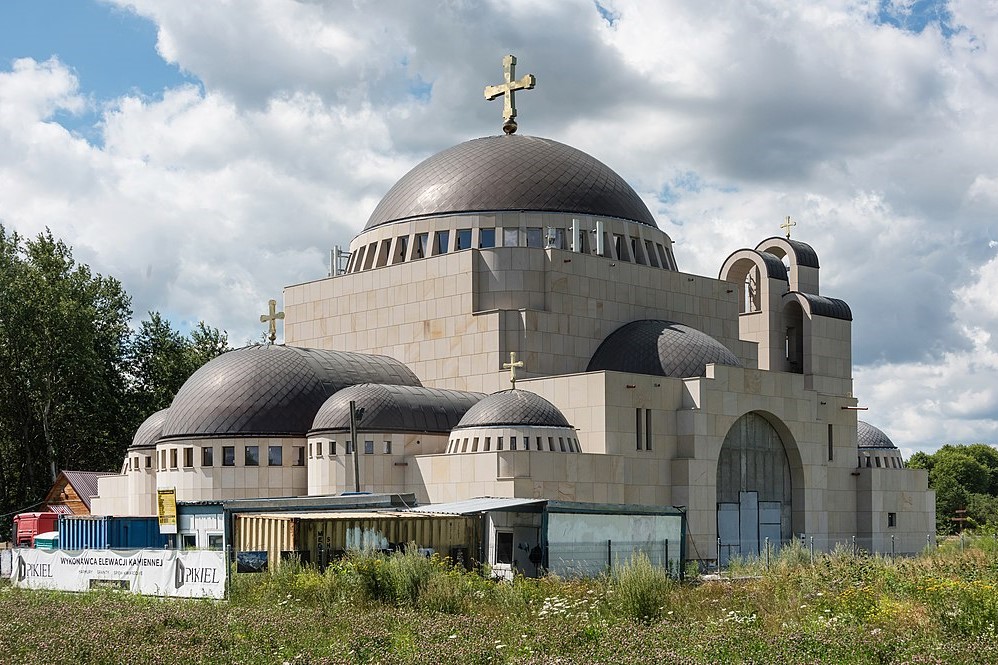
The first new Orthodox church to be built in Warsaw for over 100 years opened yesterday. It is now the third in Poland’s capital, serving a growing number of Orthodox believers.
Both its name – Hagia Sophia – and its outer appearance refer to its famous namesake in Istanbul, which was originally built as a Byzantine cathedral, converted to a mosque by the Ottoman Turks, then deconsecrated into a museum in 1934 – and finally again turned into a mosque in July this year.
The church is located in southern Warsaw, near the Ursynów and Wilanów districts. Its location will save nearby worshippers from longer trips to the city’s other two Orthodox churches: the 19th-century Metropolitan Cathedral of St Mary Magdalene in the Praga district, and the church of Saint John Climacus in Wola, built in 1905. There are also several smaller chapels dispersed around the capital.
The last Orthodox church to be built in Warsaw was opened in 1912, when the city was part of the Russian Empire.
The Alexander Nevsky cathedral – which was then Warsaw’s tallest building and located at the heart of the city in what is today Piłsudski Square – was demolished in the 1920s after Poland regained its independence, along with many other Orthodox places of worship.
At the opening of the new building, Archbishop Sawa – the head of the Polish Orthodox Church – said that it would be dedicated to Polish Orthodox believers “over the centuries” and “especially those who died in camps in the east and west, and those who, strong in faith, gave their lives during the Warsaw Uprising”.
The parish priest, Adam Siemieniuk, says that the new church should “be a tribute to the cradle of Christianity, which is the Hagia Sophia [in Istanbul],” reports Radio Plus.
The temple’s construction began in 2015. Earlier this year, its western bell tower and nine bells were consecrated, but services took place in a temporary wooden chapel near the building site. Now the church itself is open for services, with only final touches being made to the interior.
The building was designed by Andrzej Markowski, who died last year. It is 35 metres wide, with a dome limited to being only 22 metres high, as it stands on the approach path for planes landing at the nearby Chopin airport.
The new church was funded entirely from collections among Orthodox believers. “We did not receive any funds from the state budget, so we can say that the whole thing was financed by our Orthodox community,” said Siemieniuk, quoted by Nasze Miasto, a local news site.
The church will also function as the venue for a Sunday school for Orthodox children.
The current Polish Orthodox Church was established in 1924, and has been headed by Archbishop Sawa since 1998. It claims to have around 500,000 members, although exact figures are difficult to come by.
According to data from the 2011 census, membership stood at 150,000, including 40,000 in Warsaw. However, an estimate for 2019, published earlier this year by Statistics Poland (GUS), a government agency, put the church’s membership at just over 500,000.
A separate recent report by GUS estimates the number of all Orthodox believers in Poland at 0.9% of the population (up from 0.7% in 2016), which would mean around 400,000.
One reason for growing numbers of Orthodox faithful in recent years has been the unprecedented influx of Ukrainian immigrants, an estimated 1.35 million of whom now live in Poland.
Having been battered, bullied, burned and bombed so many times in the past it’s perhaps surprising that possibly the grandest pre-war structure in Warsaw was actually torn down by the locals, no less than 14 years after it was completed.
Commissioned by the Governor General of Poland, Joseph Vladimirovich Gourko, work commenced on St. Alexander Nevsky Cathedral in 1893 and continued until 1914. Earmarked to serve as place of worship for Warsaw’s ruling Russian community the building was the work of the architect Leontij Benois, a professor in The Tsarist Academy of Fine Arts in St Petersburg.
The site, on what is today Pl. Piłsudskiego was not chosen by accident; in 1840 the same patch of land was occupied by an obelisk commemorating Polish generals who had collaborated with the Russians during the 1830 November Uprising. It was financed by huge taxes levied by the insufferable Gourko, as well as a collection of funds ordered by Tsar Alexander III, though Russia’s looming economic crisis meant that construction took 18 years.
The results though were staggering. Consisting of five gold plated domes, and a 70 metre bell tower (then the tallest building in Warsaw), the cathedral proved even more dazzling on the inside. Raising comparisons to St. Mark’s in Venice, copper and oak main doors led to an interior dripping with oil paintings and icons. Sixteen mosaic panels were designed by Viktor Asnetsov, and the building was heavily adorned with precious stones. The cathedral operated as a Russian shrine until 1915 when Warsaw was captured by German forces. The next three years saw it function as a German military church, though the moment Poland gained independence plans were floated to demolish this symbol of Russian hegemony. The debate on what to do with it reigned for years, with arguments including that the building had no artistic value, that the square needed to be freed up for military parades and that the foundations were already sinking.
Finally in 1922 the tower was taken down, and between 1924-1926 some 15,000 detonations were set off to rid Warsaw of the cathedral. Not one to miss a mark, the Warsaw magistrate sold public bonds so as to allow every Pole the chance to take part in the iconoclasm. The resulting rubble was used to strengthen the banks of the Wisła and the rescued Finnish granite put to effect in many Warsaw churches.
Of the surviving decorations a few of the mosaics can now be viewed at the St. Mary Magdalene Church in Praga (one of only two Warsaw orthodox churches to survive the 20s), pulpit and altar pieces in the Sts. Peter and Paul Church in Pyry and icons in the Pokrovy Orthodox Church in Baranowicze, Belarus.
Leroy Fletcher Prouty (January 24, 1917 – June 5, 2001) served as Chief of Special Operations for the Joint Chiefs of Staff under President John F. Kennedy. A former colonel in the United States Air Force, he retired from military service to become a bank executive, and subsequently became a critic of U.S. foreign policy, particularly the covert activities of the Central Intelligence Agency (CIA) about which he had considerable inside knowledge. Prouty was the inspiration for the character “Mr. X” in Oliver Stone’s movie JFK.
Being a fan of the Dead Space series, I couldn’t help but pre-order the game (getting the free upgrade to the Limited Edition in the process) and making sure we got you the skinny you need as soon as possible. Many necromorph impalements later, we bring you Dead Space 3 in all its glory.
Dead Space 3 is rated “M” for Mature. Also note that, while I will keep spoilers to a minimum, there are a couple of things I will be giving away. I’ll try to make it only things that you will learn within the first ten minutes anyway.
Story:
It’s now two years after the events of Dead Space 2. The Unitology movement is as strong as ever and our hero, Isaac Clarke, has been laying low; trying to forget the markers and everything he’s seen. While we’ve been gone, Clarke has been hiding from the government, from the Unitologists and probably from himself too. All of that is about to change.
Isaac is cornered in his apartment by some soldiers claiming to be part of the last of the government’s military. We soon learn that Jacob Danik, the leader of the Unitology movement, has led a worldwide riot against the government and they are trying to release any and all markers in existence. Danik is played by none other than Simon Templeman, who has been awesome forever and has lent that awesomeness to videogames for years now. Some examples include Absalom in Darksiders II, Admiral Han’Gerrel vas Neema in Mass Effect 2 and Mass Effect 3, General Threnoldt in Star Wars: The Old Republic and the voice of Kain in the Legacy of Kain series (which I personally wish was still ongoing).
Gunner Wright and Sonita Henry both return to their roles as Isaac Clarke and Ellie Langford and Ricardo Chavira is the voice of Sgt. John Carver, who is the character the second player can use for cooperative play, which I also think is awesome. Coming from a guy who’s girlfriend is a Zombie Apocalypse Geek, being able to shoot space zombies (necromorphs, for purists out there) together is always a plus.
Gameplay:
The interface is the same, though the opening menu screen has a darker, grungier look to it. That goes perfectly with the story once you get started though. The rest of the interface is quicker and just as easy to use. Because of the circumstances in the story, it allowed them to change the upgrading of the suits and weapons and they did it in a very modular and interesting way.
Instead of simply having set things you can add to particular guns, they’ve made Dead Space 3 much more customizable. To start, you can create your own weapons with seemingly endless configuration possibilities. My favorite creation was a semi-automatic machine gun with a shotgun attachment, that allowed for fast shots as well as a show stopper if needed or if a necromorph got too close for comfort. Not only is the creation innovative, but you also have improvement slots with circuits you find or create yourself. As you find different kinds of circuits or plans for different gun styles and types, Isaac learns to build different circuits out of spare parts found all over. While I didn’t take advantage of this as much as I would have liked, it was still much more imaginative and far more personalized than we could have expected from previous Dead Space upgrades. I thought it was pretty awesome. You can also create schematics for the weapons you create and then share those schematics with your friends online.
Graphics:
What can I say about the graphics? They are beautiful. Definitely a good notch up from Dead Space 1 and 2, while still retaining the style we have come to love and expect. Isaac is looking a little frayed, with a beard and a little age showing (probably all the stress), but that doesn’t stop him from getting everything done.
The space walks and space flights in zero gravity are still my favorite and they showcase the graphics especially well, but there are a few new twists with things like rappelling up and down cliff faces and fast-paced zero gravity flights with obstacles and enemies to avoid.
The necromorphs are even uglier than I remember and that’s saying something. The details are as beautiful as they are disturbing. For a horror game, I can’t give higher praise.
Music:
The music, as always with the Dead Space series, seems to thrill you, calm you, keep you exactly where you need to be and just when you think you’ve got it all figured out, they throw in some heavier music and you’re ambushed by necromorphs you didn’t know could be that big; Or ugly.
Multiplayer:
There are so few truly co-operative games out there that let you go through the storyline together instead of just multiplayer online or capture the flag or things of that nature, that I’m always glad to see them. The only other truly co-op game that was memorable for me this year is Halo 4 and I haven’t even been able to Co-Op through it yet. More Co-Op, I say!
Replayability:
Are you kidding? I finished it and almost hit New Game+ right away. I had to pry my fingers off my own controller just to write this and once I’m done I have to force myself not to start a new game. So on Replayability, this one deinitely gets high marks. Now if I can just stop talking myself into starting the entire series over again…
No figure among the capitalist restorationists in the East has won more adulation from U.S. officials, media pundits, and academics than Vaclav Havel, a playwright who became the first president of post-Communist Czechoslovakia and later president of the Czech Republic. The many left-leaning people who also admire Havel seem to have overlooked some things about him: his reactionary religious obscurantism, his undemocratic suppression of leftist opponents, and his profound dedication to economic inequality and unrestrained free-market capitalism.
Raised by governesses and chauffeurs in a wealthy and fervently anticommunist family, Havel denounced democracy’s “cult of objectivity and statistical average” and the idea that rational, collective social efforts should be applied to solving the environmental crisis. He called for a new breed of political leader who would rely less on “rational, cognitive thinking,” show “humility in the face of the mysterious order of the Being,” and “trust in his own subjectivity as his principal link with the subjectivity of the world.” Apparently, this new breed of leader would be a superior elitist cogitator, not unlike Plato’s philosopher, endowed with a “sense of transcendental responsibility” and “archetypal wisdom.” Havel never explained how this transcendent archetypal wisdom would translate into actual policy decisions, and for whose benefit at whose expense.
Havel called for efforts to preserve the Christian family in the Christian nation. Presenting himself as a man of peace and stating that he would never sell arms to oppressive regimes, he sold weapons to the Philippines and the fascist regime in Thailand. In June 1994, General Pinochet, the man who butchered Chilean democracy, was reported to be arms shopping in Czechoslovakia – with no audible objections from Havel.
Havel joined wholeheartedly in George Bush’s Gulf War, an enterprise that killed over 100,000 Iraqi civilians. In 1991, along with other [e]astern European pro-capitalist leaders, Havel voted with the United States to condemn human rights violations in Cuba. But he has never uttered a word of condemnation of rights violations in El Salvador, Columbia, Indonesia, or any other U.S. client state.
In 1992, while president of Czechoslovakia, Havel, the great democrat, demanded that parliament be suspended and he be allowed to rule by edict, the better to ram through free-market “reforms.” That same year, he signed a law that made the advocacy of communism a felony with a penalty of up to eight years imprisonment. He claimed the Czech constitution required him to sign it. In fact, as he knew, the law violated the Charter of Human Rights which is incorporated into the Czech constitution. In any case, it did not require his signature to become law. In 1995, he supported and signed another undemocratic law barring communists and former communists from employment in public agencies.
The propagation of anticommunism has remained a top priority for Havel. He led “a frantic international campaign” to keep in operation two U.S.-financed, cold war radio stations, Radio Free Europe and Radio Liberty, so they could continue saturating Eastern Europe with their anticommunist propaganda.
Under Havel’s government, a law was passed making it a crime to propagate national, religious, and CLASS hatred. In effect, criticisms of big moneyed interests were now illegal, being unjustifiably lumped with ethnic and religious bigotry. Havel’s government warned labor unions not to involve themselves in politics. Some militant unions had their property taken from them and handed over to compliant company unions.
In 1995, Havel announced that the ‘revolution’ against communism would not be complete until everything was privatized. Havel’s government liquidated the properties of the Socialist Union of Youth – which included camp sites, recreation halls, and cultural and scientific facilities for children – putting the properties under the management of five joint stock companies, at the expense of the youth who were left to roam the streets.
Under Czech privatization and “restitution” programs, factories, shops, estates, homes, and much of the public land was sold at bargain prices to foreign and domestic capitalists. In the Czech and Slovak republics, former aristocrats or their heirs were being given back all lands their families had held before 1918 under the Austro-Hungarian empire, dispossessing the previous occupants and sending many of them into destitution. Havel himself took personal ownership of public properties that had belonged to his family forty years before. While presenting himself as a man dedicated to doing good for others, he did well for himself. For these reasons some of us do not have warm fuzzy feelings toward Vaclav Havel.
From Michael Parenti’s Blackshirts and Reds (1997) pp. 97-99.
Built by Shah Abbas I the Great at the beginning of the 17th century, and bordered on all sides by monumental buildings linked by a series of two-storeyed arcades, the site is known for the Royal Mosque, the Mosque of Sheykh Lotfollah, the magnificent Portico of Qaysariyyeh and the 15th-century Timurid palace. They are an impressive testimony to the level of social and cultural life in Persia during the Safavid era.
Brief Synthesis
The Meidan Emam is a public urban square in the centre of Esfahan, a city located on the main north-south and east-west routes crossing central Iran. It is one of the largest city squares in the world and an outstanding example of Iranian and Islamic architecture. Built by the Safavid shah Abbas I in the early 17th century, the square is bordered by two-storey arcades and anchored on each side by four magnificent buildings: to the east, the Sheikh Lotfallah Mosque; to the west, the pavilion of Ali Qapu; to the north, the portico of Qeyssariyeh; and to the south, the celebrated Royal Mosque. A homogenous urban ensemble built according to a unique, coherent, and harmonious plan, the Meidan Emam was the heart of the Safavid capital and is an exceptional urban realisation.
Also known as Naghsh-e Jahan (“Image of the World”), and formerly as Meidan-e Shah, Meidan Emam is not typical of urban ensembles in Iran, where cities are usually tightly laid out without sizeable open spaces. Esfahan’s public square, by contrast, is immense: 560 m long by 160 m wide, it covers almost 9 ha. All of the architectural elements that delineate the square, including its arcades of shops, are aesthetically remarkable, adorned with a profusion of enamelled ceramic tiles and paintings.
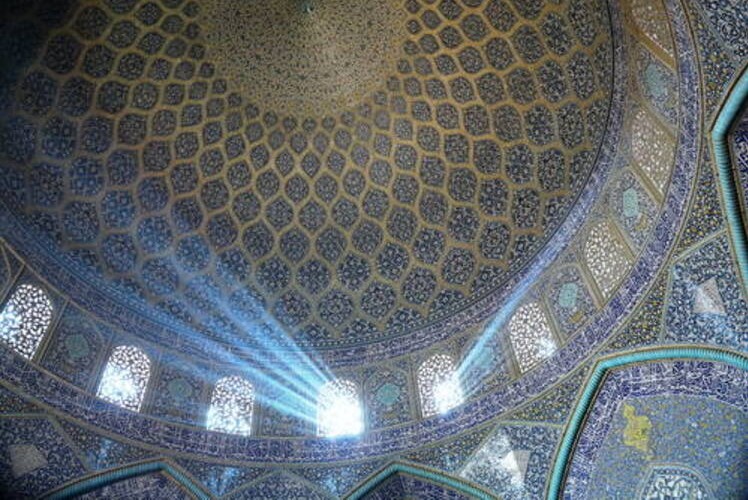
Of particular interest is the Royal Mosque (Masjed-e Shah), located on the south side of the square and angled to face Mecca. It remains the most celebrated example of the colourful architecture which reached its high point in Iran under the Safavid dynasty (1501-1722; 1729-1736). The pavilion of Ali Qapu on the west side forms the monumental entrance to the palatial zone and to the royal gardens which extend behind it. Its apartments, high portal, and covered terrace (tâlâr) are renowned. The portico of Qeyssariyeh on the north side leads to the 2-km-long Esfahan Bazaar, and the Sheikh Lotfallah Mosque on the east side, built as a private mosque for the royal court, is today considered one of the masterpieces of Safavid architecture.
The Meidan Emam was at the heart of the Safavid capital’s culture, economy, religion, social power, government, and politics. Its vast sandy esplanade was used for celebrations, promenades, and public executions, for playing polo and for assembling troops. The arcades on all sides of the square housed hundreds of shops; above the portico to the large Qeyssariyeh bazaar a balcony accommodated musicians giving public concerts; the tâlâr of Ali Qapu was connected from behind to the throne room, where the shah occasionally received ambassadors. In short, the royal square of Esfahan was the preeminent monument of Persian socio-cultural life during the Safavid dynasty.
Criterion (i): The Meidan Emam constitutes a homogenous urban ensemble, built over a short time span according to a unique, coherent, and harmonious plan. All the monuments facing the square are aesthetically remarkable. Of particular interest is the Royal Mosque, which is connected to the south side of the square by means of an immense, deep entrance portal with angled corners and topped with a half-dome, covered on its interior with enamelled faience mosaics. This portal, framed by two minarets, is extended to the south by a formal gateway hall (iwan) that leads at an angle to the courtyard, thereby connecting the mosque, which in keeping with tradition is oriented northeast/southwest (towards Mecca), to the square’s ensemble, which is oriented north/south. The Royal Mosque of Esfahan remains the most famous example of the colourful architecture which reached its high point in Iran under the Safavid dynasty. The pavilion of Ali Qapu forms the monumental entrance to the palatial zone and to the royal gardens which extend behind it. Its apartments, completely decorated with paintings and largely open to the outside, are renowned. On the square is its high portal (48 metres) flanked by several storeys of rooms and surmounted by a terrace (tâlâr) shaded by a practical roof resting on 18 thin wooden columns. All of the architectural elements of the Meidan Imam, including the arcades, are adorned with a profusion of enamelled ceramic tiles and with paintings, where floral ornamentation is dominant – flowering trees, vases, bouquets, etc. – without prejudice to the figurative compositions in the style of Riza-i Abbasi, who was head of the school of painting at Esfahan during the reign of Shah Abbas and was celebrated both inside and outside Persia.
Criterion (v): The royal square of Esfahan is an exceptional urban realisation in Iran, where cities are usually tightly laid out without open spaces, except for the courtyards of the caravanserais (roadside inns). This is an example of a form of urban architecture that is inherently vulnerable.
Criterion (vi): The Meidan Imam was the heart of the Safavid capital. Its vast sandy esplanade was used for promenades, for assembling troops, for playing polo, for celebrations, and for public executions. The arcades on all sides housed shops; above the portico to the large Qeyssariyeh bazaar a balcony accommodated musicians giving public concerts; the tâlâr of Ali Qapu was connected from behind to the throne room, where the shah occasionally received ambassadors. In short, the royal square of Esfahan was the preeminent monument of Persian socio-cultural life during the Safavid dynasty (1501-1722; 1729-1736).
Integrity
Within the boundaries of the property are located all the elements and components necessary to express the Outstanding Universal Value of the property, including, among others, the public urban square and the two-storey arcades that delineate it, the Sheikh Lotfallah Mosque, the pavilion of Ali Qapu, the portico of Qeyssariyeh, and the Royal Mosque.
Threats to the integrity of the property include economic development, which is giving rise to pressures to allow the construction of multi-storey commercial and parking buildings in the historic centre within the buffer zone; road widening schemes, which threaten the boundaries of the property; the increasing number of tourists; and fire.
Authenticity
The historical monuments at Meidan Emam, Esfahan, are authentic in terms of their forms and design, materials and substance, locations and setting, and spirit. The surface of the public urban square, once covered with sand, is now paved with stone. A pond was placed at the centre of the square, lawns were installed in the 1990s, and two entrances were added to the northeastern and western ranges of the square. These and future renovations, undertaken by Cultural Heritage experts, nonetheless employ domestic knowledge and technology in the direction of maintaining the authenticity of the property.
Management and Protection requirements
Meidan Emam, Esfahan, which is public property, was registered in the national list of Iranian monuments as item no. 102 on 5 January 1932, in accordance with the National Heritage Protection Law (1930, updated 1998) and the Iranian Law on the Conservation of National Monuments (1982). Also registered individually are the Royal Mosque (Masjed-e Shah) (no. 107), Sheikh Lotfallah Mosque (no. 105), Ali Qapu pavilion (no. 104), and Qeyssariyeh portico (no. 103). The inscribed World Heritage property, which is owned by the Government of Iran, and its buffer zone are administered and supervised by the Iranian Cultural Heritage, Handicrafts and Tourism Organization (which is administered and funded by the Government of Iran), through its Esfahan office. The square enclosure belongs to the municipality; the bazaars around the square and the shops in the square’s environs are owned by the Endowments Office. There is a comprehensive municipal plan, but no Management Plan for the property. Financial resources (which are recognised as being inadequate) are provided through national, provincial, and municipal budgets and private individuals.
Sustaining the Outstanding Universal Value of the property over time will require developing, approving, and implementing a Management Plan for the property, in consultation with all stakeholders, that defines a strategic vision for the property and its buffer zone, considers infrastructure needs, and sets out a process to assess and control major development projects, with the objective of ensuring that the property does not suffer from adverse effects of development.
Further information that has emerged about the July 1 fire on the Russian nuclear submarine Losharik in the Barents Sea, which forms part of the Russian Arctic, sheds light on the enormous dangers bound up with the preparations for world war. The fire claimed the lives of 14 high-ranking Russian navy officers.
Russian president Vladimir Putin called the disaster a “big loss to the Russian navy and army.” The Kremlin has classified details about the disaster as a “state secret.” The navy officers on board had all been trained in St. Petersburg and were, according to the newspaper Izvestiia, “the best in Russia.” They were directly subordinated to the Ministry of Defense. The Losharik is deployed by the Main Directorate of Deep-Sea Research, which reports to the Russian military intelligence agency GRU.
At the funeral for the 14 officers on Sunday, an aide to the commander of Russia’s navy, Captain Sergei Pavlov, suggested that a nuclear disaster had been narrowly averted by the crew: “With their lives, they saved the lives of their colleagues, saved the vessel and prevented a planetary catastrophe.”
The Kremlin subsequently denied the gravity of the threat posed by the fire, with spokesman Dmitry Peskov insisting that “there are no problems” with the nuclear reactor. Initially, the Kremlin had denied that a nuclear reactor had been on board the submarine at all.
However, an investigative report that appeared on July 9 in the St. Petersburg-based Fontanka newspaper confirms that the situation on the vessel was far more dangerous than previously known. The newspaper reported that the cause of the fire was an electrical short circuit that occurred while the Losharik was docking with its mothership, Podmoskovye, which led to a heat dissipation of the lithium-ion battery, which subsequently exploded and went up in flames.
The information was submitted to the newspaper by five anonymous sources, independent of each other. The newspaper wrote:
“The large-scale fire was provoked, according to our information, by heat dispersal of the battery, which was followed by a series of explosions. The personnel in the front compartment died. So powerful was the shock wave that it was even felt on the mothership. At the moment of the explosion, the apparatus [submarine] was in the process of docking onto it. The survivors sealed off the central compartment, completed the docking, shut down the nuclear reactor and evacuated to the BS-136 Orenburg. Fearing further explosions and that the fire would spread to the carrier, the crew of the mothership flooded the submarine, and this is why by the time it arrived at its base in Severomorsk the submarine was completely underwater.”
Because of the flooding of the submarine, it took over four days to recover 10 of the 14 bodies of the officers. The report about the explosions on board the Losharik would also corroborate a statement by the Norwegian Radiation Protection Authority, according to which they had been notified by the Russians of a gas explosion aboard a vessel in the Barents Sea. The report by the Norwegian Authorities had been denied by the Kremlin.
The struggle to save the submarine by the crew took up to one-and-a-half hours, according to a Russian military expert who spoke to the Komsomolskaya Pravda: “The standard fire-extinguishing equipment worked, but they could not completely eliminate the source, and the crew entered the fight for the survivability of the ship.”
Specialists told Fontanka that the height of the flames during the explosion of a lithium-ion battery could reach several meters and that it would be impossible to extinguish the fire with a dry-chemical fire extinguisher or water, because the battery itself would release flammable elements and oxygen. The only way to end the fire was to cool the battery.
The emergency breathing apparatus for the crew in the enclosed compartment provided only 15 minutes of air.
Russian fishermen witnessed the emergency surfacing that the crew managed to initiate. One of them told the Murmansk news site Severpost, “We were heading toward Kildin, and then, about half past nine in the evening, a submarine surfaces. Suddenly and completely surfaces. I have never seen anything like it in my life. On the deck, people were running around and making a fuss.”
While the Losharik is powered by a nuclear reactor, it also includes electrical propellers that are powered by batteries.
In the past, the Russian navy has been known to use silver-zinc batteries to power submarines, which are non-flammable but expensive. According to Fontanka, the Russian navy has started looking for alternatives in the form of lithium-ion batteries because they are substantially less expensive.
Lithium-ion batteries, which are commonly used to power devices like laptops and smartphones, are notorious for exploding and causing fires. In 2016, NASA lost the complex robot RoboSimian, designed to rescue people from dangerous situations, when the lithium-ion batteries implanted in the robot exploded and caused a massive fire.
It was not known that any Russian submarine had already started to deploy them and the only lithium-ion battery producer in Russia told Fontanka that all their products are still in a testing phase. In October 2018, Japan, involved in a military build-up against China, launched the first-known lithium-ion-equipped Soryu-class submarine, which does not have a nuclear reactor. South Korea has also announced plans to use lithium-ion batteries on its submarines.
The July 1 Losharik disaster is a deadly serious warning about the enormous dangers bound up with the international arms race and preparations for world war.
It remains unknown what exactly was the aim of the Losharik deployment, but there is little question that it was related to the efforts of the Russian state to prepare itself for a potential assault, involving nuclear weapons, by the US and NATO, which have engaged in an open and aggressive military build-up against Russia for years. The US build-up has recently culminated in a $750 billion military budget passed by the Senate in June and has put enormous pressure on the Russian oligarchy, which has recently cut back on military spending amidst a prolonged economic crisis.
Nuclear submarines play an important role in the build-up, both as weapons of nuclear deterrence and as a military means to spy on opponents, intercept and cut internet and other communication cables. Meanwhile, according to one former employee of Russia’s General Staff, “The reactors on submarines and other deep-sea vessels aren’t typically very well protected.”
Russian newspapers have referred to the Losharik submarine, worth an estimated $1.5 billion, as Russia’s main military “horror story” for the US. It is deemed capable of cutting internet and other communication cables and can also descend lower into the sea than all other known submarines.
In 2012, the Losharik performed missions on the sea floor in the Arctic Ocean at depths between 2,000 and 2,500 meters (6,600-8,200 ft), whereas the US Navy gives the maximum operating depth of its Los Angeles class attack submarines, the world’s largest fleet of nuclear submarines, at 200 meters (650 ft). The Losharik has played an important role in efforts by Russia to explore and dominate substantial parts of the Arctic. The rapidly melting ice in the region—a result of climate change—has dramatically intensified competition over military control over the Arctic and its natural resources in recent years.