

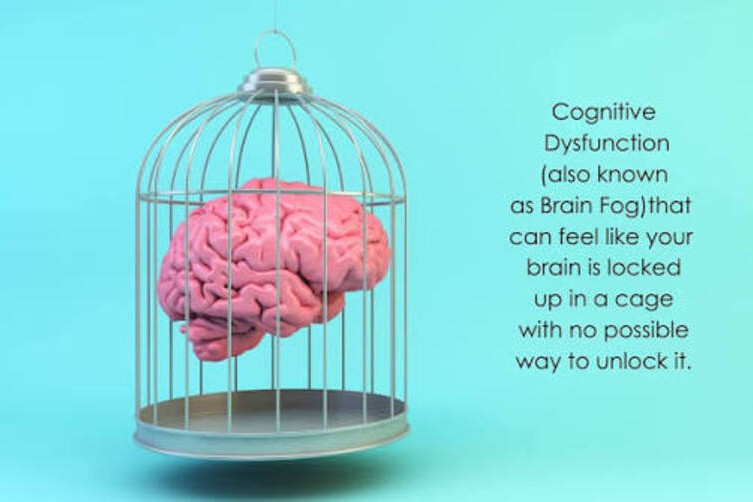
You used to be sharp. Quick with words. Good at planning, problem-solving, multitasking. Now you forget what you were saying mid-sentence. Reading a paragraph feels like trying to push through mud. Simple decisions feel overwhelming. And no one around you seems to understand why.
You’re not losing your mind. What’s happening has a clear explanation, and it’s one of the most common symptoms people with CFS experience.
Your nervous system may be stuck in protection mode, pulling the plug on thinking to conserve energy.
What Does Brain Fog Actually Feel Like?
Brain fog is a collection of cognitive symptoms including difficulty thinking clearly, short-term memory loss, trouble concentrating, and a feeling of mental cloudiness. Studies estimate that 89-100% of people with ME/CFS experience some form of cognitive dysfunction (Maksoud et al., 2020). It’s also reported in up to 65% of long COVID patients (Davis et al., 2021) and is common in fibromyalgia. Brain fog isn’t a medical diagnosis on its own. It’s a description of what happens when the nervous system diverts resources away from higher-level thinking.
If you have CFS, you probably know exactly what it feels like.
It feels like being stuck in a never-ending daydream. You’re physically awake, but your brain feels like it’s asleep. You zone out staring at a wall and can’t pull your eyes away. You start explaining something and forget what you were saying halfway through. You look at numbers on a page and they just don’t register.
For some people, it also comes with a sense of unreality. Things don’t feel quite real. You feel like there’s a barrier between you and the world around you. Some people describe it as living in another dimension, or like moving through life on autopilot.
The specifics vary person to person, but the pattern is consistent:
- Difficulty thinking clearly or following conversations
- Short-term memory loss (forgetting what you just said or did)
- Inability to make simple decisions
- Difficulty reading or processing new information
- Feeling zoned out, disconnected, or “not quite there”
- Dissociation or derealization (the world doesn’t feel real)
If your tests come back normal but you can barely string a sentence together, that’s not “nothing.” That’s your nervous system telling you something important.
Why Brain Fog Happens With CFS
Brain fog isn’t random. It makes complete sense when you understand what your nervous system is doing.
Think of your body as having different “buckets” of capacity: mental, emotional, and physical. Most people who develop CFS were overthinkers, overachievers, or over-analyzers before they got sick. Their mental bucket was already running near the top. Their brain was constantly analyzing, planning, and running mental calculations.
When that mental bucket overflows, the brain does something protective. It shuts down higher-level thinking. It goes into power-saving mode. That’s brain fog. Your brain is saying: “We can’t handle any more mental processing right now. I’m going to back off.”
So you go from being an overthinker to barely being able to think at all. The swing is dramatic, and it’s scary. But it could be a protective response rather than a sign of damage.
The nervous system connection
When your nervous system is stuck in a chronic stress response (fight-or-flight mode), it prioritizes survival functions over everything else. Digestion slows down. Sleep quality drops. And your brain redirects resources away from complex thinking toward threat detection. Research published in Frontiers in Neurology has documented that cognitive impairment in ME/CFS correlates with autonomic nervous system dysfunction.
Your brain and nervous system are completely linked. The brain drives the nervous system. When the nervous system is in overdrive, the brain checks out of non-essential functions. Reading a book, making a decision, following a conversation: these aren’t survival priorities. So the brain drops them to conserve energy. A 2022 systematic review confirmed that cognitive difficulties in ME/CFS are among the most frequently reported symptoms, affecting information processing speed, attention, and memory.
1 Your mental capacity gets maxed out
Stress, overthinking, illness, and emotional overload fill your mental bucket to the top. The brain has been running at full speed for too long.
2 The brain shifts into protection mode
When the bucket overflows, the brain shuts down higher-level cognitive function. It goes into “autopilot” to reduce the load. That’s when brain fog kicks in.
3 The fog itself creates more stress
Not being able to think clearly is scary. It generates worry, frustration, and fear. Those emotions add more stress to an already overloaded system, which makes the fog worse.
4 The cycle reinforces itself
More stress means more nervous system activation. More activation means less cognitive capacity. The loop keeps going until the underlying pattern is interrupted.
This is also why brain fog tends to get worse when you’re stressed, tired, or emotionally overwhelmed. Those experiences add more to the bucket, and the brain pulls back further to compensate.
Brain Fog vs. Normal Tiredness
Everyone has “off” days where thinking feels sluggish. But CFS brain fog is fundamentally different from regular tiredness. Here’s how to tell the difference:
Normal Tiredness
Improves after a good night of sleep, You can still push through tasks, Thinking is slower but functional, No sense of unreality or disconnection, Proportional to how little you slept, Clears within a day or two, Brain scans and tests show sleep deprivation markers
CFS Brain Fog
Persists even after sleeping 10+ hours, Simple tasks feel cognitively impossible, Thinking feels blocked, like a wall between you and your thoughts, Often includes derealization, dissociation, or “autopilot” feeling, Can hit suddenly even on “good” days after minor triggers, Can persist for weeks, months, or longer without intervention, All standard tests typically come back normal
If your experience matches the right column, that’s a strong signal that your nervous system is involved, not just a lack of sleep.
What Makes Brain Fog Worse
Brain fog fluctuates. Some days it’s manageable. Other days it’s so thick you can’t remember why you walked into a room. Understanding what triggers the worst episodes helps you make sense of the pattern.
Stress and overthinking. Mental stress is the most direct trigger. Worrying about symptoms, analyzing every sensation, trying to figure out what’s wrong: all of these activities fill the mental bucket faster. The more you think about the fog, the worse it gets.
Poor sleep. When you don’t sleep well, your brain doesn’t get the reset it needs. And with CFS, unrefreshing sleep is already common. This creates a compounding effect where poor sleep worsens brain fog, and brain fog makes it harder to wind down for sleep.
Overexertion. Physical or mental activity beyond your current capacity triggers the nervous system’s stress response. That response redirects energy away from cognitive function. This is why you might feel mentally sharp for 20 minutes and then suddenly hit a wall.
Emotional overload. Strong emotions (fear, frustration, sadness, anger) fill the emotional bucket, which spills into the mental one. When multiple buckets are overflowing at once, the brain pulls back even further.
Sensory overstimulation. Bright lights, loud sounds, busy environments, and screens all demand cognitive processing. When your brain is already maxed out, these inputs can push you deeper into fog.

