
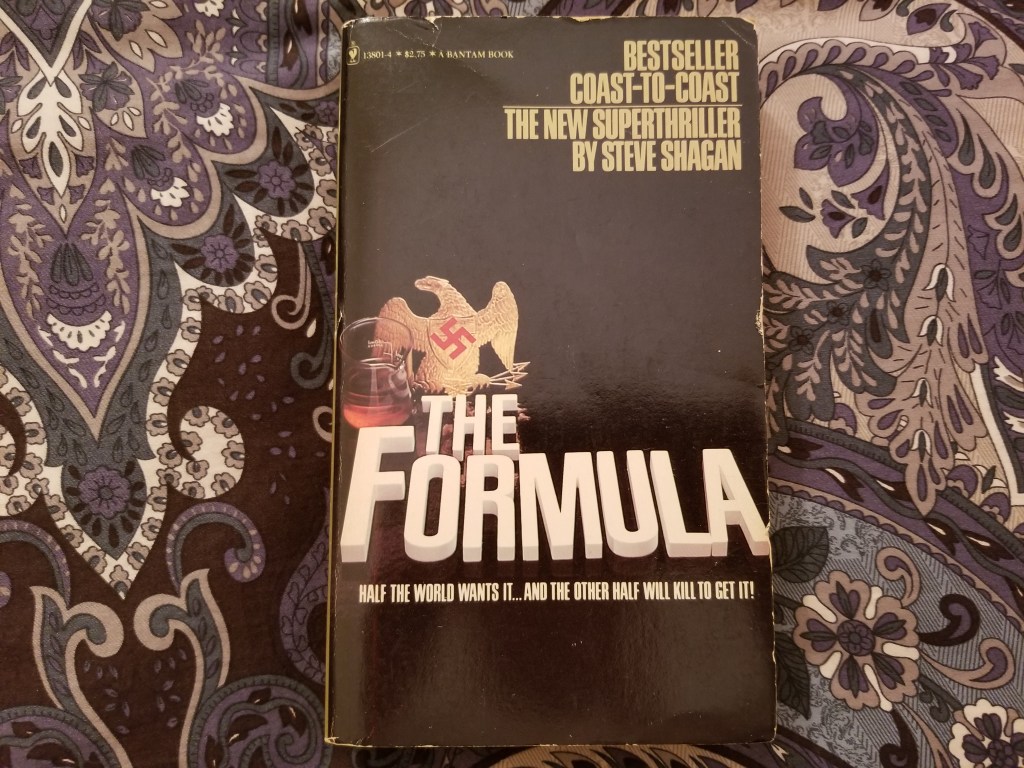
Now reading The Formula by Steve Shagan…
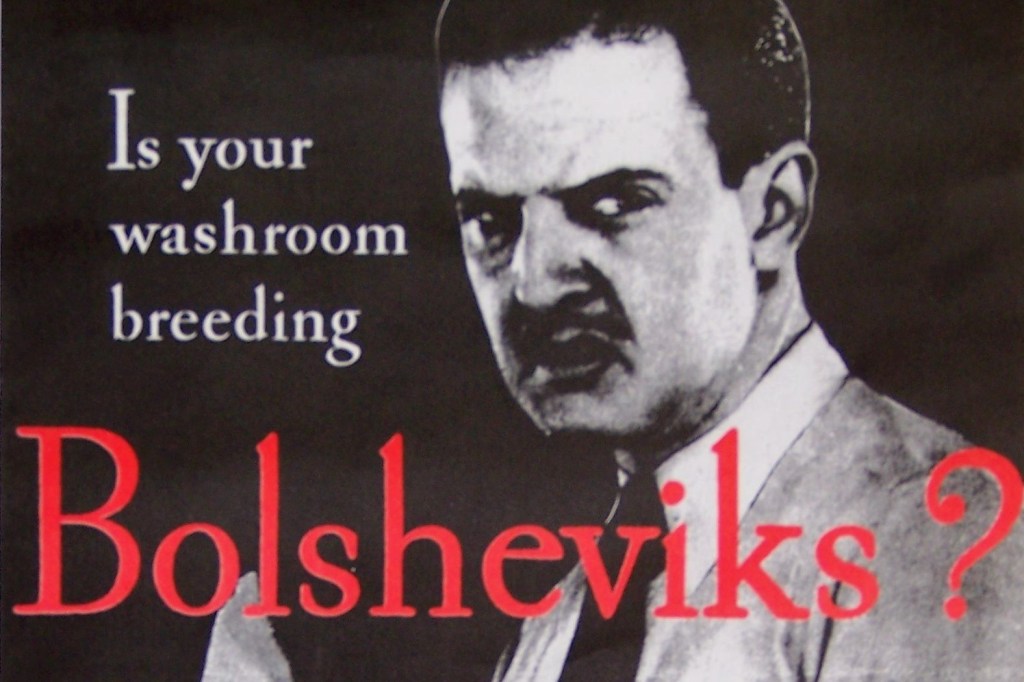
Anyone who has spent considerable time participating in political discussions is bound to run across the term “Cultural Marxism” at one time or another. It is a term typically used by the most extreme elements on the right, such as neo-Nazis and their fellow travelers, but in recent years it has become more prominent within mainstream conservative circles. Up to recently, the term has been little more than an ill-defined right-wing buzzwordin the same league as “feminazi,” “gay agenda,” “politically correct” or “community organizer.”
That all changed on 22 July, 2011. On that tragic date in Norway, a neo-fascist terrorist, Anders Breivik, launched a killing spree that took the lives of over 70 people. Breivik has a well-established history in Europe’s far right-wing, and the term “cultural Marxism” was featured prominently in his political writings.
Now more than ever, it is essential that people understand the term “cultural Marxism,” and the way in which it is used by the right as a way to both scare and rally its base into action. In short, understanding the term cultural Marxism is a key to understanding how the right thinks, communicates, and works.
First, to understand cultural Marxism as a phrase is nearly impossible. The phrase itself is meaningless. Next time you find yourself in a discussion where your partner invokes cultural Marxism, ask them to define exactly what that means. Most people don’t even attempt to answer. Those that do give a definition that has nothing to do with Marxism. They may be totally convinced that cultural Marxism is destroying their society, to the point of obsession, yet they stammer and hesitate when asked for a coherent definition.
How can one be so obsessed with something they can’t readily explain? Why does the right even bother using this term if it is nearly impossible to define? The answer to the question lies in the Cold War. Here let us examine the use of cultural Marxism, rather than its intended meaning.
History of Right-Wing Smears
During the Cold War, opponents were smeared with terms like “commie” and “red.” Liberals were often labeled “pinkos,” pink being a lighter shade of red, the implication being that liberals were just peddling sugar-coated communist ideas. Another term, which is still often used today, is “useful idiots,” primarily in reference to liberals or radical leftists who don’t identify themselves as Marxists. The term supposedly came from Vladimir Lenin, who used it in reference to liberals and leftists in other countries who unwittingly did the work of the Bolsheviks.
Not surprisingly, the quote is in fact fake; Lenin never used the term. In any case, one thing was clear in the Cold War, which is that if you wanted to smear political opponents, you insinuated that they were communists. This wasn’t necessarily limited to left-wing targets. The John Birch Society developed a reputation for accusing Republicans and Democrats alike of being active agents of international communism, insinuating that they deliberately delivered China into the hands of Mao and Cuba to Castro, in addition to deliberately losing the wars in Korea and Vietnam. Though the term was often used to describe some rather conservative figures, it was used almost exclusively by conservatives. Communism meant bad, evil, and other.
The use of communist as a pejorative would continue well into the 1990’s, and indeed it has enjoyed a resurgence amid the ramblings of the Tea Party movement and pundits such as Glenn Beck, but more astute conservative ideologues recognized that words such as “commie” and “red” had lost a lot of potency due to the collapse of the USSR and the eastern bloc. Perhaps more problematic was the task of reconciling America’s full-scale embrace of neo-liberal economics and privatization with an allegation that the same country was teetering on the edge of Marxist socialism. How could America be charging full speed toward socialist revolution at the same time it was promoting policies such as NAFTA and GATT, deregulation, and the slashing of welfare programs? Marxist still carried a negative connotation in that era, especially due to the triumphalism expressed by liberals and conservatives alike. Yet it was clear that once idealistic liberals had fully abandoned the left, class politics, and the working class itself in favor of embracing neo-liberal capitalism, accusing them of being communists might cost one’s credibility. Enter “cultural Marxism.”
“Theoretical” Basis of the Term
Cultural Marxism, as best as can be determined, originates in the early 1990’s, which also coincides with the beginning of the so-called “Culture Wars.” The term factors heavily in the writings of the original Culture-Warrior, Pat Buchanan, but also those of William S. Lind. In fact it was Lind, one of the lesser-known culture warriors, who defined the term “cultural Marxism” and attempted to write its history. Lind provides a primer on his dreaded cultural Marxism in an article aptly named “What is Cultural Marxism?” Here is his definition:
Cultural Marxism is a branch of western Marxism, different from the Marxism-Leninism of the old Soviet Union. It is commonly known as “multiculturalism” or, less formally, Political Correctness. From its beginning, the promoters of cultural Marxism have known they could be more effective if they concealed the Marxist nature of their work, hence the use of terms such as “multiculturalism.
The first problem with this definition is that if these cultural Marxists understood that they needed to conceal their Marxist nature, why would they use the term Marxism at all? Later on we will deal with those Lind was accusing, and we will see that they either identified themselves as more or less traditional Marxists, refuting the idea that they were concealing anything, or they at least openly claimed Marxist influence on their work, again discrediting the idea that they were attempting to hide something. There is no evidence to suggest that anyone sought to cover up Marxist ideas under the guise of multiculturalism.
It is also noteworthy that people like Lind and Buchanan, champions of “Western culture,” are in fact “multiculturalists.” They clearly believe that there is some kind of monolithic entity known as “Western culture” or “Western civilization.” While much of European culture draws from the same sources, typically classical Greece and Rome, it also draws influence from non-European sources. The nations of East Asia were heavily influenced by Chinese culture and philosophy, but only an ignorant fool would suggest that “Eastern culture” is monolithic. Then again, pointing out that “Western civilization” is actually multicultural would open one up to accusations of “cultural Marxism,” which shows how useful this term has been in the hands of right-wing culture warriors. However problematic this definition may be, it is incredible practical in that it allows one to use the negative connotations associated with Marxists, “reds,” and “commies,” without having to account for the fact that the target in question may be a proven advocate of liberal capitalism. His economics might be free market neo-liberalism, but he’s a cultural Marxist!
Let us continue with Lind’s error-ridden, and soon to become anti-Semitic, explanation of cultural Marxism.
Cultural Marxism began not in the 1960s but in 1919, immediately after World War I. Marxist theory had predicted that in the event of a big European war, the working class all over Europe would rise up to overthrow capitalism and create communism. But when war came in 1914, that did not happen. When it finally did happen in Russia in 1917, workers in other European countries did not support it. What had gone wrong?
Note that Lind does not give a reference to explain where Marxist theory made the prediction alluded to above. What did happen just prior to the war was a major split within what was at the time known as the social-democratic movement at the end of the Second International. Some social-democrats had taken a pro-war stance, whereas others, most notably Vladimir Lenin, took a principled stand against war. This had a detrimental effect on the movement in this crucial time. The second assertion is only true to a degree. The Bolshevik revolution in 1917 was followed by revolutions in Hungary and Germany, both of which had to be crushed by military force. In the case of the former, Romanian troops invaded and put down the revolution. While revolution did not break out in many countries, the activities of communists in Europe played a role in the failure of the intervention campaign of the Russian Civil War. In the United States, unions went on strike and refused to load ships with arms bound for the White Guards in Russia. Communist revolutions could be crushed in Western Europe via force of arms, but even the victorious Entente powers were unable to strangle the Bolshevik baby in its cradle.
Lind’s conspiracy theory continues:
Independently, two Marxist theorists, Antonio Gramsci in Italy and Georg Lukacs in Hungary, came to the same answer: Western culture and the Christian religion had so blinded the working class to its true, Marxist class interest that Communism was impossible in the West until both could be destroyed. In 1919, Lukacs asked, ‘Who will save us from Western civilization?’
Here Lind actually names names. It is worth noting that neither Gramsci nor Lukacs made an attempt to conceal the Marxist basis of their theory and works, and they identified themselves as Marxists. If they were trying to conceal the Marxist nature of their works, as Lind alleges in regards to his hated “cultural Marxists,” they had an odd way of going about it. There is also nothing to suggest that they intended to conceal their ideology under the cover of something called “multiculturalism.” Feel free to search Lukacs works for the term “multiculturalism” or “multicultural”; this author was unable to find either. Having dealt with this, we see that Lind makes a claim about Gramsci and Lukacs’ answer to the question of why Europeans outside of Russia didn’t successfully overthrow their capitalist governments. The assertion begs the question, if the Christian religion so blinded the Western European proletariat to their class consciousness, why was it that class conscious workers’ movements were more active in Western Europe prior to the end of the 19th century? After all, the first worker’s revolution was the Paris Commune, not the October Revolution. Did Lind simply forget that Christianity was far more entrenched in the Russian Empire, which was not a secular state and where the Tsar was seen as a representative of God on Earth?
The quote from Lukacs is also presented in a deceptive manner. It appears as though Lukacs is lamenting the fact that those ever-pious Christians and their “Western culture” seemed impervious to Marxist class consciousness. Here is the actual quote, in context:
When I tried at this time to put my emotional attitude into conscious terms, I arrived at more or less the following formulation: the Central Powers would probably defeat Russia; this might lead to the downfall of Tsarism; I had no objection to that. There was also some probability that the West would defeat Germany; if this led to the downfall of the Hohenzollerns and the Hapsburgs, I was once again in favour. But then the question arose: who was to save us from Western civilisation? (The prospect of final victory by the Germany of that time was to me nightmarish.) – Preface to The Theory of the Novel, 1962
Several facts become immediately obvious once we see the quote in context. First, it clearly has nothing to do with class consciousness in Western Europe or the failure of other revolutions after 1917. Also Lukacs clearly makes a distinction between the very Christian Russian Empire, the German and Austro-Hungarian empires, and “the West,” which must refer to the entente powers. As a side note, some other culture warriors from the interwar period would also accuse that “West,” consisting of the United States, the United Kingdom, and France, of being multicultural degenerate societies. Lastly, and more importantly on this note, the quote, if Lukacs ever actually said it out loud, was from 1914, not 1919 when the failure of other European revolutions would have been on his mind.
The next bit in Lind’s accusation against Lukacs is a bit revealing:
That same year [1919, which in fact would have been five years after the quote referenced above], when he became Deputy Commissar for Culture in the short-lived Bolshevik Bela Kun government in Hungary, one of Lukacs’s first acts was to introduce sex education into Hungary’s public schools. He knew that if he could destroy the West’s traditional sexual morals, he would have taken a giant step toward destroying Western culture itself.
This was quite an impressive feat, given that the Hungarian Soviet Republic under Bela Kun lasted from March 23rd to August 6th, 1919. Does that still seem like enough time to destroy sexual morality in the historical heart of European culture that is Hungary? Well Lukacs was also a commissar serving in the 5th division of the Hungarian Red Army. Do the math.
As for these alleged traditional sexual morals of “the West,” here are a few facts. A sort of mini-sexual revolution occurred in the 1920s, something which culture warriors would likely be quick to condemn. What they don’t realize is that prior to that revolution, prostitution was far more widespread, and young men were far more likely to have their first sexual experience with a prostitute. So while they may have been proper gentlemen to the virginal girls they were courting, they were preparing for their wedding night with the help of working girls. Given that William S. Lind is a military expert (despite having never served in the military), one would expect him to know about the prevalence of prostitution and how it goes hand in hand with the military.
The Spanish conquistadors often used young native girls as sex slaves in Colombus’ time, and the prospect of owning a prepubescent sex slave was a major factor in motivating some Spaniards to cross the Atlantic. Rape of slaves was common practice in the antebellum South. Even the crusading knights which so inspire the likes of right-wingers like Breivik were known to travel with a large company of prostitutes. These are all well documented facts, but people like Lind aren’t fazed by such trivial matters. Afterall, they can just accuse those who gathered them of being “cultural Marxists.” Damn that’s a useful term!
Before we continue with Lind’s idiotic screed, be warned. We’re about to enter anti-Semite territory.
In 1923, inspired in part by Lukacs, a group of German Marxists established a think tank at Frankfurt University in Germany called the Institute for Social Research. This institute, soon known simply as the Frankfurt School, would become the creator of cultural Marxism.
Note that the founders of the Frankfurt schools never called their theories “cultural Marxism.”
To translate Marxism from economic into cultural terms, the members of the Frankfurt School – – Max Horkheimer, Theodor Adorno, Wilhelm Reich, Eric Fromm and Herbert Marcuse, to name the most important – – had to contradict Marx on several points. They argued that culture was not just part of what Marx had called society’s “superstructure,” but an independent and very important variable. They also said that the working class would not lead a Marxist revolution, because it was becoming part of the middle class, the hated bourgeoisie.
Yes, all the names mentioned there were of Jewish descent, some assimilated, some not so much. Was the reader not warned? Anyway, let us make a very important observation about the Frankfurt school. They didn’t just contradict Marx on a few trivial points regarding culture and the superstructure (the body of laws and ideas which arises from a particular mode of production, e.g. capitalism). Claiming that the working class would not lead a socialist revolution is a pretty serious rejection of Marxism. Of course, proponents of the “cultural Marxist” idea aren’t really concerned with what Marxism has to say. It should be noted here that Marx himself acknowledged that under capitalism there can be a rise in real wages which can deaden the class consciousness of the proletariat. This is why he wrote that the minimum wages necessary to “reproduce the worker,” in short to get him or her to come into work the next day, vary depending on the standards of living in a particular country. It is also important to note that by the time capitalism had become dominant in the 19th century, the bourgeois were no longer the “middle class.”
Who would (lead a Marxist revolution)? In the 1950s, Marcuse answered the question: a coalition of blacks, students, feminist women and homosexuals.
Be honest, it’s nice that Lind was so willing to provide us a list of people he hates. What he doesn’t provide is a source to this assertion. Marx’s theory that the working class would lead the revolution was to hold true for any capitalist country; is Lind alleging that Marcuse was speaking only of America? Marcuse was clearly a follower of Marx’s ideas, but his own ideas differed from traditional Marxism so much as to be something other than Marxism. There comes a point when one must ask, “If cultural Marxism contains so much that is contradictory to Marxism, can it still contain the word Marxism at all?” Of course the answer is an emphatic yes, if only because some other name wouldn’t carry the stigma that Marxism has amongst conservatives.
Fatefully for America, when Hitler came to power in Germany in 1933, the Frankfurt School fled – – and reestablished itself in New York City. There, it shifted its focus from destroying traditional Western culture in Germany to destroying it in the United States.
Read those sentences very carefully. Hitler’s coming to power drove out his country’s evil Jewish professors, causing them to emigrate to America. Perhaps Lind, like many of his ideological fellow travelers, would prefer that they had stayed in Germany. In any case he alleges that they are actively seeking to destroy Germany, as Hitler would have agreed, and that they set about trying to destroy Western culture in the United States. Apparently Lind believes that both Germany and the United States share one common Western culture; see, he is a multiculturalist!
To do so, it invented “Critical Theory.” What is the theory? To criticize every traditional institution, starting with the family, brutally and unremittingly, in order to bring them down. It wrote a series of “studies in prejudice,” which said that anyone who believes in traditional Western culture is prejudiced, a “racist” or “sexist” of “fascist” – – and is also mentally ill.
The most important response to this passage is that no example is given to substantiate any of these claims. It is true that critical theory criticized institutions such as the family, but then again so did Marx and Engels. Why doesn’t Lind attack Engels’ Origins of the Family, Private Property, and the State? Perhaps because he never read it, or possibly never even heard of it? Lind also once again refers to “traditional Western culture,” yet the nature of families throughout European society and history varied greatly. As Stephanie Coontz points out in her book The Way We Never Were: American Families and the Nostalgia Trap, most Americans’ understanding of the traditional family is not traditional at all, rather it tends to borrow bits and pieces from different historical eras. Then again, she’s probably a cultural Marxist.
Most importantly, the Frankfurt School crossed Marx with Freud, taking from psychology the technique of psychological conditioning. Today, when the cultural Marxists want to do something like “normalize” homosexuality, they do not argue the point philosophically. They just beam television show after television show into every American home where the only normal-seeming white male is a homosexual (the Frankfurt School’s key people spent the war years in Hollywood).
That the Frankfurt school attempted to meld the ideas of Marx to those of Freud is a fact, and the results of this combination are among the reasons why many Marxists reject the Frankfurt school. The second part of this passage is simply bizarre. First of all, the “normality” of homosexuality has been argued not philosophically, but scientifically, by trained medical professionals. Next, Lind here alleges a direct connection between the cultural Marxist intellectuals and the entertainment industry, as though the two work in concert. Of course the thing about the last sentence which is no doubt literally screaming at the reader is the assertion that numerous television shows portray the “only normal-seeming white male” as a homosexual. Please, count up the number of television shows and films which do this. One would think that if this practice were as widespread as Lind alleges, films like Brokeback Mountain wouldn’t have drawn so much attention. Let’s move on to Lind’s final paragraph.
The next conservatism should unmask multiculturalism and Political Correctness and tell the American people what they really are: cultural Marxism. Its goal remains what Lukacs and Gramsci set in 1919: destroying Western culture and the Christian religion. It has already made vast strides toward that goal. But if the average American found out that Political Correctness is a form of Marxism, different from the Marxism of the Soviet Union but Marxism nonetheless, it would be in trouble. The next conservatism needs to reveal the man behind the curtain – – old Karl Marx himself.
Here Lind has yet to provide clear definitions for multiculturalism and political correctness, despite using the latter as proper noun as though it were an actual ideology. In reality, the ideology of the Frankfurt school actually diverges so far from Marxism that it becomes something almost anti-Marxist. One could make the argument that the influence of the Frankfurt school ideas on the so-called New Left actually did far more harm to Marxism and class consciousness than good, and the ultimate result of this influence was to sever the left from class based consciousness and materialism, rendering it fractured and ineffective. In that sense, Lind should be praising the Frankfurt school, not condemning it. That, however, is a matter for another article.
In his conclusion, Lind confirms what the author has asserted previously, to wit, that conservatives use the term cultural Marxism because they wish to preserve the pejorative value of “Marxist,” and in particular this term helps them avoid difficult questions as to how leaders and individuals who clearly embrace capitalism or neo-liberal economics could possibly be Marxist. Lind’s article is instructive as it is one of the few times we see an honest attempt by a conservative intellectual to actually define and explain cultural Marxism. Yet in his attempt to “unmask” it, he only unmasks himself as an ignorant, a bigot, a liar and a hack.
More often than not, the label “cultural Marxism” will be thrown around by conservative rank in file, as well as their more extreme neo-fascist associates. Most of the time, it is a source of amusement when they are asked to explain what the phrase actually means. But as Lind’s article proves, this word has a history, and it originated not within the halls of the Frankfurt school but in the minds of extreme right-wing ideologues who wish to provoke an automatic negative response toward concepts like equality, justice and accountability. They do this through the use of meaningless words and phrases such as multiculturalism, political correctness, and cultural Marxism. Next time you encounter someone spouting off about “cultural Marxism,” unless you want to amuse yourself by asking them for a definition and watching them squirm, simply refer to the following definition.
Cultural Marxism n. 1. A meaningless phrase used to signal that the writer or speaker has no idea what he or she is talking about.

Take yourself back to that day when you watched or listened to the attack on America; the day that everything changed. Remember where you were, who you were with, and most importantly, how you felt.
Think about the last few events of that day; how the news of the Pentagon being hit by something was followed almost immediately by the unexpected complete collapse of the South Tower (WTC 2). Remember how we had barely recovered from that shock, one that we were forced to watch in horror over and over again, when the unspeakable happened; the North Tower (WTC 1) fell in exactly the same way; at an eerie and almost supernatural speed as plumes of smoke and steel columns flung across city blocks.
Now I want you to put yourself in that very moment, once again, and prepare yourself for the missing final act that never took place and yet may be one of the most telling and condemning pieces of evidence in the ongoing unofficial investigation of 9/11.
The 9/11 Shock Opera
The North Tower has fallen and people are in absolute disbelief. The grey faces staring back at us through the live news reports tell the story; they are blank with shock like infants in a war zone.
In New York, the yelling and the screams have faded into history as the dust settles… a deafening silence fills the air in your office or your home… no one speaks save the babbling talking heads on the news, all vying for their Peabody Award and their personal place in history…
When over the shoulder of a reporter we see, way off in the distance… rising from the horizon, coming in from the south, low and just over the murky blue of the Hudson Bay… Flight 93 on its final approach.
At first the reporter doesn’t notice, but you do; everyone in your office, everyone in your home, watches in silence. There is just no way possible…it must be something else, a military plane scouring the skies, protecting us, protecting America, protecting what’s left of New York…and we all watch as it grows ever larger, just over the reporters shoulder, while a sickening despair builds in each of us silent TV witnesses till our fears become the unavoidable realization.
It’s not over.
A scream somewhere off camera seems to snap the camera-man out of his trance and he shifts ever-so-slightly his focus, your focus, to the play’s approaching last act.
The talking head finally shuts up and turns just in time to see Flight 93 diving from the tip of Lower Manhattan. There is no question, there is nothing to say; Flight 93, in front of hundreds of cameras and thousands of witnesses, and the millions watching live on TV., roars past the remains of the lower New York City skyline, darts through the remaining smoke and dust of the towers, and plows into Building 7 of the World Trade Center somewhere around the 7th floor at over 600 mph. This is the area where the diesel fuel storage tanks are kept in the building, and the resulting explosion is something to behold. Orange-red flames reach all the way up the north face of the building as someone in your office lets out a little raspy scream. Whispered prayers float up from the crowd for those lost souls onboard.
But that is just the beginning.
Rumbles immediately are heard and felt underfoot by the dust covered survivors and first responders at Ground Zero a second after Flight 93’s tail disappears in the south face of Building 7.
The rumbles continue and before the reporter can utter a word, as the smoke cloud mushrooms past the top floor grey and red with menace, more explosions and more flashes, more grey-faced people running, their faces contorted masks of shear terror, and that terrible white noise of panicked people yelling warnings incoherently to one another, then the horrible reality sets in and we allow ourselves to acknowledge that building 7 …is moving.
In 7 seconds flat, building 7 collapses right before our eyes just at that moment when we thought there was no more; we thought we were safe and the worst of the suffering was behind us. The Towers were hit, they fell. The horror should have been over… but it wasn’t.
This was the final act, the Grand Finale, as scripted for the street theater opera known as 9/11.
But a funny thing happened on the way to Ground Zero, something that changed everything in the plan to change everything; a fighter pilot met Flight 93 route to New York and he may still yet be the conspirators’ ultimate demise and our last best hope.
Hypothesis
It is my intention to show that Flight 93 was not targeting Washington, D.C. as Philip Zelikow (transition team member of the Bush White House and key contributor to the creation of the policy of the “Global War on Terror”) would have you believe, but rather, it was headed for Building 7 of the World Trade Center complex as the final act in the Shock Opera of the Neocon Vulcan’s “New Pearl Harbor” event.
This is an important aspect of the case of 9/11, for I and many others do call it a case now; a criminal investigation, if you will, which has been ongoing for years… unofficially.
For a long time, Building 7 has been considered the weakest link in the official story of what happened that day and with good reason.
Without explanation, for the first time in the history of steel framed buildings, Building 7, a steel framed 47 story tall sky-scrapper collapsed due to office fires and what NIST calls “thermal expansion”. No “jet fuel” no plane impact, no ruptured diesel fuel storage tanks, just a nearly symmetrical instantaneous failure of the entire core column structure allowing for a near-fall speed collapse of Building 7, neatly into it’s own foot-print… just like a controlled demolition. All because of sporadic office fires burning on a few “key” floors.
At least, that is what NIST says.
Sometimes more can be ascertained from the mistakes of a plan, than can be from its successes. Flight 93 was not meant to be shot down, but it was. And what ensued in the aftermath of that action, quite literally, exposes the criminals of 9/11 more so than does any other single aspect of the case, simply because of what the conspirators had to do to cover it up.
Imagine for a moment that the “conspiracy theorists” are correct. Or should I say the “alternative narrative” theorists are correct. All of a sudden, the criminals of 9/11 are staring at radar screens showing their final act in their carefully planned production, lying in ruin in Shanksville Pa. and they still have a 47 story tall building, barely even on fire, completely wired with RDX, TNT, and PETN… ready for demo.
All dressed up and nowhere to go.
If you are a follower of the alternative narrative movement, you have to take a bit of enjoyment out of that. There they stood, the real conspirators of 9/11, looking at each other with the obvious proof of their corruption and murder staring right back at them; Building 7 still stands and it’s carefully scripted reason for collapse was knocked clean out of the skies. The gallows surely flashed before the conspirators eyes in that moment before they scrambled to fix their story.
This is the story of Flight 93 and Building 7; the Grand Finale of their 9/11 Shock Opera that never took the stage. This was their biggest mistake and therefore our best chance at exposing the authors for the criminals and terrorists that they are.
To start off with, we are going to put aside all the other volumes of research done by well meaning, dedicated researchers on the subject of proving the feasibility of an alternative narrative of the events of 9/11. An alternative narrative, that is, to the “official story” of 19 (or is it 16 now?) angry Muslims with “box-cutters”. For the most part, there is some really good information out there compiled by skilled researchers, engineers, chemists, architects, intelligence agents, politicians, fire-fighters, pilots, and even simply concerned citizens trying to help make a difference. Not all of the theories out there are valid, not all follow the standardized scientific method of research, but there are enough honest efforts (albeit they are often clouded by the obvious “disinformation” efforts) to prove beyond the point of “reasonable doubt” that the official story is not only not plausible, it is simply not possible.
Part 1: Facts on the Ground
In order to accept that Building 7 was indeed “targeted”, you need to understand, at least in a cursory way, why someone would want to; motive, if you will. Aside from the obvious theatrical impact of the last act of their “Shock Opera” inspiring “terrorist attack”, the conspirators had very good reasons to want that building reduced to rubble; vast amounts of money and their own freedom.
There are scores of papers done on the subject of the contents of Building 7 and there is no time here and now to readdress all the solid work previously logged by many researchers. Let us just say that, like in the Pentagon (the Office of Navel Intelligence) that were struck that day, what was inside the building is the best clue. In the case of Building 7, it was the New York offices of the Securities and Exchange Commission (SEC) and the various investigations that were ongoing at that time.
Enron, WorldCom, Global Crossing… all of these investigations, and many others, came to a sudden end as crucial records were lost when Building 7 fell at 5:20pm, Sept. 11th 2001. Politicians and Wall Street tycoons alike must have been quietly celebrating that one. In short, the collapse of Building 7 saved careers, kept many “insiders” out of jail, saved billions in fines and restitution, and ultimately paid millions in insurance claims to the same guy whose insurance payday for the Twin Towers turned his $15 million dollar investment into a $7 billion dollar windfall. That’s what you might call a “win win win win” situation for some of the most well placed moguls of the financial and political world. I would call that serious motive.
So, motive aside, let’s look at the physical layout of the World Trade Center complex in order that we may obtain a better understanding of just what would have had to have happened and in what sequence they would need to take place, in order to take this one specific building down in true Shock Opera style.
The World Trade Center complex was located on the southern tip of lower Manhattan. Basically what you had was a main, 4 city block sized complex housing Towers 1 and 2 and Buildings 3-6 all located snuggly together and then you also had a 47 story tall building just north of the complex across the street called Building 7.
Building 7, a trapezoidal shaped structure, was tucked neatly in between two other buildings on that block which suffered almost no damage in the 9/11 attacks comparative to Building 7 that is. You will notice the proximity of Building 7 to Tower 1 or the North Tower; a bit over 300 feet (just about the length of a football field).
From the photographs you can see that Building 7 could not have been accessed by a plane strike from the south side as that the North and South towers completely shielded it from approach from that direction.
You should also notice the north side of Building 7 was also partially shielded by 3 buildings in close proximity. These buildings to the north of Building 7 didn’t completely obscure its north face from a potential air strike, but they did protect over half of its overall target area, making approach from that direction more difficult and therefore, more risky.
In a crime of this magnitude, with so much on the line, not just lives and careers and vast sums of wealth, but this was their one shot – the conspirators one chance to justify multiple illegal wars, a new doctrine of “pre-emptive aggression”, the establishment of the “unitary executive” model, the passing of the Patriot Act, the creation of the Trans Afghan Pipeline, wholesale privatization of public assets and wealth, military contracts, and just basically complete and total world domination based really on the successful completion of one act of treasonous terrorism that would galvanize the American people long enough that they would allow all of these things to take place in their name without so much as a whimper – with all that one the line, risk management became of the highest priority.
It would not do to have Flight 93 skip off the top of Building 7 and crash into some other building in lower Manhattan. Though that could still be used to tacitly explain why Building 7 came crashing down, it wouldn’t do to have investigators looking too closely at the instrumentation panels in Flight 93, nor would they want to try explaining what happened to the bodies of the passengers on that flight.
As you can see from the illustrations, once the towers “fell” out of the way, due to the layout of lower Manhattan and the Trade Center, all of a sudden, you have a clear shot right at the heart of Building 7.
As it just so happens, Mayor Giuliani cleared the building earlier, and with the exception of one key witness, who has since died under very suspicious circumstances, Building 7 was completely vacant. It’s rather odd that the mayor of New York would leave his multi-million dollar emergency command post bunker long before the first tower “collapsed”. After all, even if he says that he feared a plane attack on Building 7, as we can see, as long as the towers stood, there was little chance of that.
Part 2: Facts in the Air
(H/T – to “Dick Cheney” – Brisbane Times online quotes a prosecutor, Timothy Stone, in the trial of Osama’s driver, Salim Hamdan:
“If they hadn’t shot down the fourth plane it would’ve hit the dome,” Stone, a Navy officer, said in his opening remarks.“ Brisbane Times
Though he is still advancing the “headed to Washington” story-line from Zelikow’s 9/11 Commission Report, he is one of a number of official sources from which we can tell in fact Flight 93 was indeed shot down.)
There is little to no dispute that Flight 93 turned and headed directly toward the southern tip of lower Manhattan in its last few minutes in the air. According to the “official story” this change of heading took place somewhere around 9:58 am.
One thing you should notice when you start doing your own research into this, is that most of the MSM outlets and newspapers, when they report on the flight path of Flight 93 will show you this heading change, but almost every single one of them will NOT show New York City in relation to that change. Almost every map I ran across ends the New Jersey. They all include D.C. but almost none of them show New York in relation to that change in heading, probably because someone doesn’t want the average reader looking at the map and making this connection.
The Official Story of Flight 93
The official story that Flight 93 was heading toward D.C. comes from the work of the 9/11 Commission and from “intel” passed out on the day of the attacks to the news media by various “experts”.
As we have already slightly touched on, the executive director of the 9/11 Commission had a great deal invested in making sure the “angry Muslims” story held up. He himself had just completed a re-write of the national security directive for his friend Condi Rice (who just happened to be the leader of the “Vulcans”, a group of neocons who put together Bush’s “foreign policy objectives” in 1998 and 1999 and who also just happened to be in “the bunker” with Cheney on Sept. 11th 2001 with several other “Vulcans”) which called for a global jihad, if you will, against “the terrorists” where-ever they may be. His name was Philip Zelikow, and he is responsible for the story that Flight 93 was headed toward D.C. rather than New York.
Another rather telling aspect of the flight path of Flight 93 is how long it was in the air. Why did the hijackers wait so long to take over the plane? Logically that makes no sense.
(note: much of the timeline information comes from 911 Timeline. )
8:42 a.m.: United Airlines Flight 93 a Boeing 757-222 with a maximum capacity of 200 passengers and 11,489 gallons of fuel, lifts off from Newark International Airport in Newark, New Jersey bound for San Francisco International Airport, San Francisco, California. Take-off was scheduled for 8:01. There are supposed to be 44 victims on board, yet when you add up the official death manifest list that was published on CNN.com, there are only 33 victims.
NORAD used to pride itself on it proven track record of intercept speed. Up until that day it was something close to 7 minutes, I believe, from the time a “problem” occurs on a flight. Many flights are routinely intercepted all year long and 2001 was no exception to that rule. The only day that didn’t occur was Sept. 11th 2001. But the “hijackers” wouldn’t have known this (unless of course…) and they would have had to anticipate that after two planes had struck the towers after being hijacked, they would have armed company up there tailing them in a matter of minutes.
So why did they wait so long to take over the flight?
In fact, why did they wait at all? They near D.C. when they took off and the departure time was already delayed to start with. All they would have to have done was take over the plane once they got to cruising altitude, turn the plane south to D.C. and they would have struck there target just minutes after the towers were hit. But for some reason, the “hijackers” waited over 35 minutes before they took over the plane.
9:28 a.m.: United Airlines Flight 93, “there are the first audible signs of problems, in background cockpit noise.” Air traffic controllers hear the sound of screaming and scuffling over an open mike. They then hear hijackers speaking in Arabic to each other. Yet this is at least 8 minutes and probably at least 12 minutes after the hijackers had taken over the cockpit and done something to cause the FAA to notify NORAD of United Airlines Flight 93’s hijacking.
Why would they risk all that time in the air, coming back from Ohio? They must have known they would be shot down… if they were terrorists with box cutters that is.
However, if “the terrorists” knew that multiple national security drills would be taking place that day and that NORAD rules had been changed in June of 2001 that kept NORAD commanders from giving the “intercept and engage” order, perhaps they would have known they had more time.
Perhaps, in that case, they would have known they had just enough time to circle around on a long exposed “hijacked” flight just long enough for both towers to “collapse” just as they made it back to downtown Manhattan.
And that is exactly why they waited so long. They were waiting for a clear path to Building 7.
There are many discrepancies in the story of Flight 93 and to be honest, for a long time I too thought that no 757 could have crashed in Shanksville that day. The photos of the scene don’t look like what a crash site should look like, I will admit that. The coroner said on the scene that he saw no bodies; none. There’s no tail section, no wing sections, and from what I can see, just like at the Pentagon, no luggage or seats to speak of.
But ultimately you have to remember that whatever it was, it was headed to a place (New York or even, if you believe the “official story”, D.C.) that had already been attacked and thousands of news crews were already in place. Whatever crashed in Shanksville was about to be the most thoroughly documented crash ever; and that includes even Flight 175 that hit the south tower.
How could that been anything other than either Flight 93 itself, or a retrofitted imposter painted to look like Flight 93? No one in the planning stage would have missed that little caveat.
Whatever was headed to New York and Building 7 had to at least look like Flight 93 because, quite simply, al Qaeda doesn’t have cruise missiles and you have to frame a patsy with the tools they would have possessed.
Part 3: The Unexpected
Flight 93 was shot down. Period. The debris field 6 miles from the crash site proves it beyond any reasonable doubt. Also there were several eye witnesses at the scene who testified to hearing loud “booms” and THEN looking up to see Flight 93 still in the air and struggling to stay in the air.
Ernie Stuhl, the mayor of Shanksville: “I know of two people — I will not mention names — that heard a missile. They both live very close, within a couple of hundred yards… This one fellow’s served in Vietnam and he says he’s heard them, and he heard one that day.” He adds that based on what he has learned; F-16’s were “very, very close.”
Laura Temyer of Hooversville: “I didn’t see the plane but I heard the plane’s engine. Then I heard a loud thump that echoed off the hills and then I heard the plane’s engine. I heard two more loud thumps and didn’t hear the plane’s engine anymore after that” (she insists that people she knows in state law enforcement have privately told her the plane was shot down, and that decompression sucked objects from the aircraft, explaining why there was a wide debris field).
Though several of the eyewitness reports conflict on certain aspects of the crash, one thing they seem to agree on is that the plane was shot down, or that it was behaving in such a way as to indicate it had been shot. Even Cheney and Rumsfeld have inadvertently admitted several times over the past 7 years that Flight 93 was shot down.
Shortly after 911, a flight controller in New Hampshire ignores a ban on controllers speaking to the media, and it is reported he claims “that an F-16 fighter closely pursued Flight 93… the F-16 made 360-degree turns to remain close to the commercial jet, the employee said. ‘He must’ve seen the whole thing,’ the employee said of the F-16 pilot’s view of Flight 93’s crash.”
I remember there was also a service member stationed somewhere nearby who admitted that he himself fitted an air-to-air missile on a fighter that had gone up that day after it retuned to the base.
One key piece of evidence that the flight was shot down unexpectedly was the phone calls supposedly placed that day that created the story that the flight had been taken over by the passengers. The whole “Let’s roll!” story was fabricated after the fact to explain the unexpected crash of Flight 93.
You see, as several other investigators have pointed out, with voice morphing technology already proven to have been available at the time, the real perpetrators of the attacks of 9/11 were able to fake phone calls to various family members of passengers in order to support the “hijacking” story-line in real time… as the events of the day were unfolding.
That is a key element in the believability factor for the “official story” of 9/11; the fact that these calls took place to “witnesses” on the ground who could end up verifying who called and at what time. These calls were planned and scripted before hand as part of an elaborate cover story.
However, all of the calls that support the “taking over the plane” story never got through to family members or even to specific people on the ground that day. Ever single one of the 3 calls that support this story were between a member of the hijacked passengers and either an operator or a 9/11 operator. This is a very important fact in that these calls could easily have been recorded and inserted into “the records after the fact. There is no real tangible witness to testify as to the time of the call.
9:45 a.m. to 9:58 a.m.: United Flight 93 passenger Todd Beamer tries to call his family but gets patched through to a Verizon supervisor. He said that the pilot and copilot were apparently dead, 2 hijackers were in the cockpit, one was guarding first class and another was guarding 27 passengers at the rear of the plane. He said that they have voted to storm the hijackers and the supervisor hears before he hangs up “Are you guys ready? Let’s roll.”
9:58 a.m.: Confrontation with the hijackers and the passengers begins aboard United Airlines Flight 93. Emergency dispatcher in Pennsylvania receives a call from a passenger on Flight 93. The passenger says: “We are being hijacked!”
The time of these phone calls is also very important; 9:58 am… the same time Flight 93 made a course correction directly toward New York City. The “official story” uses the manufactured heroics to explain this all important heading change as well as the crash of Flight 93. Apparently during the struggle, whom ever was piloting the plane inadvertently changed course and then for some reason maintained that same heading, straight towards New York for the next 5-6 minutes until the plane finally veered off course and crashed in Shanksville.
That’s not very likely. More believable is the idea that after waiting just long enough for the buildings to have been hit and partially evacuated, Flight 93 was turned and header straight back to it’s real target, while still far enough away to give enough time for the buildings to “collapse” out of the way.
Just one minute after Flight 93 made its turn toward New York at 9:58am, the South Tower collapsed.
9:59:04 a.m.: The south tower of the World Trade Center suddenly collapses, plummeting into the streets below. A massive cloud of dust and debris quickly fills lower Manhattan.
10:06:05 a.m.: According to seismic data, United Airlines Flight 93 crashes near Shanksville, Pennsylvania, in Somerset county, about 80 miles southeast of Pittsburgh.
Thirty minutes after the south tower fell, Tower 1, the North Tower, met the same fate. Interestingly, it is reported in several places that someone from the police helicopter gave a warning before it fell stating it looked like the tower was “leaning” and was about to collapse. That warning gave the people 10 minutes to clear out and the North Tower fell almost exactly 10 minutes later.
10:28:31 a.m.: The North Tower of the World Trade Center collapses.
If you plot out the position, heading, and the airspeed of Flight 93 you will see that it, had it continued on its adjusted path after 9:58, it would arrive in the air space of lower Manhattan just about the same time the North Tower collapsed or just thereafter. Of course arrival time could be manipulated by varying air speed.
So who was flying Flight 93?
Flight Termination System/Remote Piloting
One of the members of the Vulcans (Condi Rice’s “foreign policy advisers” on Bush’s transition team from 1998 to 2000) was a man by the name of Dov Zakheim. He is a neocon member of the Project for the New American Century and at the time that he was a member of the Vulcans, he also ran a company called SPS International, which makes among other things, remote control flight systems for jumbo jets.
That is, in 2001 Dov was CEO of SPS International, part of System Planning Corporation, a defense contractor majoring in electronic warfare technologies, including remote-controlled aircraft systems, and the notorious Flight Termination System (FTS) technology that could hijack even a hijacked plane and land or crash it wherever.
Six witnesses in Shanksville reported seeing a small white business type jet with no markings flying low and following Flight 93. They all report it having been there seconds or a minute after Flight 93 crashed. The fact that it was there is interesting but the fact that it was reported as having no markings is even stranger.
10:06 a.m.: and after “Lee Purbaugh is one of at least half a dozen named individuals who have reported seeing a second plane flying low and in erratic patterns, not much above treetop level, over the crash site within minutes of United Airlines Flight 93 crashing. They describe the plane as a small, white jet with rear engines and no discernible markings.”
Lee Purbaugh, Susan Mcelwain, Dennis Decker, Rick Chaney, Jim Brandt and Tom Spinello all report seeing a small plane with no markings stay about one or two minutes over the crash site before leaving. The FBI later says this was a Fairchild Falcon 20 business jet, directed after the crash to fly from 37,000 feet to 5,000 feet and obtain the coordinates for the crash site to help rescuers.
The story that emerged later from the FBI is that this plane was directed to the site by an air traffic controller who asked it to “check out” the area of the crash. This is odd because the secretary of transportation had already given the order for all planes to be grounded with no exception. The notion that an air traffic controller would counteract that command does not make sense. Also, as has been reported, there was an F-16 in the area already, so there would be no reason for this unmarked plane to have to “check it out”.
This plane would appear to have been tailing Flight 93 and probably flying it by remote.
Conclusion
The inescapable conclusion drawn from this is that a lot of very odd things had to happen to put Flight 93 on a direct collision course with Building 7 at just the right time after the two towers were cleared out of the way. Odd that is, if one believes they all happened by chance.
But, if you take a look at these events in the context of a deliberate schedule then you see that these “odd occurrences” took place in exactly the right sequence to put that plane in the north face of Building 7 at just the precise moment to not only justify the complete collapse of the building (and destruction of volumes of evidence) but also to serve as the final terrifying act of the “New Pearl Harbor” event the neocon Vulcans sitting in the command bunker had written about just 1 year earlier.









These two images, although thirty five years apart, appear almost identical. On the corner is a building on a site acquired by one of Chinatown’s merchants, the Sam Kee Company, run by Chang Toy. Sam Kee acquired two 25 foot lots at the corner of Pender and Richards in 1904, and the Empress Rooms were completed in 1906. In 1905 it was put up for sale for $20,000 and acquired by William Walsh, a lawyer who owned quite a bit of property in this part of the city. He spent $25,000 to build the Grant and Henderson designed building, and apparently cashed in nicely in 1909 selling for $200,000 to an Oakland investor. These days it’s the home of MacLeods Books. In 1981 the second store in the building, down the hill, was the All Nations Stamp and Coin Co; today it’s an Antiques and Collectables store, with
The other half of the block is Century House, built in 1911 for the Canada Permanent Mortgage Corporation. The building was designed by J S D Taylor, an architect trained in Scotland. Canada Permanent operated at Century House until 1951. Since then, it has been home to an insurance company, a trade school, an antique store, a book store and a restaurant. Today it appears on the internet as a recording studio. The exterior is made of cut granite stone, except for two beavers and a lighthouse cast in concrete, which crown the buildings. It’s the emblem of the building’s developer.
Teen films is a film genre targeted at teenagers and young adults in which the plot is based upon the special interests of teenagers, such as coming of age, first love, rebellion, conflict with parents, teen angst or alienation. Often these normally serious subject matters are presented in a glossy, stereotyped or trivialized way. For legal reasons, many teenage characters are portrayed by young adults. Some teen films appeal to young males while others appeal to young females. Films in this genre are often set in high schools, or contain characters that are of high school age. Sexual themes are also common, as are crude forms of humor.


Initially, I wasn’t going to see The Batman (2022). When information appeared about this film and its release, I had almost no interest in it. I didn’t care about who played the role of Bruce Wayne. When it comes to superhero movies, DC Films has a bad track record. Therefore, I wasn’t going to waste my time and money on another DC blunder. But then, about a week ago, when I was taking out the trash late in the evening, something very unusual happened. When I was walking back to the house, I heard a familiar laugh. At first, I couldn’t believe what I was hearing. I turned around and began walking toward the nearby bushes, where I thought that the laughter is coming from. The darkness was illuminated by only a few nearby lights. The familiar laughter and giggling continued on and off. Finally, when I was close to the bushes, one of them ignited, but the flames weren’t consuming it. The burning bush spoke, and I realized that the laugh and the voice belong to the one and only Rich Evans, the god of bad movies. Rich, speaking through the burning bush, said, “You will see The Batman.” In my amazement, I said, “Rich, no. Please. It’s like 3 hours long. I don’t think that I’ll be able to withstand seeing such an atrocity.” Rich said, “Silence! You will see The Batman, and you will tell everyone you know about how bad it is.” After that, the flames and the voice of his holiness, Rich Evans, disappeared. I mean, I couldn’t defy a god. Therefore, I decided to see The Batman on home video. I definitely wasn’t going to pay the price of a ticket to see it in a theater. But I must admit that I was a little curious to find out how bad the film really is. Don’t get me wrong. I have nothing against the Batman comics. I like the Batman films that were directed by Tim Burton a lot. His Batman films are still the best by far. I can even put up with watching Christopher Nolan’s Batman films, with all of their flaws. But The Batman is something else. It’s a modern film, it’s a film by a different director, and it’s a film by DC Films, a studio that just can’t make a good superhero movie. After seeing The Batman, I understand why the god of bad movies wanted me to review it. This film really is a new level of low. It’s a film that has no reason to exist except to make money, to make the dumb masses throw away their earnings only because the bought and paid for film critics told them to do so and because it’s a new film. This fact makes me weep for the human race, for how misguided and foolish people are. Anyway, The Batman is a mish mash of elements from other, better films. It’s clear that the director, Matt Reeves, wanted to make a kind of film noir, but he doesn’t have the skills or the knowledge to do this well. The detective story in The Batman, around which the clunky plot is structured, was clearly taken from Seven (1995). Seven is a superb film, but The Batman rips it off in a lame way and doesn’t do anything original with the detective story. The cinematography by Greig Fraser is so dark that I couldn’t see what was going on a third of the time. The music by Michael Giacchino is passable but certainly nothing special. The costume designs are bland and forgettable. There’s little action. The action scenes are brief, simple, and not memorable. The characters are poorly developed. None of them stand out. Robert Pattinson does almost nothing as Bruce Wayne. He has the Batman suit on for almost the entire run time of the film. We’re informed that Wayne is a philanthropist, but we don’t get to see him doing any philanthropy and we don’t get to find out what kind of philanthropy he’s involved in. Gotham City in this film is an uninteresting and grungy place that’s stocked with uninteresting people and sights. Like Nolan’s Dark Knight trilogy, The Batman features certain propaganda from the establishment, but I won’t get into explaining what this propaganda is. If you want to check what this propaganda is about, see this badly-directed and badly-conceived film for yourself. In conclusion, The Batman is incompetent, modern filmmaking at its most obvious. I just hope that the god of bad movies doesn’t make me go through a trial like this again.
Now that I’m done reviewing The Batman, let’s get to the good stuff. In the last several months, I’ve seen some very enjoyable films on home video. Seeing just about any film that got made before the 2000s is a pleasure for me. Even the so-called bad films that got made in the 20th century now appear to be good if they get compared to modern films. The film that I enjoyed seeing the most is The Shooting Party (1985). I had no idea what it’s about before I began watching it. I picked it up only because it’s a film from the 1980s. This British drama film turned out to be a delight. The clothes and the makeup for the actors in this film were perfect. The acting is excellent. In short, it’s a well-made historical drama. Like so many other films that got made before the 2000s, it has an artistic touch, which is something that almost all films that got made after the 1990s lack. Another memorable British film that I got to see recently is The Wicker Man (1973). This is an unusual film. It’s usually advertised as a horror film, but it’s not really a horror film. I’d call it a detective story, though the twist at the end of the film overturns the expectations of the viewer. The main thing that makes The Wicker Man work well is Edward Woodward’s excellent performance in the leading role. The other cast members delivered good performances as well. I had heard of this film many times before deciding to see it, but the film’s poster had always put me off from seeing it for some reason. Well, now that I’ve seen it, I can say that it’s definitely worth seeing. Another horror film that I got to seeing is Altered States (1980). This film is one of my favorites from the 1980s. There’s a lot to like about this science-fiction horror film. Now that I’ve see it again, I can point out that the direction by the famous director Ken Russell is very good. There’s a good cast, good acting, good special effects, good dialogue, and a good music score by John Corigliano. It’s just an all-around high-grade and memorable picture. Another film from the 1980s that I watched recently is The Prince Of Pennsylvania (1988). This film didn’t make it on my list of the 50 best teen movies of the 80s, but this was perhaps a mistake because The Prince Of Pennsylvania has some good scenes, especially at the end. Since it’s a film from the 1980s, I can watch it from beginning to end without any problems, but it’s still not a bad film by any means. I was surprised because it has some good comedy, a good cast, some memorable scenes, and it’s definitely worth seeing. I certainly enjoyed seeing the Poltergeist trilogy again. The first film, Poltergeist (1982), is known as a so-called classic horror film. It deserves this honor because it really is a well-made film with many memorable scenes. The cast, the acting, the special effects, the music, and the story in it are all good. It’s one of the most well-known films of the 1980s. So, what about the sequels? The sequels were made in order to cash in on the popularity of the first film. But are they bad? Not at all. They’re competently made and enjoyable films. The cinematography in the sequels is also often beautiful. The acting is just fine. The special effects are good and inventive. Some people criticize the sequels for not making much sense and for being cash grabs. But this doesn’t make them bad films, and I had a pleasure watching them. Like so many other so-called bad films from the 1980s, they now seem good if they get compared to modern films, which are bland and have no artistic touch. I’d rather watch the Poltergeist trilogy than Christopher Nolan’s Dark Knight trilogy, for example. I’ve already pointed out in one of my posts that I like to watch Westerns now. The Western that I liked seeing the most recently is Arizona Bushwhackers (1968). Like many other Westerns, it’s set during the American Civil War, which is a war that I became interested in after listening to Webster Tarpley talk about it almost a decade ago. It was a big and bloody war. It’s quite interesting to read about it, as it turns out, and, therefore, I recently acquired a book, ‘Battle Cry of Freedom’ by James M. McPherson, in order to learn more about this war. I began reading this book only recently, and I don’t yet know how good it is, but I have to start somewhere. It’s a book from the 1980s, and it’s critically acclaimed. So, I have a feeling that it will be a good read. I watched Arizona Bushwhackers because Yvonne De Carlo had a role in it. Another famous actor who had a role in it is Howard Keel, who also had a role in Dallas from 1981 to 1991. Well, I’d recommend seeing every Western that I’ve seen so far, but Arizona Bushwhackers is the one that I enjoyed seeing the most recently. Another film from the 1960s that I decided to see is Red Desert (1964). Since I’m not against seeing foreign cinema, I’ve already seen many films from overseas, like European, Soviet, Japanese, and Hong Kong films. I got to see many foreign films when I was in my teens and early twenties. For the last several years, however, I’ve been focusing on seeing Hollywood films that I haven’t seen before. I like Red Desert very much, and I think that it’s a memorable film, though it hasn’t become one of my favorite films. There’s a certain artistic quality to it, but it’s clearly not a film meant to entertain. It’s a film for adults because it was directed by Michelangelo Antonioni. Antonioni and cinematographer Carlo Di Palma managed to make Monica Vitti look quite attractive in this film. Richard Harris also had a role in this Italian film, but I didn’t know that he’s in it until I looked at some info about Red Desert on the internet. Red Desert is definitely worth seeing for those people that like foreign films or artistic films.



It seems that I had made an entire post about the recent happenings in Ukraine, but that I completely forgot to mention that I had been to Ukraine. I had been there once as a tourist, and the place where I went is the Crimea, when it was still a part of Ukraine. The climate of this peninsula is sunny and warm. Therefore, I understand why the Ancient Greeks decided to establish settlements on this peninsula. However, I didn’t go to Chersonesus, which is the most famous Greek colony on the peninsula. The place where I went is called Gaspra, where the Swallow’s Nest is located. By the way, there’s an entry about Athens, the famous Greek city, in one of the books that I own, which is ‘Encyclopedia of the World’ (in Colour) by Hamlyn Publishing Group Limited, published in 1978. “Athens is the capital of modern Greece. Athens lies in the plain of Attica by the 500 foot (152 metres) high Acropolis and has 2.5 million inhabitants, if its seaport, Piraeus, is included. This metropolis controls the country’s industry and commerce, and much of the marketing of the agricultural produce – tobacco, coriander, raisins and olive oil. It is also responsible for the import of petroleum, timber and manufactured goods. The modern city dates from the 1830s, from the rebirth of the Greek nation. On the Acropolis stand remains of temples, amphitheatres and statues from ancient Hellas, whose classical civilisation both spread into, and later inspired, the western world in its development of democracy and culture. The most imposing remains are those of the Parthenon, symbol of the glory that was Greece. This white marble temple, surrounded by 46 Doric columns, was built during the ‘golden age’ of Pericles and dedicated to Athena, the city’s patron goddess. Athens reached the peak of her glory in the 5th century B.C., after defeating the Persians at Marathon. Democracy flourished under Pericles, and the names of Socrates, Aristotle and Plato are for ever linked with the city and its culture. The rivalry between Athens and Sparta led to the Peloponnesian War (431-404 B.C.) in which Athens was temporarily subdued, but the city’s power did not finally wane until the Macedonian conquest of Greece in 338 B.C. By the middle of the 2nd century B.C., Athens had declined to the status of a Roman dependency. It remained within the Byzantine Empire until the Crusades, then came under Turkish rule in 1458. The archaeological relics together with the sunny climate have led to the growth of a tourist industry which attracts many visitors to Athens.”
The people that follow my blog have probably noticed that I’m again watching all of the films by Marvel Studios in order. This is my third time doing this. I began doing this by accident and out of curiosity at the end of March, mostly to see how well the films from Phase One of the MCU fare against subsequent films in the MCU. The films from Phase One are a little special to me because I got to see them in theaters at a time when I began going to theaters more often than I had before. Moreover, I saw these films in theaters that no longer exist. One of these theaters was called Empire Granville 7 Cinemas and the other was called Cineplex Cinemas Esplanade. Seeing a film in these theaters definitely added to the enjoyment of seeing a film because their auditoriums were built in the old style and their decor was appealing. For example, I remember that after I finished watching Captain America: The Winter Soldier, which is one of the best films in the MCU, in one of the auditoriums of Cineplex Cinemas Esplanade, in the spring of 2014, I came out to the well-designed foyer on the second floor and stopped to look around for several minutes and to look through the large windows at the scenery outside. It was sunny and warm outside, the trees were blooming, and the strong sunlight was beaming through the windows of the foyer. So, I took a moment to stand in the sunlight and enjoy the view. There were also no people around me at that time. The closure of the two theaters saddened me. Cineplex Cinemas Esplanade was the last one that was closed, in 2019. Since then, I haven’t been going to theaters as often as I had before because the experience was no longer the same. The theaters that got built in the 2000s are simply bland. At that time, I also finally came to the conclusion that movie studios in the West can’t make films as competently as they did before the 2000s. Almost all of the films that got made after the 1990s have no replay value. Anyway, I got to see all of the films from Phase One for the first time in theaters. I remember in which theater I saw each film, what the weather was like on that day, and even what happened on that day. I got to see Iron Man (2008), the first film from Phase One, at Cineplex Cinemas Esplanade. This is also where I got to see The Incredible Hulk (2008) a little later on. Of course, at that time, I had no idea what the people at Marvel Studios were planning, that they had an idea of creating a cinematic universe. The film from Phase One that I liked seeing the most at that time is Thor (2011). It’s still my favorite film from Phase One. Admittedly, it’s not the best film from Phase One. That honor goes to Iron Man or The Avengers (2012). But it is my favorite because I got to see it in my favorite theater, Empire Granville 7 Cinemas, on a sunny day, at the end of spring. And the films featuring Thor have remained some of my favorite films from the MCU ever since. I still get excited when I see the Bifrost travel sequence in the first Thor film. There’s also the fact that I like the characters, the action, the music, and the comedy in this film. I’d like to point out that I like all of the films that got made by Marvel Studios. I don’t consider any of them to be bad. I like seeing some of them more than others, but I consider all of them to be enjoyable. I know that I criticized Avengers: Endgame (2019), but I still like this film a lot. Perhaps the film that stood out the most to me this time is Iron Man 2 (2010). I like it more now than I used to. There are some really neat touches in this film. The MK V armor is my favorite Iron Man armor. It looks fantastic. The comedy in Iron Man 2 is quite effective. Sam Rockwell, in particular, is very funny in some scenes. The dialogue is good and so is the action, especially the fight at the end involving Black Widow. The only letdown is the music, which isn’t very memorable, but this isn’t a big problem. One thing that I have noticed when seeing the films from Phase One again is that they’re not geared toward children as much as the films from Phase Four. The films from Phase One are more serious and edgy than subsequent MCU films. They even contain a few horror elements. The Incredible Hulk, in particular, contains a few scenes that can be called scary. I think that after Marvel Studios got acquired by Walt Disney Studios in 2015, MCU films began to be geared mostly toward children, and the typical Disney messages began to appear in MCU films. The one film so far where this is most obvious is Shang-Chi And The Legend Of The Ten Rings (2021). I enjoyed seeing this film, but not as much as I thought I would. The film is clearly geared toward children because it features many cute mythological creatures and childish comedy. At times, it even seemed like a Disney animated film because of all of the CGI action and characters in colorful costumes. Even the presence of Tony Leung Chiu-wai, who looks good as usual, and the cool-looking rings can’t distract from how lightweight this film is at times. But I’ve got to say that the return of Trevor Slattery was a welcome surprise. Moreover, the short All Hail The King (2014), in which this fake Mandarin appears again, is a must-see film, as I’ve recently discovered because I’ve never seen it before. I enjoyed watching Black Widow (2021) and Eternals (2021) about as much as Shang-Chi And The Legend Of The Ten Rings. These films are good, but they’re not my favorite MCU films. I like Scarlett Johansson’s performance in Black Widow and I like the action. Natasha Romanoff is much more appealing as a character in this film than in any of the previous MCU films. In Eternals, I like the CGI and I like the action. When it comes to characters in this film, I think that the character interactions are hit or miss. The big surprise of Phase Four for me so far was Spider-Man: No Way Home (2021). I waited to see this film on home video because I couldn’t go to a theater when it was released in theaters. It’s because vaccine mandates were still in effect at that time. The films in the MCU featuring Peter Parker as the main character have never been my favorites. They’re good, but they just don’t click with me as well as other films in the MCU. May Parker, played by Marisa Tomei, is not an interesting or appealing character at all in the Spider-Man films. She didn’t have much screen time anyway. Tom Holland was the right age to play Peter Parker, but he’s not all that good in the role. Tobey Maguire remains the best Peter Parker for me because he’s a better actor. Anyway, while Tobey is as good as ever in Spider-Man: No Way Home, the real surprise is Andrew Garfield’s Peter Parker. Andrew delivered a very appealing performance, and he’s better in this film than in the two awesome (terrible) Spider-Man films that he starred in. I mean, in The Amazing Spider-Man 2 (2014), Paul Giamatti delivered a simply majestic performance as the Rhino. How can you top that? So, the inclusion of the three Peters and the fact that their friendship was filmed well elevated this film to my favorite film of Phase Four so far and to the best Spider-Man film in the MCU so far. But this is how I felt before Doctor Strange In The Multiverse Of Madness (2022) was released in theaters. I got to see Doctor Strange In The Multiverse Of Madness several days ago. I can easily say that this film is now my favorite film of Phase Four so far. The reason why this is the case is because I enjoyed watching it from beginning to end. The previous films in Phase Four, even Spider-Man: No Way Home, were hit or miss for me. But Doctor Strange In The Multiverse Of Madness isn’t only a feast for the eyes from beginning to end. It also features good performances from Benedict Cumberbatch, Elizabeth Olsen, Benedict Wong, and Rachel McAdams. Some critics criticized the inclusion of the Illuminati, but I actually enjoyed seeing this group of superheroes. I found Earth-838 to be very appealing visually. Even the Earth of the destroyed universe looks incredible. By the way, Olsen, who plays Scarlet Witch, looks better in this film than in any other film in which she has appeared. Her makeup and costume look perfect. Doctor Strange In The Multiverse Of Madness is by no means a perfect film. The plot and the characters can be criticized. America Chavez didn’t have to appear in this film, and she was included only as a way of finally introducing this character in the MCU. But I don’t expect to see The Godfather (1972) or Gandhi (1982) when I go to see a film by Marvel. Doctor Strange In The Multiverse Of Madness is simply an entertaining, delightful, and well-directed film, and this is good enough for me. So, while Phase Four has suffered somewhat from interference by Disney, I don’t think that MCU films are bad now. For example, Spider-Man: No Way Home and Doctor Strange In The Multiverse Of Madness have become some of my favorite MCU films. In order to keep up with what’s going on in Phase Four, I finally got around to watching the series that Marvel has put out since 2021. WandaVision is the first show that got made, and it’s also the best show from Phase Four so far. I wasn’t expecting much from this show. This is why I got around to watching it only a few months ago. But I was pleasantly surprised by the time the show came to an end. I don’t like absolutely everything about this nine-episode series. For example, the idea of having the town of Westview and its residents change their appearance in almost every episode is interesting, but it wasn’t executed all that well, in my opinion. Sure, Wanda and Vision get to wear different clothes, but little else is done with this concept. At least this concept is somewhat important to the character of Wanda because she enjoyed watching some American shows from different decades when she was growing up. I did like the performances of Olsen and Paul Bettany. They definitely contributed to making WandaVision as good as it is. Where this show really shines is the second half, especially the last few episodes. Some of the scenes are truly memorable, and they contributed to making Wanda and Vision much more appealing characters than they had been previously. When it comes to The Falcon And The Winter Soldier and Loki, I don’t have much to say about these shows. I think that these shows are good, and I enjoyed watching them for the most part, but they have their flaws. The Falcon And The Winter Soldier can be noted because it features some impressive action scenes, though they’re sometimes cut so quickly that it’s difficult to see what’s going on. Loki can be noted because it features some impressive visuals. So, there you have it. I somehow ended up making another post about films by Marvel Studios. I didn’t plan on doing this, but I guess that I just had to share my thoughts.

