














Granville Street is a major street in Vancouver, British Columbia, Canada, and part of Highway 99. Granville Street is most often associated with the Granville Entertainment District and the Granville Mall. This street also cuts through suburban neighborhoods like Shaughnessy, and Marpole via the Granville Street Bridge.
The community was known as “Gastown” (Gassy’s Town) after its first citizen – Jack Deighton, known as “Gassy” Jack. “To gas” is period English slang for “to boast and to exaggerate”. In 1870 the community was laid out as the “township of Granville” but everybody called it Gastown. The name Granville honours Granville Leveson-Gower, 2nd Earl Granville, who was British Secretary of State for the Colonies at the time of local settlement.
In 1886 it was incorporated as the city of Vancouver, named after Captain George Vancouver, who accompanied James Cook on his voyage to the West Coast and subsequently spent 2 years exploring and charting the West Coast.
During the 1950s, Granville Street attracted many tourists to one of the world’s largest displays of neon signs.
Towards the middle of the twentieth century, the Downtown portion of Granville Street had become a flourishing centre for entertainment, known for its cinemas (built along the “Theatre Row,” from the Granville Bridge to where Granville Street intersects Robson Street), restaurants, clubs, the Vogue and Orpheum theatres, and, later, arcades, pizza parlours, pawn stores, pornography shops and strip clubs.
By the late 1990s, Granville Street suffered gradual deterioration and many movie theatres, such as “The Plaza, Caprice, Paradise, [and] Granville Centre […] have all closed for good,” writes Dmitrios Otis in his article “The Last Peep Show.” In the early 2000s, the news of the upcoming 2010 Winter Olympic Games, to be hosted in Whistler, a series of gentrification projects, still undergoing as of 2006, had caused the shutdown of many more businesses that had heretofore become landmarks of the street and of the city.
Also, Otis writes that “once dominated by movie theatres, pinball arcades, and sex shops [Downtown Granville is being replaced] by nightclubs and bars, as […it] transforms into a booze-based ‘Entertainment District’.” In April 2005, Capitol 6, a beloved 1920s-era movie theatre complex (built in 1921 and restored and reopened in 1977) closed its doors (Chapman). By August 2005, Movieland Arcade, located at 906 Granville Street became “the last home of authentic, 8 mm ‘peep show’ film booths in the world” (Otis). On July 7, 2005, the Granville Book Company, a popular and independently owned bookstore was forced to close (Tupper) due to the rising rents and regulations the city began imposing in the early 2000s in order to “clean up” the street by the 2010 Olympics and combat Vancouver’s “No Fun City” image. (Note the “Fun City” red banners put up by the city on the lamp-posts in the pizza-shop photograph). Landlords have been unable to find replacement tenants for many of these closed locations; for example, the Granville Book Company site was still boarded up and vacant as of July 12, 2006.
While proponents of the Granville gentrification project in general (and the 2010 Olympics in specific) claim that the improvements made to the street will only benefit its residents, the customers frequenting the clubs and the remaining theatres and cinemas, maintain that the project is a temporary solution, since the closing down of the less “classy” businesses, and the build-up of Yaletown-style condominiums in their place, will not eliminate the unwanted pizzerias, corner-stores and pornography shops – and their patrons – but will simply displace them elsewhere (an issue reminiscent of the city’s long-standing inability to solve the problems of the DTES).

When learning about Islamic history, it’s hard to not be amazed at the scientific and intellectual accomplishments of Muslims in the past. From medicine to mathematics to philosophy to art to physics, during their golden age, Muslims were at the forefront of almost all sciences, making new discoveries and building on earlier ones. Names like Ibn Sina, Ibn al-Haytham, Ibn Khaldun, and al-Farabi come to mind when people think of the giants of Islamic science.
One man who is in this elite group of the greatest scholars of all time is the Muslim Persian polymath, Abu Rayhan al-Biruni. He lived from 973 to 1048 and spent most of his life in Central Asia and the Indian Subcontinent. During his illustrious career, al-Biruni became an expert in numerous subjects, including history, physics, mathematics, astronomy, linguistics, comparative religion, and earth sciences. Despite the unsettling political problems the Muslim world was dealing with during his life, he managed to rise above the instability and become one of the greatest scholars of history.
Early Life
Al-Biruni was born in the province of Khorasan, in Northeastern Persia in 973. Like many other children in his time, he was educated at a young age, learning the Arabic and Persian languages, as well as basic Islamic studies, and natural sciences. Early on, he took an interest in mathematics and astronomy, which he specialized in under the eminent astronomers of the day.
In his 20s, he moved away from home in his pursuit of knowledge. For 3 years he traveled throughout Persia, learning from scholars about numerous subjects. When he finally settled in Jurjan (modern Gorgan) in 998, he worked for the local ruler, Shams al-Ma’ali Qabus. For the next 10 years, he lived in this small northern Irani city, doing research, writing books, and learning more.
During this time, he wrote a monumental work that analyzed historical chronologies of ancient civilizations, along with the rise and fall of empires. The book foreshadowed his future as a scholar of numerous subjects. It is more than just a history book, as it brings history, science, astronomy, and cultural studies together to explain events of the past. Al-Biruni clearly became one of the foremost minds of his day through his work in Jurjan.
In Ghazni
Al-Biruni would not accomplish some of his greatest works until he moved to Ghazni, and was under the patronage of Sultan Mahmud. Ghazni was a major city at the time, located in what is now Afghanistan. Mahmud’s empire stretched far beyond the borders of modern Afghanistan, however, into present-day Iran, Pakistan, and India. In this powerful empire, al-Biruni had the resources and ability to show what he was capable of doing.
Of particular benefit to al-Biruni was the fact that Sultan Mahmud regularly embarked on military expeditions into India to protect his domain there. Mahmud had a habit of taking al-Biruni along on all his military campaigns, so al-Biruni was exposed regularly to language, culture, and religion in India.
Blessed with a mind that was capable of picking up new ideas easily, al-Biruni quickly managed to learn Sanskrit, the language of Hindu liturgy. This opened up an entire realm of Indian books that he could learn from and compare with books from other parts of the world. He translated books from Sanskrit into Arabic and Persian, and also translated from Arabic to Sanskrit. He was a firm believer in the idea that civilizations should aim to learn from each other instead of destroy each other.
Because of his ability to read ancient Hindu texts, al-Biruni was able to compile an encyclopedia of ancient Indian history, known as Kitab Tarikh al-Hind – The Book of Indian History. In fact, much of what is known today about ancient India comes directly from al-Biruni’s book. Tarikh al-Hind does more than tell the reader about ancient India, however. It is also a testament to the fact that al-Biruni was able to put together so many different sciences to fully understand the background of historical events. The book is a window into Indian philosophy, geography, and culture, which al-Biruni immersed himself in to give himself a better understanding of Indian history. As such, Tarikh al-Hind can truly be considered one of the world’s first books on anthropology – the study of human societies and their development.
Scientific Discoveries
Besides being an expert in Indian history and culture, al-Biruni managed to find time to make scientific advances as well. Because of his travels, he was able to see different geographic features first-hand, and come up with theories as to how they are connected. By analyzing the different types of soil particles in the Ganges River from its source to the Bay of Bengal, al-Biruni formulated theories about erosion and how land forms are shaped, particularly noting the role of water in this process.
In a related study, he discovers fossils of ancient sea animals in the mountains that cut India off from the rest of the world – the Himalayas. It seems unlikely that lowly sea snails and other shellfish would travel thousands of miles inland and up the side of a mountain, so al-Biruni came to the conclusion that the Himalayan Mountains must have been under the ocean at one point, and moved to their present location over millions of years. This directly led to the modern understanding of plate tectonics – how continents move and shift over time.
Al-Biruni also pioneered the field of geology, as he collected, analyzed, and compiled hundreds of metals and gems. He described their properties, how they are made, and where they can be found. His books on gemstones served as a standard for understanding precious stones for hundreds of years.
Al-Biruni continued a remarkable career in the early 1000s, doing research into fields such as:
How the earth spins on its axis
How wells and springs transport water to the surface
Combining statics and dynamics into the study of mechanics
Recording the latitude and longitude of thousands of cities, which allowed him to determine the direction towards Makkah for each city
The optical nature of shadows, particularly their use for the calculation of prayer times
Separating scientific astronomy from superstitious astrology
During his 75 years, al-Biruni managed to revolutionize the way numerous subjects were understood. By the time he died in 1048, he had authored well over 100 books, of which many have not survived till today. His intellect and mastery of various subjects, and his ability to relate them together to gain a better understanding of each puts him among the greatest Muslim scholars of all time. His life serves as proof of the ability of Muslim scholars of the past to push the limits of knowledge and establish new frontiers in the sciences. It also serves to show the ability of the best scholars to rise above political problems, wars, and and general instability to still do world-changing research and make remarkable discoveries.

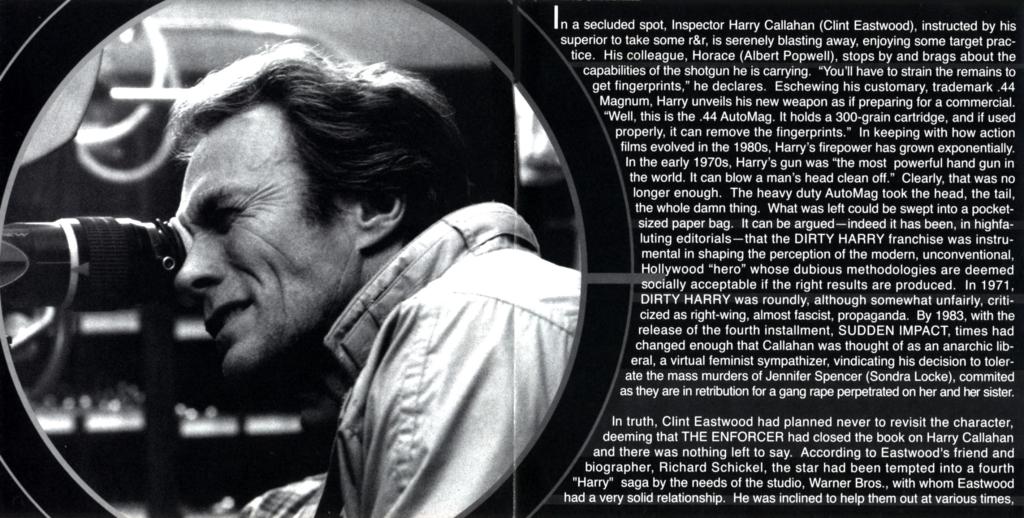
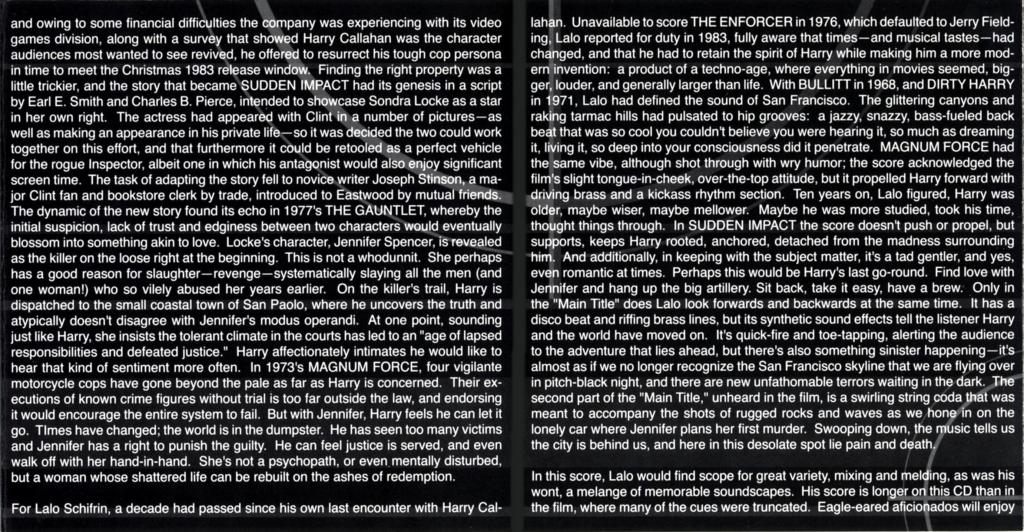
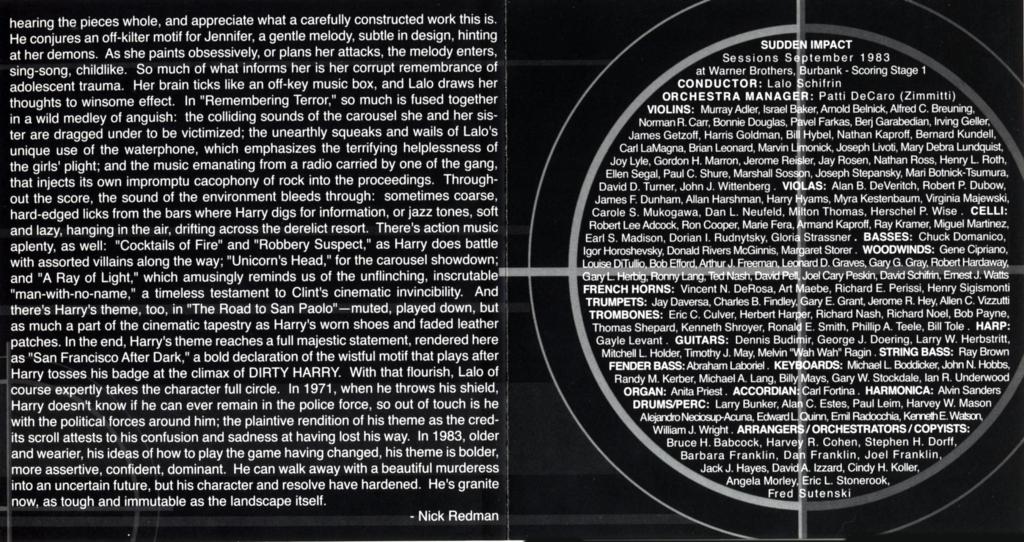
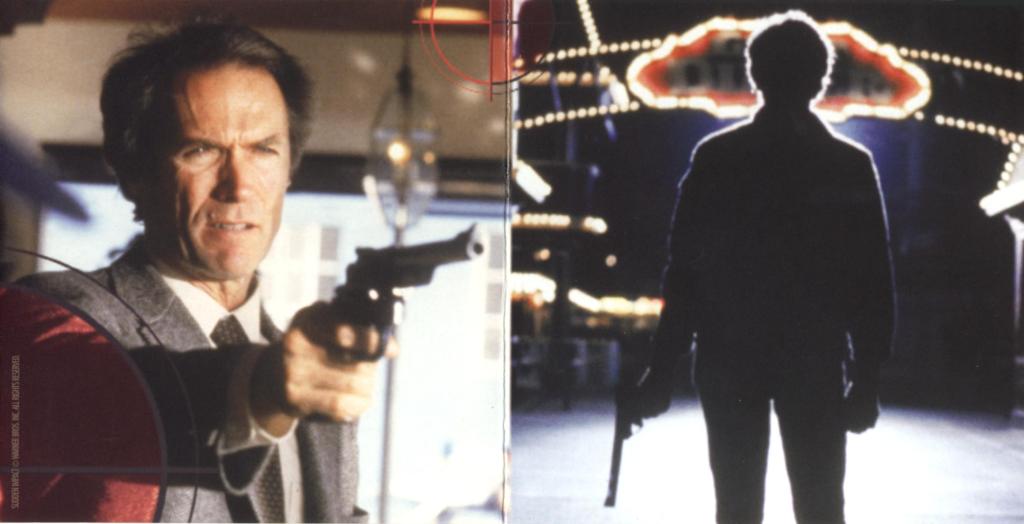
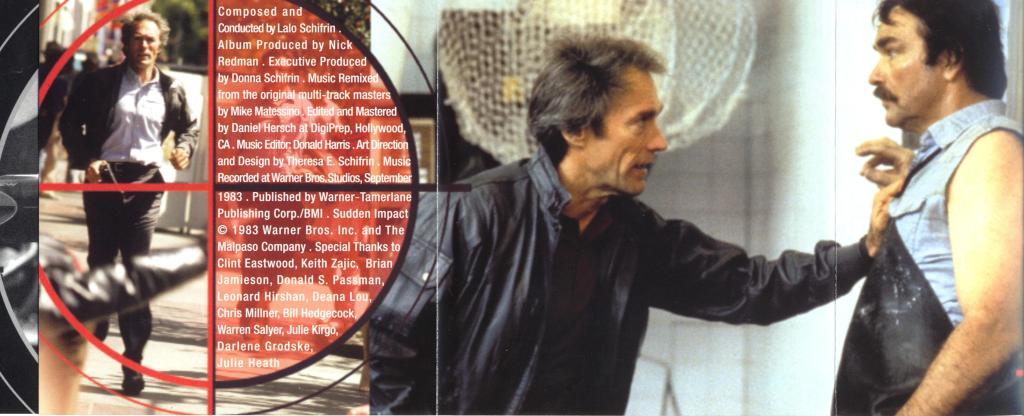

http://www.movie-wave.net/titles/sudden_impact.html
Clint Eastwood returned to one of his most enduring roles in 1983’s Sudden Impact, the fourth of five times he played “Dirty” Harry Callahan, and the only entry in the series he directed. The deliberate pacing of most of Eastwood’s directorial outings is gone, in its place a succession of violent actions scenes which make for great entertainment. The third film in the series, The Enforcer, had been scored by Jerry Fielding, but Lalo Schifrin returned this time and delivered a typically stark, modern effort.
“Modern” this time doesn’t just refer to the fierce orchestral music (though there is plenty of that), but Schifrin also incorporated the sounds of the day (including, unexpectedly, scratching records and early 80s pop in the main title) – these sections are little more than a curio today, a relic of another age which is thankfully behind us. The real meat of the score is in those orchestral passages, which finds Schifrin offering a bleak, uncompromising soundscape – often dominated by harsh, genuine dissonance.
It is not difficult to admire Schifrin for putting music like this into an early 80s action thriller – and nobody would dare offer anything like it today, such challenging music having long since disappeared from films – but many will find it difficult to actually enjoy when separated from the film. Schifrin rarely, if ever, gets mentioned with people like Fielding and Alex North as someone who really pushed the boundaries of avant garde orchestral music in films, but if anything he pushed them even further than those two composers, less concerned with using melody as his base and instead concentrating on texture. He is especially adept at an orchestral jazz fusion sound, and sections of this score simply ooze class.
“Eclectic” is certainly a word to use, though – for every piece of harsh orchestral modernism is a piece accompanied by a drum kit and electric guitars, and while these (in particular “Ginley’s Bar”) work well, the contrast with the rest of the score is perhaps a little too far. Most eclectic of all is the seven-minute “Remembering Terror”, which goes from carnival source music to avant garde orchestral experimentation to 80s pop, and back again. It’s masterful in its own way, but I’m forced to return to my observation that it’s not actually very easy to enjoy. The rapturous, gorgeous love theme that finally reveals itself during the end title is a rare exception.
Despite that – this is impressive music, and by and large follows the established Dirty Harry sound impressively while updating it to the then-current time. The album features great sound quality and informative notes from Nick Redman. Sudden Impact may not be a score for everyone, but for those who enjoy more challenging music it’s a sure-fire winner. It is available on Schifrin’s own label Aleph Records, who have also previously released the music from the first three films in the series.

Despite being the most obvious answer to the question “name a film that’s better than the book”, Peter Benchley’s debut novel ‘Jaws’ is an entertaining read. Published way back in 1974, it has stood the test of time pretty well and still grips today, with some themes that haven’t dated too badly.
Sian reviewed it here 2 years ago, but she wasn’t much of a fan, so I thought I’d write a review to balance things out.
Amazingly (or perhaps not, given how fickle publishers can be), it’s the only one of Benchley’s 8 novels that is still in print, in the UK at least. It was, of course, a huge success on its original release, the hardcover staying on the bestseller lists for almost a year. It’s not hard to see why. The concept both grabs the attention and makes it a great beach read. The classic cover can’t have hurt either. The first edition hardback has a more stylistic version of the shark’s head and swimmer design that became so famous. It was the Bantam paperback that carried the lower brow but more effective picture that went on to be the movie poster. And that title! Benchley claims it was arrived at out of desperation as the date of publication approached. He reminisces that he told his editor “it’s short; it fits on a jacket, and it may work”.
The setup and characters will be familiar to anyone who has seen the film. Giant shark preys on swimmers off the beaches of Amity Island, local police chief Brody tries to protect his citizens, eventually teaming up with Hooper, a young marine scientist, and Quint, a grizzled boat captain.
The plot is slightly different from the movie’s, with a much slower second act that focuses on Chief Brody’s marriage. It’s less effective than the pacier and more eventful approach the film took, but it does do a good job of building the relationship between Brody and Hooper. The final act is more similar to the film, although it lack the brilliant drunken scar comparing competition and the classic ‘sinking of the Indianapolis’ speech. What it does have in spades is the musing on modern masculinity, with Brody as the Everyman, Hooper as the trendy intellectual and Quint as the embodiment of macho charisma. The three metaphorically compare dick size whilst hunting the fish, making it feel at time a bit like low rent Hemingway.
Unfortunately, this being a popular novel from the 1970s, it’s not without its representation issues. It’s deeply racist at times, and the biggest female character, Brody’s wife, is really only there to give Brody and Hooper a trophy to fight over.
But for all that it’s great fun. The shark is a suitably menacing enemy, and Benchley manages to keep things tense despite that fact that all anyone has to do to keep out of trouble is stay on dry land. It has everything a holiday read should have and is worth a picking up even though you’ve seen the movie.

I love Metal Gear Solid 3: Snake Eater. I love playing the game, hanging out with other people while they’re playing the game, reading about the game, and watching videos of the game; you name it, I love it. It would have been really hard for Konami to make it so I don’t enjoy playing one of my favorite games ever on my current favorite videogame console (the 3DS), but heavens to Murgatroyd, they came pretty close.
Metal Gear Solid: Snake Eater 3D does not come off like the paragon of technical excellence that the original title did when it was first released on the PS2 in 2004. Part of that is because the 3DS is not a PS2. Nintendo’s latest portable is capable of much more than that now-“retro” home console, as proven by titles like Resident Evil: Revelations. The other part is that Snake Eater 3D feels unfinished. There are a few cool new features here, but Snake Eater 3D is also a downgrade from the original in a lot of ways — not something you’d expect on newer hardware.
It’ll be up to the individual consumer to determine if Metal Gear Solid 3D: Snake Eater‘s technical failings are damaging enough to cancel out the worth of the port’s newly implemented features, and the original title’s impeccable writing, scenario design, and gameplay design. Maybe you’ll have a better time of reasoning that out for yourself after I break down some details for you.
Snake Eater is Kojima’s best work, combining Hollywood action-movie tropes, pure videogame logic, densely packed Japanese pseudo-science fantasy, a period-piece war story, absurdist comedy, and heart-wrenching drama into a seamless whole. As far as Metal Gear games go, this one bursts with the most personality and creativity. That goes for both the game’s scripted events and its allowance for the player to guide the story in a direction that reflects who they are.
On the surface, Snake Eater‘s central theme is survival. That’s a pretty common theme in games today, whether it’s Call of Duty or Resident Evil. Part of what makes Snake Eater special is the lengths to which it goes to first limit the player in their capacity to survive, then allow them to overcome those limits in the most incredible, imaginative methods possible. There are so many ways to deal with the problems presented to you in Snake Eater, with so many bonuses, Easter eggs, diversions, and surprises to be found by those who are creative and lucky enough to discover them.
The result of this dedication to variables is a game that truly makes you feel like a co-developer. The player is just as responsible for generating the particulars of their Snake Eater experience as Kojima and company. It’s up to you to decide if you want to kill a guard, choke him out, sneak past him, or throw a snake to at him to scare him off. That’s just entry-level stuff. The amount of choices the game gives you from there, and the truly bizarre events that you can bring about, is nothing short of astounding.
Also worth noting is how much the game focuses on minutiae. More so than any other Metal Gear title, Snake Eater is about juxtaposing quiet moments with load, boisterous action scenes. How much action you play, versus how much time you spend in nature, is largely up to you. Personally, I love the hunting and gathering aspects of the title, so I tend to approach Snake Eater as an opportunity to commune with an artificial environment in as thorough (and hopefully conflict-free) a way as possible. I can spend inordinate amounts of time just in hunting different kinds of animals, sneaking around and listening to the sounds of the jungle, and goofing off, without getting bored.
Others will focus on speed and lethality, working to move forward and take out enemies as efficiently as possible. Still others will focus on exploration and completionism, working to see every event, listen to every line of dialog, finish every task, and so on. Snake Eater is a true sandbox game. It may have a linear story, but there are many, many deviations you can take from that path to make the story your own.
I could go on and on about all the things that make Snake Eater an amazing game. Let’s get on to the specifics regarding this particular version. I’ve never liked the way Metal Gear Solid 3 controls, or the way most Metal Gear Solid games control. It’s not that they’re too limiting; it’s that they’re overly complicated and cluttered.
Snake Eater 3D fixes a few of those issues, but creates new problems. The controls are definitely less cluttered, and the touchscreen menu makes operating your sub-screen a breeze. That said, the new controls will definitely throw off veterans who like the way Metal Gear Solid games traditionally play. The use of the face buttons to aim will be especially off-putting to longtime fans. It may not bother those who are new to the series, as the controls are serviceable. That’s one of the many reasons why this port is best suited to those who’ve never played Metal Gear Solid before.
The camera, however, is sure to annoy everyone. The depth of field is very hard to get just right, which is crucial in a game that’s all about being aware of everything around you. There is also no simple way to quickly reset the camera back into position behind the player. The best way to do that is to quickly hit the “aim” button, which is pretty disorienting (especially if you prefer first-person aiming). The Circle Pad Pro definitely helps in making the camera, and all of the game’s controls, easier to manage, but it shouldn’t have been necessary. Konami could have enabled touchscreen aiming, or at the very least allowed us to customize the controls.
With or without the Circle Pad Pro, there is never a way to auto-reset the camera. What’s really weird is that with the Circle Pad Pro, there is a button for auto-resetting the character — it makes Snake automatically face north. So Konami knew that we’d want to auto-reset something. They just didn’t realize that it’s the camera, not the character, that we need more control over. It may sound like a small gripe, but it’s a huge oversight that makes playing through Snake Eater 3D a lot more confusing and convoluted than it needs to be.
Speaking of playing through the game, I may be doing it wrong, but there seems to be a lot of stuff missing from this version. The secret dream sequence mini-game is missing, as is the monkey-catching mini-game, along with a few other little touches. If anything, Konami should have been adding content to a game that most interested parties likely already own.
Snake Eater 3D is also lacking technical polish. The frame rate is low throughout, and some cut-scenes are even more choppy. This didn’t bother me too much, but if you feel uneasy spending time with videogames that struggle to stay smooth, prepare to feel awkward.
Instead of a smooth frame rate, 3DS players are presented with (what else) stereoscopic 3D effects, which look pretty nice, particularly in first-person mode. It’s never quite as enveloping as the 3D in Ocarina of Time or RE: Revelations, but it still does a good job of making an unnatural polygon-based world feel more real. The game also appears to have slightly improved character models and animations. Snake’s smirking and scowling seems just a touch more expressive, and the many colors of the jungle seem slightly more vibrant. It’s strange that Konami went the extra mile with these visual flourishes, while permitting the frame rate to suffer so badly. It really does feel like there was a time that Snake Eater 3D was intended to be a visual powerhouse, but was instead rushed out before it could be fully optimized.
Other 3DS-specific features include some occasional gyroscope controls that are difficult to acclimate to, and the ability to make your own camouflage by taking photographs of real objects with the 3DS camera. Neither feature stuck out as worthwhile to me, especially the camouflage thing, which, if abused, could completely void the value of collecting in-game camo. Probably the least flashy but most worthwhile addition to the game is the crouch walk from Metal Gear Solid 4. It really helps to keep the game flowing toward the player at a brisk pace. CQC has also been streamlined, making hand-to-hand combat much more breezy. That’s what people like about stabbing guys in the neck, right? The “breezy factor”?
There are a few other little nods to Nintendo in the game, like Yoshi dolls that are hidden in nearly every stage, and the occasional issue of Nintendo Power lying around in Snake Eater 3D‘s more upscale locations. These touches are cute, but they don’t quite offset the amount of content that didn’t make the jump from the PS2 original to this handheld port.
It all results in a game with 9.5/10 ideas delivered in a 6/10 package. If you already own the original, or if you aren’t keen on playing Snake Eater on a portable, then there is no reason to pick it up again. If you do want the game on the go, you may be better off waiting for the Metal Gear Solid HD Collection on the PS Vita. If you’re never going to buy a Vita and you have no other way to get your hands on Metal Gear Solid 3, you should definitely grab Snake Eater 3D. Those who were hoping for a new or improved version of the game will be disappointed.
Snake Eater 3D‘s sometimes-slapdash presentation weighs the title down. It’s a far cry from the majesty we saw from Metal Gear Solid: The Naked Sample back at E3 2010. Still, some camera failings and an unreliable frame rate are not enough to completely crush one of the finest games ever made.