

“Like the brief doomed flare of exploding suns that registers dimly on blind men’s eyes, the beginning of the horror passed almost unnoticed.” When a book begins like this, you know it’s going to be good.
William Peter Blatty’s tale of a possessed little girl and a mother who will do anything to save her is probably best known as one of the greatest horror films ever made, and the novel is often overlooked. It shouldn’t be – it really is a phenomenal tale, extremely well-written and full of little details that didn’t survive the transition to the cinema screen.
It’s terrifying, too – remember that episode of Friends where Joey puts The Shining in the freezer? That’ll start to seem like a good idea, although the book is so demonic that I can’t help but wonder whether ice or flames could even damage it.
The characterisation is also much more explicit in the novel than in the film, and by the end of the book I felt like Father Karras was… well, a father to me. In fact, all of the characters are much more believable, and it’s easy to feel both empathy and horror towards young Regan, often at the same time.
Perhaps it’s so believable because parts of the novel are based on real events – Father Merrin is based upon Gerald Lankester Harding, a British archaeologist who excavated the caves where the Dead Sea Scrolls were found. In fact, Harding and Blatty met each other in Beirut, and Blatty himself has confirmed that the character was based on his real-life acquaintance.
It’s also thought that the novel is based on the actual exorcism in 1949 of a young boy in Maryland, known under the pseudonym of ‘Roland Doe‘. Blatty himself studied at a Jesuit school in the 1950s, and it was there that he first heard Doe’s story.
It’s Blatty’s Jesuit influences that allow him to write so convincingly on a subject that most would look upon as religious fiction – I’m a thoroughbred atheist, so why was I so terrified by a story about possession?


One of the certainties encountered by any person involved in the realm of political participation for any amount of time is that they will inevitably hear at least a few conspiracy theories. As a phenomenon, conspiracy politics have become more and more in vogue in the United States and elsewhere, and were given a tremendous boost in the post-9/11 era. The political center of each particular conspiracy theory varies, with the popular talk of the “Zionist Occupational Government” (Z.O.G) on the far-right, and other, more pedestrian theories like “who shot JFK” and the 9/11 Truth Movement making their way into the mainstream of the national consciousness and the arena of political discourse.
The position of the American Party of Labor on this issue is two-fold. On one hand, many of what we know to be historical fact is, or would be, considered outlandish conspiracy theories by most of the public at large. Organizations such as the American Party of Labor have seen too much of the true nature of the state and are well aware of the sort of activities the CIA/FBI engage in (MK-ULTRA, COINTELPRO, etc) so there is no “conspiracy theory” as far as we are concerned; it is a generally acknowledged fact. On the other hand, as a rule, the American Party of Labor generally rejects conspiracy politics.
Origins of Conspiracy Theories
The true impulses that give birth to the rise and popular proliferation of the conspiracy theories in the United States are generally related to:
A) The political disenfranchisement of the people, and their inability to control their own circumstances or chart their own future. This leads to a general desire to seek awareness and to know what is going on, since people feel exasperated and helpless to change it.
B) The desire of the people, rooted in their own direct experiences, to know whether or not the state that governs over them is anti-democratic, and to what lengths are they willing to go to maintain their political domination.
This desire to understand and to be aware of the actions of a political power that the overwhelming majority are so thoroughly alienated from often goes to extreme lengths, with generous rationalizations of personal prejudices, to the point where things become ridiculous.
“Both the U.S. and Soviet governments are controlled by the same furtive conspiratorial cabal of internationalists, greedy bankers, and corrupt politicians. If left unexposed, the traitors inside the U.S. government would betray the country’s sovereignty to the United Nations for a collectivist New World Order managed by a ‘one-world socialist government.’”
The above quote is from Robert Welch Jr., the founder of the John Birch Society, a far-right free-market organization with nationalist, anti-labor and anti-Semitic views.
Nevertheless, the desires of the people at the base of conspiracy politics, the desires to be empowered, to take charge of their own destiny, and to make themselves aware of the world around them are very valid desires and will continue until the problem of their disempowerment is rectified.
There is no “conspiracy” as to whether or not the United States is in the hands of a ruling class, who will hold onto power by any means necessary. The American working class doesn’t need to watch the movie “Zeitgeist” to know that. Analyzing published photographs of the Kent State Massacre of student protestors by the national guard and even a brief introduction to the history of the American labor movement, where labor strikes have often been put down by the military with live ammunition, should be a sufficient answer to any uncertainties that still linger.
What Theories Are Popular?
The general proliferation of conspiracy theories is large, and they are a dime a dozen. With the infamous Kennedy assassination, there has been an abundance of compelling evidence compiled to possibly implicate the CIA, the Miami Cuban exiles, etc. in his assassination, but it is still inconclusive. There is similarly compelling evidence that implicates certain forces within the United States government in the actions of September 11th, which has culminated in the “9/11 Truth Movement.”
The leaders of the 9/11 Truth Movement are also generally believers in something that they call the “NWO” or the “New World Order.” They are not talking about a “New World Order” in a metaphoric sense, but a literal sense. They believe that a powerful secret group has been planning, for over a hundred years according to them, to take over the world. These people sincerely believe that there is an “NWO” that will make a one world government and that it will force “collectivism” and “socialism” on the broadest sections of the people. They claim that the United Nations is one of those organizations, and that all major figures in world history, from Karl Marx to Woodrow Wilson to Hitler and Noam Chomsky, are all in on it.
These sentiments, often associated with and oriented towards the political right-wing, have long existed in the United States. In the 1990’s, they had the support of the right-wing militia movements made of angry white men, but precious little support other than that—then the events of September 11th happened. The far-right (and even left elements as well) have since rode the wave of anti-Bush sentiment, pushing the claims that the Bush clique engineered 9/11.
Tactics and Methodology
As for the American Party of Labor, we do not place much stock in the theory that the US government orchestrated 9/11, the JFK assassination, or any other conspiracy theory of which we do not have solid proof. Whether or not these conspiracies have elements of truth to them or not is not the issue. The issue with conspiracy politics always boils down to “What are you going to do about it?”
In this respect, the greatest advocates of conspiracies fall flat. The 9/11 Truth Movement and other conspiracy-oriented people and organizations generally revolve all of their tactics around the idea that, “if people just knew the truth there would be spontaneous riots in the streets.” Their vision is one of the angry masses spontaneously taking power into their own hands and rectifying the horrible situation in which they find themselves.
This is a classical textbook example of how far removed from actual struggle and strife the advocates of conspiracy generally are. Because the advocates of conspiracy politics have rarely experienced overt, naked repression, they think that their tactics, which rely primarily around “spreading the word” would be sufficient to get people into the streets to change their circumstances. This is a comically naïve point of view which overlooks the experience of every single country that has ever had the pleasure of living under a military junta, or experienced a coup, or experienced other open repression.
In places around the world where fresh bodies are found in the river every day, and it is common knowledge among the people to hide from government soldiers when they come, why does this not lead to the spontaneous mass anger that the advocates of conspiracy politics hope to achieve? Certainly, historically, this open repression has often lead to small scale insurgencies, often popular with the masses of oppressed peoples, but oppression itself is not and has not been the sole ingredient that leads to uprising.
Why haven’t the entire population of Iraq stood up on their feet against the American occupation? The tanks in their streets are real and tangible, not just the warnings on the distant horizon of conspiracy theorists, but present-day fact. True, there has been a large insurgency in Iraq and it has a popular base, but why has there not been a larger resistance? The decisive ingredient in resistance is, and always has been, organization.
To the Marxist-Leninist, the dissemination of information is always towards the achievement of concrete political goals, and always in the context of organizing. With the conspiracy theorist, there is rarely organizing of any type and only the vaguest of goals accompanied by the vaguest of intentions. Their “movement” is generally typified by a loose association of individuals, rather than an organized entity with goals or aspirations of any kind.
For this reason, rarely is their dissemination of information followed by concrete political demands or a coherent call to action of any kind, nor is any sort of political infrastructure built to carry out any demands. To the conspiracy theorist, “spreading the word” is not the means to accomplish the goal, but is generally the goal itself. Educating and informing the masses doesn’t become a mode of political agitation towards an end; it becomes the focus and long term goal of the entire “movement.”
The tactics of conspiracy politicians are generally non-committal, individualistic and all of their attempts to wake the people up are entirely a matter of individual initiative. The individual has to take the initiative to go on “infowars” and inform themselves after seeing a website URL. The individual has to take the initiative to watch films like “Loose Change” and “Zeitgeist.” The individual has to take the initiative to do whatever they see fit to hamper the forces at the root of perpetrating the conspiracy, without anything resembling collective or coordinated and organized actions towards definite goals.
The uncoordinated complete lack of (bordering on rejection of) organization typified in conspiracy politics is not too distant from the tactics employed by the “anti-authoritarian” left-wing. The most striking similarity is that both have failed to ever produce any tangible change on the planet Earth.
Who Cares Who Shot JFK?
The impotent, sporadic and individualistic response of the adherents of conspiracy politics to what they see as impending doom is hardly the only problem with these movements. In addition to the general glaring fact staring in the face of all conspiracy politics (that without political power in the hands of the people nothing will be turned around, and without concrete political organization there will never be political power in the hands of the people), there is also the fact that many of the contemporary conspiracies are actually a service to the status quo rather than opposition to it.
The JFK assassination theories are a case in point. Again, I understand the needs of the people to know where the ultimate decision making power in the United States rests, and what the forces that hold power are willing to do to keep it. That said, the JFK assassination theories have effectively canonized and absolved a man guilty of his fair share of crimes against the people of the United States and the world.
John F. Kennedy was the head of state of the USA, and the list of crimes of his administration include such highlights as an unsuccessful invasion of Cuba to overthrow the popular revolution in that country, the continued funneling of aid and “military advisers” into South Vietnam to continue and exacerbate the Vietnam conflict, and sanctioning the “removal” (the coup d’état and subsequent murder) of South Vietnamese puppet president Ngo Dinh Diem when he refused to cooperate. Now, if a similar coup d’état took place in the United States, a putsch among the ruling elite, then of what concern is this to the people of the United States and the world at large?
I don’t need to know if agents of the United States government were behind the death of JFK. I know that they were behind the deaths of many prominent Black Panther Party members and American Marxists, and that is enough for me.
I would like to know conclusively whether the United States government killed Anna Mae Aquash, not JFK. I don’t need to know if the Miami Cuban exile community had a hand in the Kennedy assassination—they weren’t exactly saints before then. The Miami Cuban exile organizations have had their hands in numerous acts of sabotage, terrorism, subversion and murder of Cubans over the decades since the Cuban Revolution, so whether or not they had a hand in the JFK incident becomes trivia rather than an incriminating sin.
As for 9/11, whether or not the United States government had a hand in it also becomes trivia, in the context of the legacy of crimes that span the entire existence of the United States. If the US government did orchestrate the entire 9/11 incident, that may be tragic but not at all surprising—the entire history of the United States government is a litany of all of the peoples who have been crushed underneath its jackboot, both domestically and internationally.
I don’t need to know if the United States government was behind the destruction of the World Trade Center on September 11th, and the subsequent deaths of 3,000 people. I already know for a fact that the United States government has been behind the destruction of entire cities on every corner of the earth, leading to the death and indirect deaths of millions. I already know that the US government has historical precedents of killing their own citizens covertly. What is so mysterious or scandalous about 9/11, whether the US government had a hand in it or not?
These conspiracy theories about 9/11 are not only diversions from the everyday hardships of the people of the world, but in actuality, they are the epitome of ethnocentrism. More people die in one hour worldwide from starvation, every day, than the total death toll from the events of 9/11.
I say this not to trivialize the deaths of those who perished on September the 11th, but to point out the selective way that tragedy and the loss of innocent human life is measured. Three thousand Americans die, it’s a landmark world tragedy that must be marked every year indefinitely. Over a million Iraqis die and it’s a newspaper clipping, a “current event” of interest, and nothing more. These conspiracies are beyond irrelevance, as they pass into the realm of service to bourgeois reformism and apologizing for the very status quo that they claim opposition to.
Implications & Conclusions to Draw
Conspiracy politics, regardless of their accuracy and legitimacy, have very little to offer the people of the United States or any other country, aside from intriguing or demoralizing trivia. The real road to ending the injustices that weigh heavy on the minds of conspiracy theorists , and on the majority of all peoples in general, is and always has been Marxism-Leninism.
The working class will not change the situation that they find themselves in today by watching online documentaries or enlightening themselves by frequenting conspiracy websites for the latest analysis. While these things may ultimately aid them in their emancipation, and these are measures that are also practiced by the Marxist-Leninist left, the element that is missing from the actions of the conspiracy theorists is the element most fundamentally decisive to turning the situation around and empowering the people: organization.
In order to be a contender to seize power from an organized force (the bourgeois state), the working class and oppressed peoples of the world will likewise have to constitute themselves an organized force as well. At the head of the efforts to realize this aim, you will find the Marxist-Leninists.
You’ve no doubt heard that everything’s bigger in Texas. That’s more than just a trite expression, and I’m not just saying that because Texas is home to U.S. Global Investors.
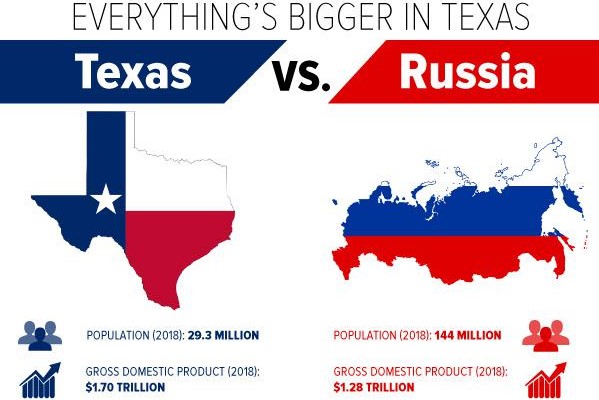
Want to know how big Texas really is? Let’s compare its economy with that of Russia, the world’s largest country by area. As you probably know, Russia’s been in the news a lot lately, so the timing of this comparison makes sense. The U.S. just levied fresh sanctions against the Eastern European country for its alleged meddling in the 2016 presidential election, and early last week President Donald Trump warned Russia that the U.S. military could soon strike its ally Syria in response to its use of chemical weapons—a promise he kept Friday evening.
The Russian ruble traded sharply down following the news, decoupling from Brent crude oil, the country’s number one export.
But back to the comparison. Even though Russia has nearly five times as many residents as Texas, the Lone Star State’s economy is more than $40 billion larger. Texans, therefore, enjoy a gross domestic product (GDP) per capita of around $58,000, whereas Russians have one closer to $8,700.
Texas Is So Much More than Oil Country
The Russian Federation is the largest single producer of crude in the world, pumping out 10.95 million barrels per day (bpd) in January, according to the country’s energy minister. Texas is no slouch, though, as its output came close to 4 million bpd in January. That’s the most ever for a January since at least 1981. And from December 2017 to February 2018, its oil and gas industry accounted for nearly 30 percent of the state’s employment growth, according to the Federal Reserve Bank of Dallas.
But whereas Russia’s economy is highly dependent on exports of oil and petroleum products, the Texas economy is broadly diversified. The state ranks first in the U.S. for not only oil production but also wind energy. It has a robust agricultural sector, and it’s a leading hub for advanced technology and manufacturing, aeronautics, biotechnology and life sciences. Austin, the state capital, is steadily emerging as the most dynamic U.S. filmmaking city outside of Hollywood.
All of this has helped contribute to Texas being among the fastest growing states in the U.S. In 2017, it grew by more than 1,000 new residents per day.
Meanwhile, Russia’s population is slowly shrinking because of low birth rates and low immigration. Its population peaked at 148 million in the early 1990s—right around when the Soviet Union fell—and by 2050, it’s estimated to sink to 111 million.
Can Russia Root Out Its Corruption?
One area where Russia trumps Texas is in corruption. If you think Texas—or any other state—has a corruption problem, Russia takes it to a whole new level. Last year, it ranked 135 out of 180 countries on Transparency International’s Corruption Perceptions Index (CPI), released in February. Among Eastern European countries, only Uzbekistan, Tajikistan and Turkmenistan ranked lower. Watchdog group Freedom House was similarly critical in its most recent analysis, giving the country an overall democracy score of 6.61 out of 7, with 7 being “least democratic.”
So notorious and widespread is Russia’s mafia that a number of movies have been made about it. One of the best among them is David Cronenberg’s excellent Eastern Promises (2007).
Having said all that, I believe it’s prudent for investors to underweight Russian stocks for the time being and overweight Western Europe. Because of U.S. sanctions, Americans have until May 7 to divest completely from a number of Russian names, including Rusal, En+ Group and GAZ (Gorkovsky Avtomobilny Zavod), all of which saw serious outflows last week. The MSCI Russia Index, which covers about 85 percent of Russian equities’ total market cap, plunged below its 200-day moving average, but last Thursday it jumped more than 4 percent, its best one-day move in two years.
Weaker Greenback and $1 Trillion Deficit Helps Gold Glitter
Gold is rallying right now, but as I told Daniela Cambone in last week’s “Gold Game Film,” it has little to do with Russian geopolitics, or even trade war fears, which have subsided somewhat in the past couple of weeks. Instead, the price of gold is responding primarily to a weaker U.S. dollar. For the 30-day period, the greenback has dipped close to 20 basis points—for the year, more than 11 percent.
I think what’s also driving the yellow metal right now are concerns over the U.S. budget deficit and ballooning government debt. This week the Congressional Budget Office (CBO) said it estimated the deficit to surge over $1 trillion this year and average $1.2 trillion each subsequent year between 2019 and 2028, for a total of $12.4 trillion. By the end of the next decade, then, debt held by the public is expected to approach 100 percent of U.S. GDP.
According to the U.S. National Debt Clock, government debt now stands at over $21 trillion—or, put another way, $174,000 per taxpayer. Imagine what the interest payments on that must be.
The CBO, in fact, commented on this. Believe it or not, the government’s annual payments on interest alone, made even more burdensome by rising rates, are expected to exceed what it spends on the military by 2023. And remember, defense is one of the country’s top expenditures, alongside Medicare, Medicaid and other entitlement programs.
There was even more news last week on debt and the deficit, as Congress tried, and failed, once again to amend the Constitution by requiring a balanced budget. The amendment could not get the two-thirds support it needed.
You can probably tell where I’m headed with all of this. Savvy investors and savers might very well see this as a sign to allocate a part of their portfolios in “safe haven” assets that have historically held their value in times of economic contraction.
Gold is one such asset that’s been a good store of value in such times. As I’ve shown before, gold has tracked U.S. government debt up since 1971, when President Richard Nixon ended the gold standard. I always recommend a 10 percent weighting in gold—5 percent in bars and coins; 5 percent in high-quality gold stocks, mutual funds or ETFs.
Asset Allocation Works
On a final note, I think it’s important that investors remember to stay diversified, especially now with volatility hitting stocks and geopolitical uncertainty on the rise. I’ve discussed Roger Gibson’s thoughts on asset allocation with you before, and I believe his strategy still holds up well today to capture favorable risk-adjusted returns.
In the chart above, based on Gibson’s research, you can see that a portfolio composed of U.S. stocks, international stocks, real estate securities and commodity securities gave investors an attractive risk-reward profile between 1972 and 2015. This diversified portfolio, represented above by the orange circle, delivered good returns with a digestible amount of volatility, compared to portfolios that contained only one, two or three asset classes. Concentrating in only one or two asset classes could possibly give you higher returns, but you’d also likely see much greater risk, which many investors aren’t willing to accept.
In the chart above, based on Gibson’s research, you can see that a portfolio composed of U.S. stocks, international stocks, real estate securities and commodity securities gave investors an attractive risk-reward profile between 1972 and 2015. This diversified portfolio, represented above by the orange circle, delivered good returns with a digestible amount of volatility, compared to portfolios that contained only one, two or three asset classes. Concentrating in only one or two asset classes could possibly give you higher returns, but you’d also likely see much greater risk, which many investors aren’t willing to accept.