
Author: ulaghchi
On Georgia Street in Downtown Vancouver. Autumn of 2015.


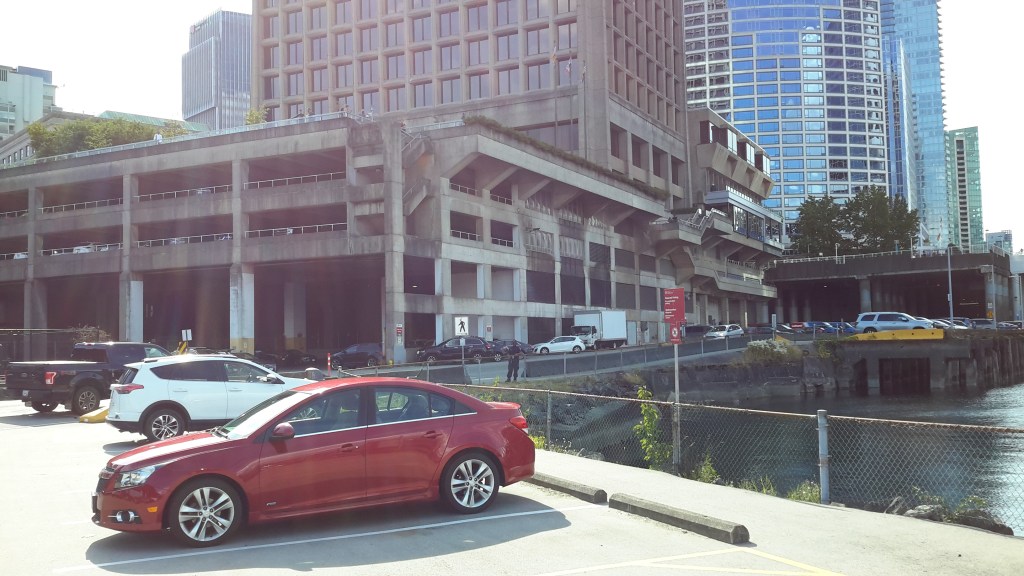


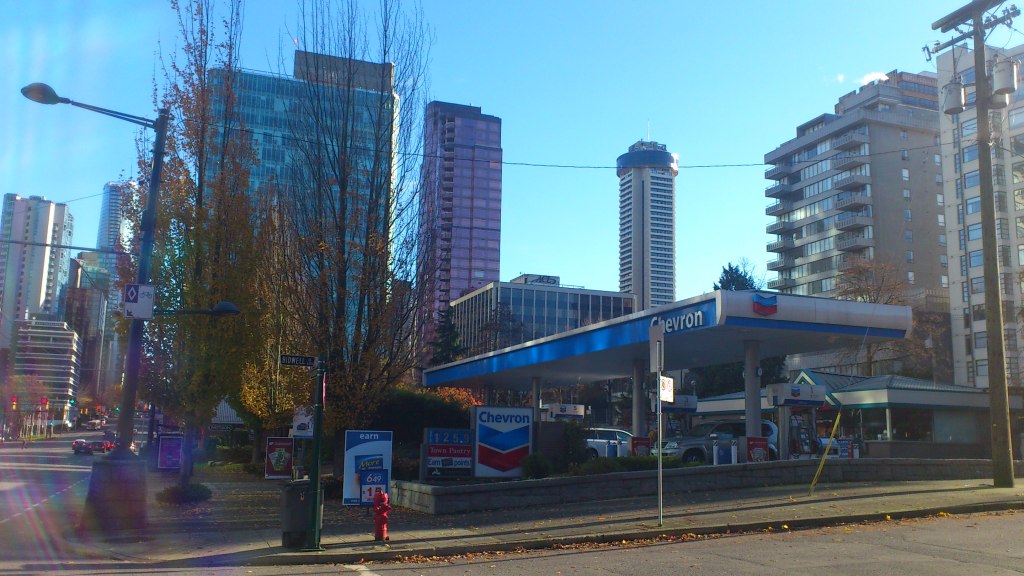
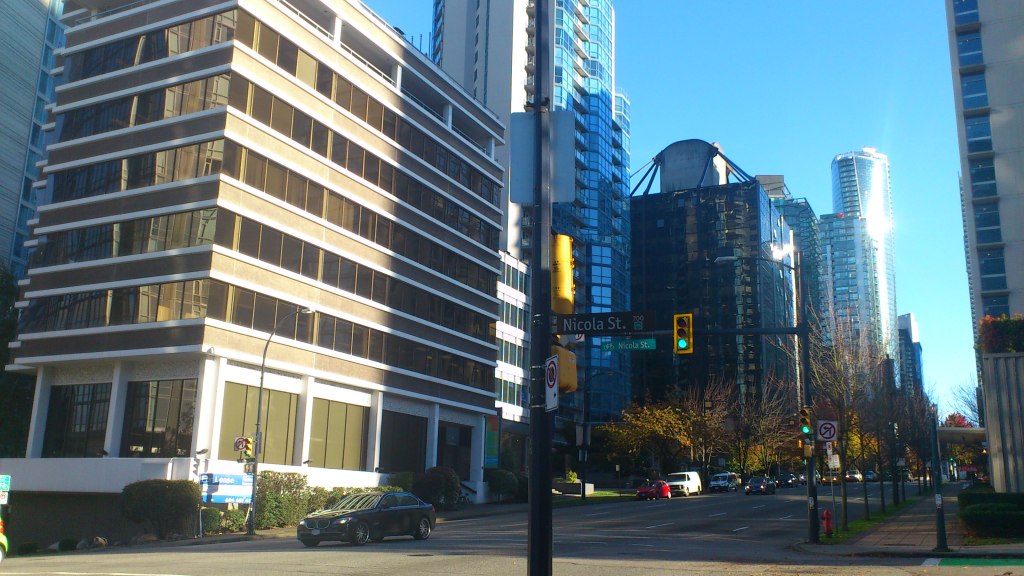
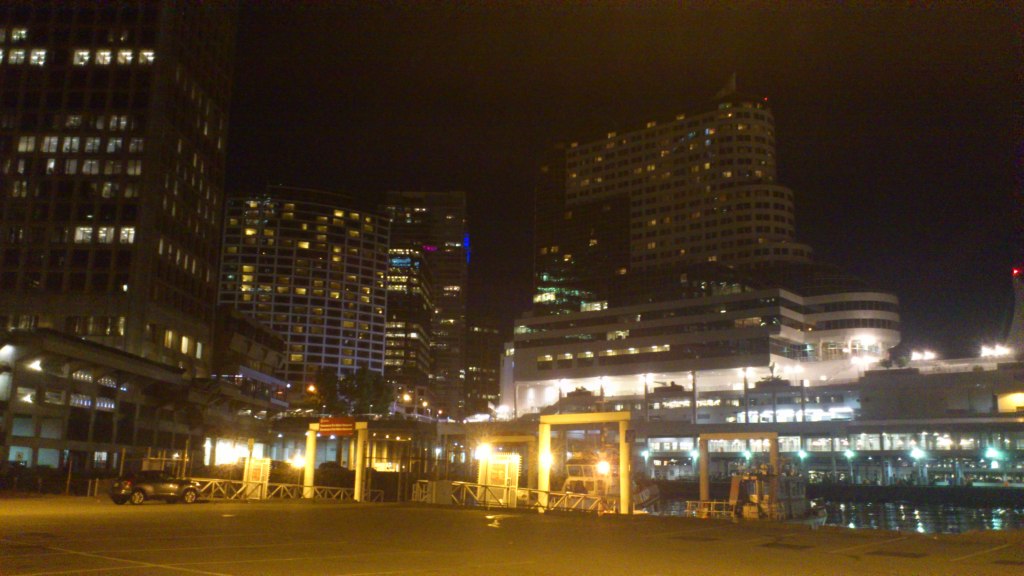

Georgia Street is an east–west street in the cities of Vancouver and Burnaby, British Columbia, Canada. Its section in Downtown Vancouver, designated West Georgia Street, serves as one of the primary streets for the financial and central business districts, and is the major transportation corridor connecting downtown Vancouver with the North Shore (and eventually Whistler) by way of the Lions Gate Bridge. The remainder of the street, known as East Georgia Street between Main Street and Boundary Road and simply Georgia Street within Burnaby, is more residential in character, and is discontinuous at several points.
West of Seymour Street, the thoroughfare is part of Highway 99. The entire section west of Main Street was previously designated part of Highway 1A, and markers for the ‘1A’ designation can still be seen at certain points.
Starting from its western terminus at Chilco Street by the edge of Stanley Park, Georgia Street runs southeast, separating the West End from the Coal Harbour neighbourhood. It then runs through the Financial District; landmarks and major skyscrapers along the way include Living Shangri-La (the city’s tallest building), Trump International Hotel and Tower, Royal Centre, 666 Burrard tower, Hotel Vancouver and upscale shops, the HSBC Canada Building, the Vancouver Art Gallery, Georgia Hotel, Four Seasons Hotel, Pacific Centre, the Granville Entertainment District, Scotia Tower, and the Canada Post headquarters. The eastern portion of West Georgia features the Theatre District (including Queen Elizabeth Theatre and the Centre in Vancouver for the Performing Arts), Library Square (the central branch of the Vancouver Public Library), Rogers Arena, and BC Place. West Georgia’s centre lane between Pender Street and Stanley Park is used as a counterflow lane.
East of Cambie Street, Georgia Street becomes a one-way street for eastbound traffic, and connects to the Georgia Viaduct for eastbound travellers only; westbound traffic is handled by Dunsmuir Street and the Dunsmuir Viaduct, located one block to the north.
East Georgia Street begins at the intersection with Main Street in Vancouver’s Chinatown, then runs eastwards through Strathcona, Grandview–Woodland and Hastings–Sunrise to Boundary Road. East of the municipal boundary, Georgia Street continues eastwards through Burnaby until its terminus at Grove Avenue in the Lochdale neighbourhood. This portion of Georgia Street is interrupted at several locations, such as Templeton Secondary School, Highway 1 and Kensington Park.
Georgia Street was named in 1886 after the Strait of Georgia, and ran between Chilco and Beatty Streets. After the first Georgia Viaduct opened in 1915, the street’s eastern end was connected to Harris Street, and Harris Street was subsequently renamed East Georgia Street.
The second Georgia Viaduct, opened in 1972, connects to Prior Street at its eastern end instead. As a result, East Georgia Street has been disconnected from West Georgia ever since.
On June 15, 2011 Georgia Street became the focal point of the 2011 Vancouver Stanley Cup riot.
Majestic Hollywood: Interview with Mark A. Viera

As pretty much every classic movie fan knows, the year 1939 is considered special, well, extraordinary really. Film historians refer to it as the greatest year in the history of Hollywood due to both the high quality and high attendance of the films that came out. With World War Two as an ever-looming threat and the economic pressures of the Great Depression almost at an end, it’s no wonder people flocked to the theaters in droves. Whether you wanted to escape down the yellow brick road with Dorothy, never go hungry again with Scarlett, or say goodbye to Mr. Chips, there was no shortage of great films for audiences to go and see. In celebration of the Golden-Era’s most Golden year, Mark A. Vieira has penned the book Majestic Hollywood: The Greatest Films of 1939. The book chronicles 50 of the year’s greatest films, including behind-the-scenes information, production highlights and stunning photographs that tell the stories of 1939.
I would like to extend my gratitude to Mark A. Vieira for taking the time to do this interview as well as to Running Press Publishers for supplying CMH with a copy of the book as well as the photos accompanying this post!
1.) With so much already written about Hollywood’s Golden Year, what inspired you to write Majestic Hollywood: The Greatest Films of 1939?
I wrote Majestic Hollywood for Running Press so you can celebrate the 75th Anniversary of these great films.
The book is full of tidbits that will help you enjoy them even more. Just reading the reviews is a treat. The film critic in 1939 had to review the film with its first-night audience; we can go back in time and feel what it was like to see a familiar classic for the first time.
Most importantly, I can finally answer the question “Why were so many great films made in one year?” Just because some company in 1989 said this was so doesn’t mean it was. I had to find out for myself.
2.) You clearly did your research for this book, covering the history and production of 50 classic films. Where did you begin your research? Did you start with individual films or simply the year itself?
When I write a book, I’m telling a story. To do that, I create a timeline. I started in 1938. I looked in the Los Angeles Times. And that’s where I found the answers to my big question. There were five reasons for the proliferation of quality films. The reasons were cultural, financial, and political. But you’ll have to read the Introduction to find out exactly what they were!
3.) Your book is filled with interesting facts and anecdotes about the films’ productions. While in the researching process, what was your favorite or most interesting discovery?
The Cowardly Lion costume in The Wizard of Oz had a zipper on its back, not buttons or another type of fastener.
4.) In the book, you mentioned the social/political conditions surrounding Hollywood that allowed for such a “Big Film” year in 1939. How much of your research centered on those conditions that created Hollywood’s Golden Year?
World politics was one of the reasons that the Hollywood studios pushed quality projects. They knew they were about to lose Europe to a major war, which meant a third of their revenue, so they planned big movies that could open with road shows and bring in big money right away.
5.) In 1939, Hollywood released hundreds of films. In you book you managed to narrow the list down to 50. What was the criterion for making the cut?
The list created itself; there wasn’t a lot of agonizing. The only one we found it hard to cut was Made for Each Other.
It was a pleasure working with an editor who knows so much about classic films and has a true enthusiasm for them. Cindy De La Hoz has, of course, written a number of landmark books of her own, so I’m lucky to have her as my editor.
6.) What would you consider Hollywood’s greatest achievement of 1939?
Trusting its audience with intelligent fare. Most of these films couldn’t be greenlighted in 2014. Watching them requires thought.
7.) What is your personal favorite film (or films) from 1939?
The Rains Came has become my favorite. From childhood both Union Pacific and The Wizard of Oz were real favorites. I didn’t see Gone With the Wind until I was sixteen, but it quickly joined my personal pantheon (My favorite non-1939 films are King Kong, Grand Hotel, The Scarlet Empress, The Sign of the Cross, and Portrait of Jennie.)
Back to the Future Part 3 (10/10) Movie CLIP – Your Future Is Whatever You Make It (1990) HD
Doc Brown (Christopher Lloyd) and Clara (Mary Steenburgen) say goodbye to Marty (Michael J. Fox) before flying away in a train.
The final installment in the Back to the Future trilogy picks up where the second film left off, but it casts off the dizzying time travel of the first two films for mostly routine comedy set in the Old West. Marty McFly (Michael J. Fox) receives a 70-year-old letter from his inventor friend, Doc Brown (Christopher Lloyd), who tells Marty that he has retreated a century in time to live out a relatively quiet life in the Old West. Doc Brown reveals that he hid his DeLorean car/time machine in an abandoned mine outside town, and when Marty does some research and discovers that the Doc died shortly after writing the letter, he decides to find the car, travel back in time, and warn the Doc about his demise. Meanwhile, the Doc, who has fallen in love with a local woman (Mary Steenburgen), realizes he can’t hide in the past from the problems he has caused to the time flow in the previous two adventures. He reluctantly decides to return to the present with Marty, but first, they have to find a way to get the DeLorean up to time-travel velocity with a broken fuel line and no gasoline.
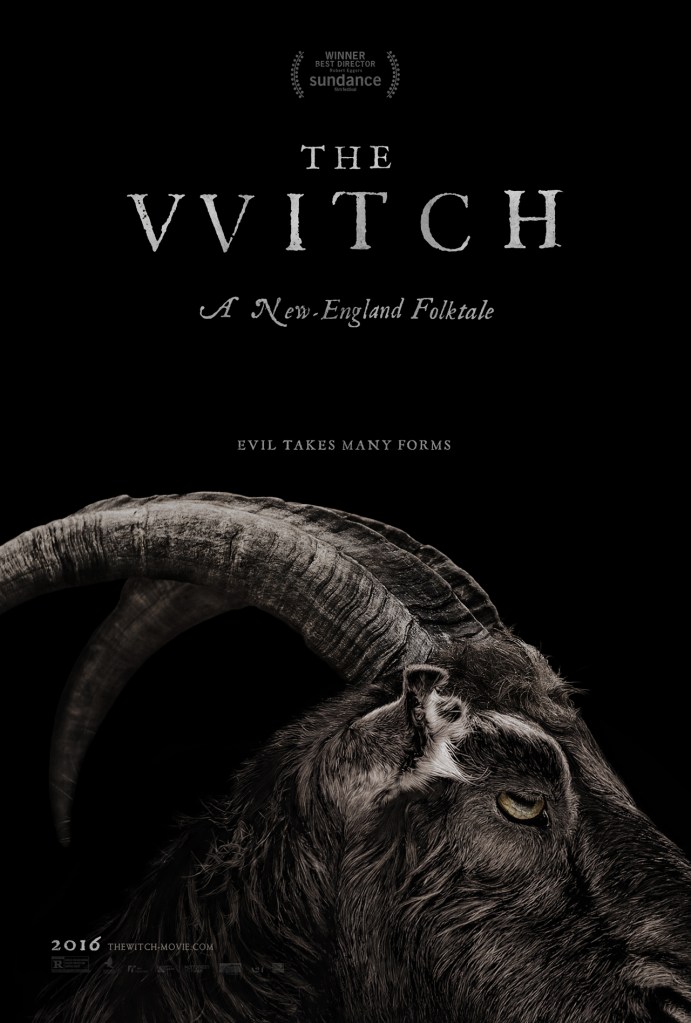
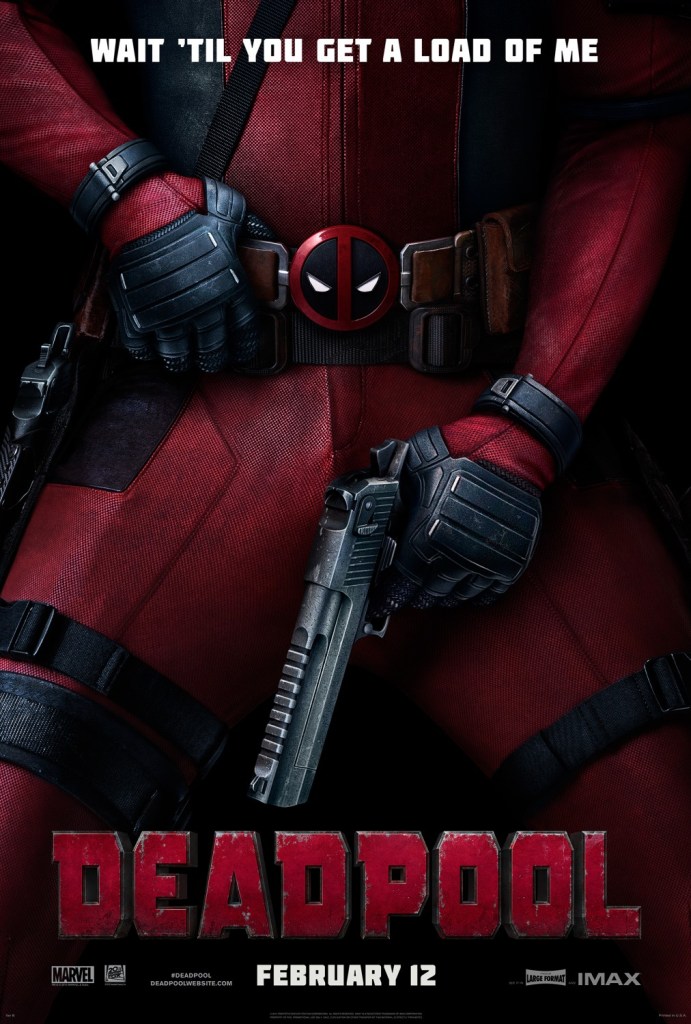
Just finished watching The Witch (2015) and Deadpool (2016)…
Fire Emblem: New Mystery of the Emblem (DS)

Fire Emblem: New Mystery of the Emblem is a remake of the second half of the SNES game, Fire Emblem: Mystery of the Emblem, which itself was a combined remake and sequel to the original Fire Emblem on NES. It’s a companion game of sorts to Fire Emblem: Shadow Dragon on DS as Shadow Dragon remade the events of the original and the first half of Mystery of the Emblem whereas this game remade the events of Mystery that took place after the events of the first game. To give a little more incentive to buy this game, though, it also bundles the four maps from the Satellaview streaming exclusive BS Fire Emblem: Archanean War Chronicles which aren’t (legitimately) playable any longer outside of this DS release.
The story picks up where Shadow Dragon left off. The Dark Pontiff Gharnef has been defeated and evil shadow dragon has been banished from this world. A new threat has emerged, however, as Hardin, the new emperor of the mighty Archanean Empire, has begun to act extremely out of character, ruling his realm with an iron fist and mercilessly crushing any dissent. It quickly becomes apparent that while the shadow dragon’s body was defeated, the evil of its soul continues to persist, casting a new cloud of darkness over the continent. It once again falls to Marth to muster his allies and face down this evil with swords, magic, and waifus.
The most significant change to the Fire Emblem formula that New Mystery of the Emblem introduced was the addition of Casual Mode. To some folks, this forever ruined Fire Emblem by making it approachable to casual players, but I disagree. I would call Casual Mode the single most significant addition to the series since the weapon triangle for that very reason – it makes accessible to less skilled or less patient players an incredible series. For that, I have a lot of respect for Mystery of the Emblem. The character portraits and battle sprites look absolutely fantastic for the DS. The DS was perfectly capable of decent looking 3D games, but New Mystery of the Emblem perfectly demonstrates how exceptional the DS is as a 2D system.
Everything about New Mystery of the Emblem has been streamlined since the SNES game it remakes. The menu system between battles is simple and intuitive, the conversations between characters that flesh out their characters have been expanded to show more of their personalities and interactions with one another, and the control in battle is simple to use and free of any waste. The screens are perfectly used to keep the focus on the action. The bottom screen always displays the battlefield while the top screen can be used to display either unit formation (hit points, items, etc) or a mini-map with the force strength of each side.
Fire Emblem: New Mystery of the Emblem is everything a classic Fire Emblem game should be. It takes everything that made Shadow Dragon great and improves it, and it takes most of the flaws Shadow Dragon had and fixes them. It’s a shame that this game never saw a Western release, but fortunately, an excellent fan translation exists if you can find a working ROM and a good DS emulator (or, as I did, load the patched ROM onto a micro SD card and play it on a real DS with an R4 card). The inclusion of the BS Fire Emblem maps is my favorite “extra” from any Fire Emblem game just because how difficult it is to find a working ROM of those maps, in general, let alone a ROM patched into English. For Fire Emblem fans, this game is an absolute must even if you have to use some dubious means to play it in English.
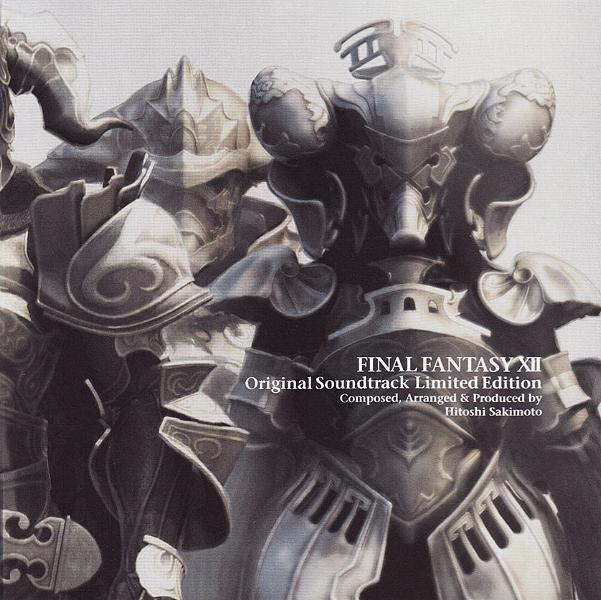
Now listening to Final Fantasy XII by Hitoshi Sakimoto and Casino Royale by David Arnold…

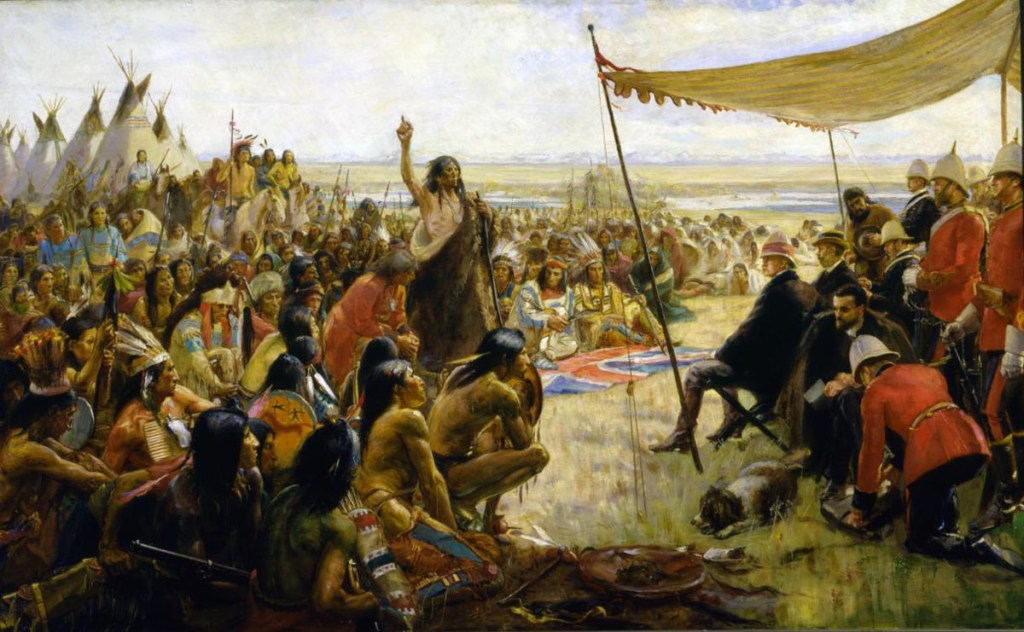
Last Indian Council Held On Canadian Soil by Sydney Prior Hall, 1891.
US Marines Support Nazi Symbol
A new disgusting low has been reached in the US armed forces.
Machinarium Review – The Things We Do For Love | TheXboxHub
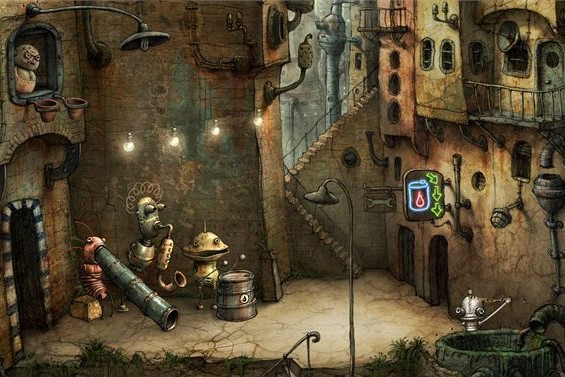
It’s a tale as old as time. But before this gets too soppy, I am of course talking about love. And it’s that love in Machinarium that motivates our main hero on his quest to rescue his girlfriend. You play as Josef the robot, who sets out to save his other half, Berta, who has been kidnapped by the villainous Black Cap Brotherhood gang. It’s quite an adventure that awaits our little tin hero too, filled with dangerous obstacles, nasty villains and some weird and wacky locals.
Some of you may be familiar with Machinarium, as it was originally released way back in 2009 for the PC. In the years that followed, it made its way to many platforms, including mobile and handheld devices, but never graced an Xbox console. Until now that is.
Partly thanks to a cult following, and widespread praise from critics, Machinarium is a point and click puzzle adventure which picked up numerous awards along its journey, grabbing everything from top soundtrack to best overall game. It all sounds very promising so far then.
The game starts with Josef hurtling towards a rubbish heap from the top of a very tall tower. It’s clear that where he lands is a huge junkyard full of spare parts and abandoned robots. Not exactly ideal then. It’s from here where he must battle his way back to Berta.
Thanks to the point and click nature of Machinarium, Josef is pretty simple to control and it’s easy to get the hang of things. He can extend if you click his head (or use the right thumbstick) and then this allows you to collect any objects within reach. You can move by hovering your cursor over your destination and hitting A. Whether it’s stretching, walking, or something else entirely, your cursor will change to an appropriate symbol when it is possible to take such action.
Some items you collect can be combined too – remembering this is crucial to solving many puzzles as you venture on. Your inventory is shown across the top of the screen when you scroll the cursor up to it, or you can use the left thumbstick on the Xbox controller. If you scroll to the bottom of the screen, you can access the main menu (alternatively you can press the menu button).
As Machinarium is a puzzle game, you may find yourself stuck. And trust me, you will. Thankfully then, you’re offered help in two ways. Firstly, you are gifted one hint per level, which is represented by a light bulb at the end of your inventory bar. This is designed to nudge you in the right direction. Secondly, there is a walkthrough book just next door to the hint bulb which will depict a step by step comic of what you will need to do. However, to unlock the book you need to play through a short arcade-esque side-scrolling shooter first. This is a fresh way of building in a help mechanic to a puzzle game, which works well. The only downside to this is the lack of variation, as you’ll play the same stage each time to unlock the walkthrough which differs from screen to screen. Don’t get too complacent though, as even after using both of these aids, I still got stuck in several parts of the game.
As you solve each puzzle, watching Josef navigate his surroundings is a beautiful spectacle. He’s a clumsy thing, but utterly charming, and bursting with character right down to how he stores what he finds in his metal chest by eating it whole. He will also reminisce about his time with Berta throughout the game, which strikes a beautiful chord, hitting somewhere between light-hearted and mournful.
It’s not just Josef who impresses, and in Machinarium the moody, watercolour effect visuals and eerie soundtrack fully immerse you in the game world. It’s not an attractive environment in the traditional sense of the word; it’s a grim, murky, dark and depressing location that Josef finds himself in. However, the way developer Amanita Design realises this world makes it beautiful to look at.
Another of the great things about Machinarium is how simple its puzzles seem at first, only for you to discover how intricate and clever they are. You’ll have plenty of light bulb moments, and there will also be times where you’ll be tricked into thinking the solution is more simple than it actually is. It’s great game design and there are no cheap deaths here either. In fact, you can’t die – which is good because I’m not sure I could deal with that considering how attached I’ve become to Josef.
I’m ashamed to say I had never even heard of Machinarium before starting this review. However, now I understand the hype. It’s an indie game in the truest sense of the word which carves out its own distinct identity. It’s just a shame it has taken so long to make the journey over to Xbox One.
Machinarium on Xbox One is a beautiful, stylish little puzzler that provides a real challenge. More important than that, however, is the fact that it immerses you in a fascinating and mysterious world that is an absolute pleasure to explore.

