The impeachment crisis and US war plans against Russia

https://www.wsws.org/en/articles/2019/12/31/pers-d31.html

With each passing day of the impeachment crisis, the distance between the official reasons for the conflict in Washington and the real reasons grows wider.

It has become increasingly clear that the central issue is not Trump’s attempt to “solicit interference from a foreign country” by “pressuring a foreign country to investigate one of the president’s main domestic political rivals,” as alleged in the whistleblower complaint that triggered the impeachment inquiry.

Rather, the conflict raging within the state centers on Trump’s decision to temporarily delay a massive weapons shipment to Ukraine.

The ferocity with which the entire US national security apparatus responded to the delay raises the question: Is there a timetable for using these weapons in combat to fight a war against Russia?

A New York Times front-page exposé published Monday, coming in at 5,000 words and bearing six bylines, makes it clear that Trump’s decision to withhold military aid—over a month before his phone call with Ukrainian President Zelensky—triggered the conflict that led to the president’s impeachment.

As the Times reports, “Mr. Trump’s order to hold $391 million worth of sniper rifles, rocket-propelled grenades, night vision goggles, medical aid and other equipment the Ukrainian military needed to fight a grinding war against Russian-backed separatists would help pave a path to the president’s impeachment.”

The newspaper states that Trump decided to hold up the distribution of military aid to Ukraine on June 19 after he read a news article saying that the “Pentagon would pay for weapons and other military equipment for Ukraine, bringing American security aid to the country to $1.5 billion since 2014.”

Trump’s action sparked a “fiery internal debate,” according to the Times, leading to an intervention by the “national security team” arrayed in a “united front” around National Security Advisor John Bolton, an architect of the Iraq war.

After Trump rejected the officials’ calls for the aid to be released, saying, “We are pissing away our money,” details of the hold on the military assistance were leaked to the press and a high-ranking CIA official submitted a “whistleblower” complaint accusing Trump of soliciting “dirt” on his political rival.

The CIA spun up its “Mighty Wurlitzer.” The intelligence agencies and the media began promoting the narrative that Trump held up the military aid to hurt his political rival, even though Trump made his decision on the aid package a month before he asked Zelensky to investigate former Vice President Joe Biden.

These actions would ultimately lead to only the third impeachment of a president in the history of the United States, throwing the country into a constitutional crisis with an unknown outcome.

All of this begs the question: Given the enormous political cost of impeachment to those who initiated it, what could possibly explain the urgency and ferocity with which the entire national security establishment responded to a delay in the distribution of weapons to Ukraine?

Is there a timetable for using these weapons in combat? Is the United States planning a provocation that would thrust Ukraine into a major new military offensive?

The Russian military is certainly drawing such conclusions. In a statement earlier in December, the chief of the Russian General Staff, Valery Gerasinov, said the increased tempo of US exercises in Eastern Europe indicates that the US is making plans for “using their forces in a large-scale military conflict.”

“Military activities are increasing in the Baltic States and Poland, in the Black and Baltic Seas,” Gerasimov said. “The intensity of the [NATO] bloc’s military exercises is growing. Their scenarios point to NATO’s deliberate preparation to use their forces in a large-scale military conflict.”

In February, the United States will ship some 20,000 soldiers to Europe to participate in a military exercise that will be the largest deployment of forces to the European continent in a quarter-century. The exercise, dubbed Defender 2020, will include 17,000 European troops and, according to Breaking Defense, see NATO forces “extend their logistics trains and communications lines from the Baltic to the Black Seas.” The exercise will cost $340 million.

The National Defense Authorization Act, passed with overwhelming bipartisan support within days of the House vote to impeach Trump, includes an additional $300 million in military aid to Ukraine as part of a record-shattering increase in US military spending.

Overall, the United States and its NATO allies have provided more than $18 billion in military and other aid to Ukraine since the 2014 US-backed coup that overthrew the pro-Russian president, Viktor Yanukovych, and installed the current pro-US regime. This was on top of what Assistant Secretary of State Victoria Nuland bragged in 2013 was “over $5 billion” in aid to “ensure a secure and prosperous and democratic Ukraine.”

The bags of money handed out by the CIA via various “civil society” pass-throughs in Ukraine helped overthrow its elected government and bring to power a US proxy regime supported by the extreme right.

In 2013, the US supported a measure that would integrate Ukraine into a political association and trade pact with the EU. This was intended to pave the way for Ukraine joining NATO. When the Yanukovych government opposed the agreement, the US launched the 2014 coup, installing a puppet regime viciously hostile to Russia.

The 2014 coup was a pivotal point in the efforts of the United States to militarily encircle and ultimately carve up Russia. Since the dissolution of the USSR, the United States has led a systematic drive to expand NATO right up to and beyond the borders of the former USSR.

As Foreign Affairs notes:

In March 2004, NATO accepted into its ranks the three Baltic states—Estonia, Latvia, and Lithuania—which were once part of the Soviet Union, and four other states. The accession of the Baltics signaled that NATO enlargement would not halt at the former border of the Soviet Union. The EU followed suit in May 2004, extending its border eastward to include a number of former Soviet republics and allies, including the Baltic states, the Czech Republic, Hungary, Poland, Slovakia, and Slovenia.

But the US was taken aback by Russia’s determined response to the Ukraine coup. Russia annexed Crimea following a referendum in which the overwhelming majority of the population of the enclave supported leaving Ukraine. Moscow at the same time backed a secessionist movement in the country’s east.

Given these circumstances, Foreign Affairs writes:

In fact, that Ukraine is at the center of this storm [the impeachment crisis] should not be surprising at all. Over the past quarter-century, nearly all major efforts at establishing a durable post–Cold War order on the Eurasian continent have foundered on the shoals of Ukraine. For it is in Ukraine that the disconnect between triumphalist end-of-history delusions and the ongoing realities of great-power competition can be seen in its starkest form.

Despite the unforeseen and disastrous consequences of the CIA-backed coup in Ukraine, the United States is determined to continue its efforts to militarily encircle Russia, which it sees as a major obstacle to its central geopolitical aim—control of the Eurasian landmass, which would give it a staging ground for a conflict with China.

The relentless drive for military escalation has brought the Democrats into an alliance with the fascistic right in Ukraine, which has held street demonstrations to pressure President Zelensky to continue and escalate the US-backed proxy war against Russia.

One thing is clear. If there is indeed a timetable to use the hundreds of millions of dollars in weapons being transferred to Ukraine, such a war risks a nuclear escalation. In 2018, Elbridge A. Colby, one of the principal authors of the National Defense Strategy issued by the Pentagon in January of that year, published an article titled, “If You Want Peace, Prepare for Nuclear War.”

He wrote:

The risks of nuclear brinkmanship may be enormous, but so is the payoff from gaining a nuclear advantage over an opponent.

Any future confrontation with Russia or China could go nuclear… In a harder-fought, more uncertain struggle, each combatant may be tempted to reach for the nuclear saber to up the ante and test the other side’s resolve, or even just to keep fighting.

Amid a growing upsurge of the class struggle all over the world, the Trump administration, representing a despised and isolated capitalist class, can see in war a means to tamp down, as one comment in the Financial Times recently put it, the “class war” at home, and “make domestic antagonism seem beside the point, if not unconscionable.”

But it is the international growth of the class struggle that provides the means to oppose the war drive of the ruling elite. As mankind enters the third decade of the 21st century, the advanced stage of war preparations on the part of the ruling class makes it all the more urgent, in the immortal words of Leon Trotsky, to counterpose to the “war map” of the capitalists the “map of the class struggle.”

This means unifying the growing struggles and forging a common movement against war and attacks on democratic rights, as an essential part of the struggle for socialism.
The 6,000

https://nomadiceveryman.blogspot.com/2019/09/the-6000.html

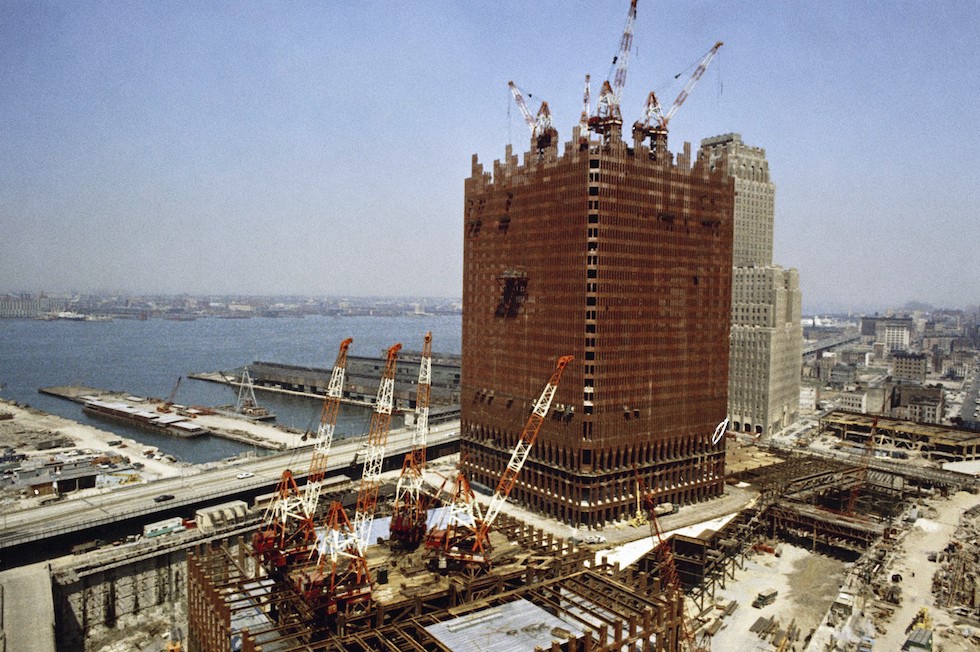
High above the Manhattan skyline, in the early 70’s, over 6,000 of these prefabricated floor sections were hoisted by construction cranes and then set into place by union steel workers fabricating the World Trade Centers. On Sept. 11th 2001, according to the official record of that day, they simply fell and in so doing, disappeared into the history books as if they never existed.

I for one, would like to know how that is possible.

They were prefabricated elsewhere and lifted and set in place by the construction cranes, as pictured.

Some consisted of 3 trusses but most were made up of 4.

18′ wide by 60′ long, they were welded together along with the transverse mounted trusses (3 Bridging Trusses you can see in the picture) and the corrugated metal floor pans that the concrete for the floors was poured on top of.

“Two or more beams will be preassembled with steel decking and erected as a unit, to save erection time…” Engineering News Record

I reported yesterday that the trusses were made of A-36 structural steel. I was wrong. The columns were made of A-36 structural steel. The trusses were made of High-strength low-alloy (HSLA) which is quite a bit stronger than even A-36 structural steel, with a yield strength of up to 80,000 psi as compared to the 35,000 psi of A-36.

“Clear span of the floorbeams is as much as 60 ft. They will be fabricated of high-strength low-alloy steels.” Engineering News Record

“Their (HSLA steels) yield strengths can be anywhere between 250–590 megapascals (36,000–86,000 psi). Due to their higher strength and toughness HSLA steels usually require 25 to 30% more power to form, as compared to carbon steels.” Wiki

So in fact, the trusses themselves were made of stronger and harder metal than the columns were.

We know that the floors were brought in an set in place in sections, not just because the article from Engineering News Record says so, but also because we have photographic evidence that supports the claim.

In the photograph above, you can clearly see the floor sections are being set in place and one of them is laying on the lower floor (left side) waiting to be lifted installed.

From this other photo, we can see the same process.

When they were lowered into place as a prefabricated unit, they were bolted then welded to both the interior core columns and the exterior columns at the spandrels.

Then the next section would be brought in and it would then be bolted and welded in the same manner, but also then welded to the previous floor section at the floor pan and the transverse mounted trusses.

The end result, per floor, would look something like this prior to the pouring of the concrete floor.

Now why is all of this important?

According to the official explanation of the collapse of these two buildings, the upper section fell down on the lower, intact building, crushing the concrete into dust, and destroying the structural integrity of the building.

But no amount of pressure that could possibly have been generated by the upper block, or “piston”, can explain the virtual disappearance of the floor systems you are now looking at.

So what you should see, if nothing else, is at least several thousand of these lying scattered about the Ground Zero debris field.

Allow me to put this another way.

The standard size of these was 18′ x 60′. That equals 1,080 square feet of surface area for the floor pan.

A football field is 360 feet by 160 feet. That equals 57,600 square feet of surface area.

With those dimensions, it would take only 53 of these floor sections to cover an entire football field.

There were about 4,400 of these 60′ floor sections used to make the 220 floors of the Twin Towers.

That means that with just the 60′ sections alone, there were enough of these floor sections to cover 83 football fields. 83.

And again, I ask you, do you see anything that even resembles the floor sections (much less, 83 football fields worth of them)?

With 20 60′ prefabricated floor sections and 8 35′ sections per floor times 110 floors of each of the two World Trade Centers, that comes to over 6,000 welded floor sections that had to have “fallen” to the ground on Sept. 11th 2001.

I ask you to find one. Just one.

I can find them for you. Steven Jones already found them for you (he just called them something else) as did the RJ Lee study and the FEMA report.

They just look a little different now.

Now the question is, what could have turned the prefabricated floor systems into tons of “iron-rich” spheres in the blink of an eye?

My guess would be this.

Peter Kuznick on Untold History of the United States

American University historian Peter J. Kuznick talks with David Swanson of Talk Nation Radio about the 2012 documentary series directed, produced, and narrated by Oliver Stone.

The documentary miniseries for Showtime had a working title Oliver Stone’s Secret History of America. It covers “the reasons behind the Cold War with the Soviet Union, U.S. President Harry Truman’s decision to drop the atomic bomb on Japan, and changes in America’s global role since the fall of Communism.” Stone is the director and narrator of all ten episodes. The series is a re-examination of some of the under-reported and darkest parts of American modern history using little known documents and newly uncovered archival material. The series looks beyond official versions of events to the deeper causes and implications and explores how events from the past still have resonant themes for the present day.

How Team Hillary played the press for fools on Russia

https://nypost.com/2017/10/26/how-team-hillary-played-the-press-for-fools-on-russia/

Hillary Clinton’s campaign didn’t just pay for the Kremlin-aided smear job on Donald Trump before the election; she continued to use the dirt after the election to frame her humiliating loss as a Russian conspiracy to steal the election.

Bitter to the core, she and her campaign aides hatched a scheme, just 24 hours after conceding the race, to spoon-feed the dirty rumors to an eager liberal media and manufacture the narrative that Russia secretly colluded with her neophyte foe to sabotage her coronation.

But it was Hillary who was trying to kneecap Trump, even after he licked her, fair and square, in Wisconsin, Pennsylvania, Michigan and other blue states.

Exhibit A is the book “Shattered: Inside Hillary Clinton’s Doomed Campaign,” by Jonathan Allen and Amie Parnes. In light of this week’s revelation that Hillary’s campaign funded the dirty anti-Trump “Steele” dossier, the book takes on a new significance. It reveals:

“Within 24 hours of her concession speech, [campaign chair John Podesta and manager Robby Mook] assembled her communications team at the Brooklyn headquarters to engineer the case that the election wasn’t entirely on the up-and-up. For a couple of hours, with Shake Shack containers littering the room, they went over the script they would pitch to the press and the public. Already, Russian hacking was the centerpiece of the argument.”

The plan, according to the book, was to push journalists to cover how “Russian hacking was the major unreported story of the campaign,” and it succeeded to a fare-thee-well. After the election, coverage of the Russian “collusion” story was relentless, and it helped pressure investigations and hearings on Capitol Hill and even the naming of a special counsel, which in turn has triggered virtually nonstop coverage.

A new Media Research Center study finds that, since the inauguration, major TV news networks have devoted an astonishing 1,000 minutes out of a total 5,015 minutes of Trump administration coverage discussing speculation that the Trump campaign may have colluded with Moscow in hacking Clinton campaign emails, “which means the Russia story alone has comprised almost one-fifth of all Trump news this year.” In contrast, they so far have devoted just 20 seconds to the more substantive scandal of Hillary and her husband possibly trading US uranium rights for Russian cash.

MRC analysts also found that more than a third of the networks’ Russia “scandal” coverage was based on anonymous sources who worked in the Obama administration, including Hillary’s State Department.

Though some of that coverage has proved erroneous, leading to retracted stories and fired reporters, the damage is done. Trump’s approval ratings have suffered, and the Russia investigation has distracted the administration.

Which was also part of Hillary’s plan.

In March, former Clinton campaign communications director Jennifer Palmieri summed up the post-election strategy in a Washington Post column comparing “Russiagate” to Watergate and encouraging the press and other Democrats to “turn the Russia story against Trump.”

“If we make plain that what Russia has done is nothing less than an attack on our republic, the public will be with us. And the more we talk about it, the more they’ll be with us,” she advised. “Polls show that voters are now concerned about the Russia story and overwhelmingly support an independent investigation.”

In short, Hillary couldn’t beat Trump with the political dirt she secretly purchased during the campaign, so she tried to cripple his presidency with help from an overwhelmingly anti-Trump media. Framing Trump as some sort of modern-day KGB plant was an easy sell, since the pro-Democrat media were also searching for a scapegoat to rationalize the crushing defeat of their shared liberal agenda at the polls.

The irony is, it may have in fact been Hillary who came closer to colluding with the Russians in smearing Trump as a Russian traitor than anything Trump did in trying to beat Hillary. The information in the dossier she bought for millions came from Russian intelligence sources, and her lawyers brokered the deal with a Kremlin-tied lobbyist. When it failed to stop Trump, the Russia paymaster turned into the Russia spinmeister.

Now we really know “What Happened.”