Main theme from the 1988 Soviet film All Costs Paid. Composed by Igor Nazaruk.
All Costs Paid (За всё заплачено) is a three-part television feature film from 1988, filmed by director Alexei Saltykov and based on the documentary novel of the same name by A. Smirnov. It’s one of the first films to show the war of the USSR in Afghanistan.
The city of Constantinople (modern Istanbul) was founded by Roman emperor Constantine I in 324 CE and it acted as the capital of the Eastern Roman Empire, or Byzantine Empire as it has later become known, for well over 1,000 years. Although the city suffered many attacks, prolonged sieges, internal rebellions, and even a period of occupation in the 13th century CE by the Fourth Crusaders, its legendary defences were the most formidable in both the ancient and medieval worlds. It could not, though, resist the mighty cannons of the Ottoman Sultan Mehmed II, and Constantinople, jewel and bastion of Christendom, was conquered, smashed, and looted on Tuesday, 29 May 1453 CE.
An Impregnable Fortress
Constantinople had withstood many sieges and attacks over the centuries, notably by the Arabs between 674 and 678 CE and again between 717 and 718 CE. The great Bulgar Khans Krum (r. 802-814 CE) and Symeon (r. 893-927 CE) both attempted to attack the Byzantine capital, as did the Rus (descendants of Vikings based around Kiev) in 860 CE, 941 CE, and 1043 CE, but all failed. Another major siege was instigated by the usurper Thomas the Slav between 821 and 823 CE. All of these attacks were unsuccessful thanks to the city’s location by the sea, its naval fleet, and the secret weapon of Greek Fire (a highly inflammable liquid), and, most importantly of all, the protection of the massive Theodosian Walls.
The city’s celebrated walls were a triple row of fortifications built during the reign of Theodosius II (408-450 CE) which protected the land side of the peninsula occupied by the city. They extended across the peninsula from the shores of the Sea of Marmara to the Golden Horn, eventually being fully completed in 439 CE and stretching some 6.5 kilometres. Attackers first faced a 20-metre wide and 7-metre deep ditch which could be flooded with water fed from pipes when required. Behind that was an outer wall which had a patrol track to oversee the moat. Behind this was a second wall which had regular towers and an interior terrace so as to provide a firing platform to shoot down on any enemy forces attacking the moat and first wall. Then, behind that wall was a third, much more massive, inner wall. This final defence was almost 5 metres thick, 12 metres high, and presented to the enemy 96 projecting towers. Each tower was placed around 70 metres distant from another and reached a height of 20 metres. The towers, either square or octagonal in form, could hold up to three artillery machines. The towers were so placed on the middle wall so as not to block the firing possibilities from the towers of the inner wall. The distance between the outer ditch and inner wall was 60 metres while the height difference was 30 metres.
To take Constantinople, an army would, then, need to attack by both land and sea, but all attempts failed no matter who tried and no matter what weapons and siege engines they launched at the city. In short, Constantinople, with the greatest defences in the medieval world, was impregnable. Well, not quite. After 800 years of resisting all comers, the city’s defences were finally breached by the knights of the Fourth Crusade in 1204 CE, although the attackers got in through a carelessly left-open door and not because the fortifications themselves had failed in their purpose. Repaired and rebuilt by Michael VIII (r. 1261-1282 CE) in 1260 CE, the city remained the most difficult military nut to crack in the world, but this reputation did not in any way deter the ever-more ambitious Ottomans.
The Ottoman Empire
The Ottoman Empire had begun as a small Turkish emirate founded by Osman in Eskishehir (western Asia Minor) in the late 13th century CE, but by the early 14th century CE, it had already expanded into Thrace. With their capital at Adrianople, further captures included Thessaloniki and Serbia. In 1396 CE, at Nikopolis on the Danube, an Ottoman army defeated a Crusader army. Constantinople was the next target as Byzantium teetered on the brink of collapse and became no more than a vassal state within the Ottoman Empire. The city was attacked in 1394 CE and 1422 CE but still managed to resist. Another Crusader army was defeated in 1444 CE at Varna near the Black Sea coast. Then the new Sultan, Mehmed II (r. 1451-1481 CE), after extensive preparations such as building, extending, and occupying fortresses along the Bosporus, notably at Rumeli Hisar and Anadolu in 1452 CE, moved to finally sweep away the Byzantines and their capital.
The Defenders
The crushing of the Crusader army at Varna in 1444 CE meant that the Byzantines were now on their own. No significant help could be expected from the West where the Popes were already unimpressed with the Byzantine’s unwillingness to form a union of the Church and accept their supremacy. The Venetians did send a paltry two ships and 800 men in April 1453 CE, Genoa promised another ship, and even the Pope later promised five armed ships, but the Ottomans had by then already blockaded Constantinople. The people of the city could only stock up on food and arms and hope their defences would save them yet again. According to the 15th-century CE Greek historian and eyewitness Georges Sphrantzes, the defending army was composed of fewer than 5,000 men, not a sufficient number to adequately cover the length of the city’s walls, some 19 km in total. Worse still, the once great Byzantine navy now consisted of a mere 26 ships, and most of those belonged to the Italian colonists of the city. The Byzantines were hopelessly outnumbered in men, ships, and weapons.
It seemed that only divine intervention could save them now, but in the many previous sieges over centuries gone by, it was believed that just such intervention had saved the city; perhaps history would be repeated. Then again, there were also ominous tales of impending doom: prophesies that proclaimed the fall of Constantinople when the emperor was called Constantine (a good number were, of course) and there was an eclipse of the moon – which there was in the days before the siege of 1453 CE.
The Byzantine emperor at the time of the attack was Constantine XI (r. 1449-1453 CE), and he took personal charge of the defence along with such notable military figures as Loukas Notaras, the Kantakouzenos brothers, Nikephoros Palaiologos, and the Genoese siege expert Giovanni Giustiniani. The Byzantines had catapults and Greek Fire, the highly inflammable liquid which could be sprayed under pressure from ships or walls to torch an enemy, but the technology of warfare had moved on and the Theodosian Walls were about to get their sternest ever test.
The Attackers
Mehmed II had one thing that previous besiegers of Constantinople had lacked: cannons. And they were big ones. The Byzantines had actually had first option on the cannons as they had been offered them by their inventor, the Hungarian engineer named Urban, but Constantine could not meet his asking price. Urban then peddled his expertise to the Sultan, and Mehmed showed more interest and offered him four times what he was asking. These fearsome weapons were put to good use in November 1452 CE when a Venetian ship, disobeying a ban on traffic, was blown out of the water as it sailed down the Bosphorus. The captain of the vessel survived but was captured, decapitated, and then impaled on a stake. It was an ominous sign of things to come.
According to Georges Sphrantzes, the Ottoman army numbered 200,000 men, but modern historians prefer a more realistic figure of 60-80,000. When the army assembled at the city walls of Constantinople on 2 April 1453 CE, the Byzantines got their first glimpse of Mehmed’s cannons. The largest was 9 metres long with a gaping mouth one metre across. Already tested, it could fire a ball weighing 500 kilos over 1.5 km. So mammoth was this cannon that it took an awfully long time to load and cool it so that it could only be fired seven times a day. Still, the Ottomans had plenty of smaller cannon, each capable of firing over 100 times a day.
On 5 April, Mehmed sent a demand for immediate surrender to the Byzantine emperor but received no reply. On 6 April the attack began. The Theodosian Walls were relentlessly blasted, chunk by chunk, into rubble. The defenders could do no more than fire back with their own smaller cannons by day, hold off the attackers where the cannons had punched the biggest holes, and try and repair those gaps each night as best they could, using rocks, barrels, and anything else they could get their hands on. The resulting rubble piles actually absorbed the cannon shot better than fixed walls but, eventually, one of the infantry assaults would surely get through.
A Fight For Survival
The onslaught went on for six weeks but there was some effective resistance. The Ottoman attack on the boom which blocked the city’s harbour was repelled, as were several direct assaults on the Land Walls. On 20 April, miraculously, three Genoese ships sent by the Pope and a ship carrying vital grain sent by Alphonso of Aragon managed to break through the Ottoman naval blockade and reach the defenders. Mehmed, infuriated, then got around the harbour boom by building a railed road via which 70 of his ships, loaded onto carts pulled by oxen, could be launched into the waters of the Golden Horn. The Ottomans then built a pontoon and fixed cannons to it so that they could now attack any part of the city from the sea side, not just the land. The defenders now struggled to station men where they were needed, especially along the structurally weaker sea walls.
Time was running out for the city but, then, a reprieve came from an unexpected quarter. Back in Asia Minor, Mehmed faced several revolts as his subjects became unruly while their Sultan and his army were abroad. For this reason, Mehmed offered Constantine a deal: pay tribute and he would withdraw. The emperor refused, and Mehmed gave the news to his men that now, when the city fell, as surely it would, they could plunder whatever they wished from one of the richest cities in the world.
Mehmed launched a massive go-for-broke, throw-everything-at-them assault at dawn on 29 May. First to be sent in after the usual cannon barrage were the second-rate troops, then a second wave was launched with better-armed troops, and, finally, a third wave attacked the walls, this time composed of the Janissaries – the well-trained and highly determined elite of Mehmed’s army. It was during this third wave that disaster struck the Byzantines who by now were forced to employ women and children to defend the walls. Some fool had left the small Kerkoporta gate in the Land Walls open and the Janissaries did not hesitate in using it. They climbed to the top of the wall and raised the Ottoman flag, then they worked their way around to the main gate and allowed their comrades to flood into the city.
Destruction
Chaos now ensued with some of the defenders maintaining their discipline and meeting the enemy while others rushed back to their homes to defend their own families. It is at this point that Constantine was killed in the action, most likely near the Gate of St. Romanos, although, as he had discarded any indications of his status to avoid his body being used as a trophy, his demise is not known for certain. The emperor could have fled the city days before but he chose to stay with his people, and a legend soon grew up that he had not died at all but, instead, he had been magically encased in marble and buried beneath the city which he would, one day, return to rule again.
Meanwhile, the rape, pillage, and destruction began. Many of the city’s inhabitants committed suicide rather than be subject to the horrors of capture and slavery. Perhaps 4,000 were killed outright, and over 50,000 were shipped off as slaves. Many sought refuge in churches and barricaded themselves in, including inside the Hagia Sophia, but these were obvious targets for their treasures, and after they were looted for their gems and precious metals, the buildings and their priceless icons were smashed, the cowering captives butchered. Uncountable art treasures were lost, books were burned, and anything with a Christian message was hacked to pieces, including frescoes and mosaics.
In the afternoon, Mehmed entered the city himself, called an end to the pillaging and declared that the Hagia Sophia church be immediately converted into a mosque. It was a powerful statement that the city’s role as a bastion of Christianity for twelve centuries was now over. Mehmed then rounded up the most important survivors from the city’s nobility and executed them.
Aftermath
Constantinople was made the new Ottoman capital, the massive Golden Gate of the Theodosian Walls was made part of the castle treasury of Mehmed, while the Christian community was permitted to survive, guided by the bishop Gennadeios II. What was left of the old Byzantine empire was absorbed into Ottoman territory following the conquest of Mistra in 1460 CE and Trebizond in 1461 CE. Meanwhile, Mehmed, aged only 21 and now known as “the Conqueror”, settled in for a long reign and another 28 years as Sultan. Byzantine culture would survive, especially in the arts and architecture, but the fall of Constantinople was, nevertheless, a momentous episode of world history, the end of the old Roman Empire and the last surviving link between the medieval and ancient worlds. As the historian J. J. Norwich notes,
“That is why five and a half centuries later, throughout the Greek world, Tuesday is still believed to be the unluckiest day of the week; why the Turkish flag still depicts not a crescent but a waning moon, reminding us that the moon was in its last quarter when Constantinople finally fell.” (383)
This is Episode 11 of Season 2 of the B-Movie Roll-Out, and this episode takes a look at “Red Scorpion”, a controversial film that was produced by notorious lobbyist Jack Abramoff and starred Dolph Lundgren. This is meant to be humorous as well as legitimate criticism.
I think that it’s already time for me to quickly reply to some of the feedback that I’ve been getting to a few of my posts. Enough time has passed. In general, I’m a little proud of these posts because I’ve been able to come up with satisfactory predictions and explanations, in my view. When it comes to the Russian society, it was very easy to explain what has been happening and to make predictions. It’s because, unlike some other people, I have an interest in the history of different societies. I can read, I can learn, I can make comparisons, and I can make predictions. Apparently, Carroll Quigley’s writing is interesting for right-wingers in the USA because they think that it’s in tune with their beliefs. Therefore, they promote and digest most of what he wrote, and they like to reinforce their right-wing, often irrational, conspiracy theories with it. But something that I noticed about them is that they lack good knowledge of history. They’re not interested in history, or in other societies, or in processes, or in systems. They’re only interested in coming up with conspiracy theories and in how these conspiracies allegedly affect them and their “nation”. Therefore, the predictions that they make, if they even attempt to make them, based on Quigley’s writing, are rather disappointing. They take what Quigley wrote, and they can’t come up with their own predictions based on what he wrote because they seemingly can’t think outside the box or because some of them are anti-communist, neo-isolationist researchers of the American establishment such as G. Edward Griffin. On the internet, I’ve yet to find anything close to the predictions and explanations that I’ve been able to make. Anyway, Russian Civilization had the state as its instrument of expansion from about 1,500 AD to about 1,900 AD. In 1,900 AD, the state ceased to function as an instrument of expansion in Russia, it became institutionalized, and Russian Civilization entered upon the Age of Conflict. Interestingly, only two decades after Russian Civilization entered the Age of Conflict, it got its first post-expansion empire, which was the Soviet Union. Because of the distress that took place in Russia from 1900 to 1920, the political unit known as the Bolshevik Party was able to conquer almost all of the territory of Russian Civilization. The Bolsheviks created the military empire known as the Soviet Union, and they brought unity and new achievements to Russian Civilization for several decades. The Soviet Union disintegrated after 1985, after about two decades of decay, and Russian Civilization got thrown into a second period of disunity and conflict, which is continuing. So, when it comes to Russia, only a few questions are worth asking. First, how long will the current period of conflict and disunity last before a new post-expansion empire gets established on the territory of Russian Civilization? Second, what political unit will establish this post-expansion empire? Will an outside invader come in and conquer the weak Russia, with its demoralized population, like when the Mongols (Yuan) conquered China or when the Turks (Mughals) conquered India? Or will a new, so-called revolution take place, like in 1917? It’s when a party of intellectual, decisive, and militant revolutionaries (the Bolsheviks) was able to seize power in Petrograd and then go on to conquer the rest of the territory of Russian Civilization in the so-called Russian Civil War. By the way, I think that the smartest thing that the Bolsheviks did after coming to power in Petrograd was creating the Red Army, with which they were able to defeat enemies on the territory of Russia. Because of what they were able to acquire and to loot during the Russian Civil War, the Bolsheviks were able to finance the economic growth of the Soviet Union from the 1920s to the 1940s. In my view, this is all that is worth considering when it comes to the current, disorganized territory that is called Russia. Another thing that would be interesting to do is to go over a few of the disagreements that I have with what Quigley wrote in his books, mainly in ‘Tragedy and Hope’ (1966). One of the characteristics of Western thought is its disinterest in, and dislike of, the outside world. In Medieval times, people in Western Europe thought of the outside world as a sea of monsters and myths, and this situation has changed little or not at all since then because Western culture and the Western outlook have continued to exist. When it comes to Russian history, Quigley, as a fairly good and rational Western historian, got things right, up to the year 1917. He wrote on page 11, “The first period of expansion, covering 1500-1900, had just begun to change into an Age of Conflict (1900-1920) when the vested interests of the society were wiped away by the defeat at the hands of Germany in 1917 and replaced by a new organization of society which gave rise to a second Age of Expansion (since 1921).” Now, after everything that has happened in Russia since 1917, I can safely say that this elaborate explanation by Quigley is erroneous. Russian Civilization did not enter upon a new Age of Expansion in 1921. The Age of Conflict that began in Russia in 1900 continued, and the Soviet Union was actually the first post-expansion empire that appeared. But, since Quigley thought that the Soviet Union represents a new Age of Expansion of Russia, he got a number of other things wrong in his book as well. Firstly, he pretty much wrote that the Soviet Union is a serious threat to Western Civilization. This would have been correct if Russian Civilization had indeed entered a new Age of Expansion in 1921. If this had happened, Russian Civilization would have been a serious threat to Western Civilization right now, for example, because Western Civilization is continuing to stagnate. But such is not the case because the Soviet Union, as a post-expansion empire, began to go into decay in 1965 and it collapsed after 1985. Secondly, because of this viewpoint about the Soviet Union, Quigley was rather hostile to the Soviet Union in his book. He accepted pretty much all of the anti-Soviet propaganda and lies that are circulated in the West because he thought of the Soviet Union and of “communism” as a serious threat to the West. He also wrote, for example, that Joseph Stalin behaved like an autocrat. Well, again, this would have been correct if Russian Civilization had been in a new Age of Expansion. But, since this was not the case, Stalin, in reality, did not behave like an autocrat (like a tsar). He behaved and acted like a leader of a post-expansion empire (like a Roman emperor, like an Egyptian emperor, like an Ottoman emperor, like a Kamakura emperor, like a Mughal emperor, or like a Ming emperor, for example). This also helps to explain what Stalin did during his rule. We know that the Bolsheviks, under Vladimir Lenin, conquered almost all of the territory of Russian Civilization from 1918 to 1920. However, a few territories, like Poland and Finland, had been lost after the collapse of the Russian Empire. So, the reason why Stalin wanted to get Finland and Eastern Poland into the USSR was because those territories belonged to the Russian Empire before 1918. This explains why Stalin made the agreement of non-aggression with Adolf Hitler in 1939, in order to divide Poland and to get the Baltic states back. Stalin wanted to retrieve those territories, but he did not want to “attack Europe”, as numerous anti-Russian propagandists in the West claim. I think that he wanted the Soviet Union to stand on the side, to avoid war, and to let the conflicting Western European powers settle matters among themselves. But Adolf Hitler, after getting tricked by the British, attacked the Soviet Union anyway, in order to get his hands on the resources of Russia. I’d also like to point out something else that I read in a rather old history book at my local library when I was in my early teens, though I don’t remember the title of the book or the author. According to this book, not long before the invasion of the Soviet Union in June of 1941, Hitler said to his associates that if Stalin gets 5 to 10 more years to develop and grow the Soviet economy, the Soviet Union will be strong enough to conquer all of Europe. So, there’s a possibility that one of Hitler’s reasons for attacking was his fear of the Soviet Union and his intention to knock the Soviet Union out of the game before it became unbeatable. Anyway, the war that Hitler began and then lost is what eventually led the Russians to Berlin and to Central Europe. If Hitler hadn’t attacked the Soviet Union, I think that the Russians wouldn’t have even attempted to get to Central Europe. Herein, I’d like to point out that there’s a scientific explanation for the atrocious behavior of the Germans in Russia. Since the Germans have Western culture, they naturally behaved in a bad manner on a foreign territory such as Russia, where people have a different culture. So, it’s not surprising that the Germans killed many people in Russia. A recent analogy, for example, is how the Americans, who are also Westerners, behaved in Iraq. Hitler wanted to conquer a large territory like Russia in only several months, and all kinds of atrocities against the Russian population were justified, in his view. I think that one thing that Russian leaders know is that the countries of Western Europe and Central Europe are more populous and wealthier than Russia. Germany alone has a population of over 80 million people. The European part of Western Civilization has a population of several hundred million people, but the entire population of Russian Civilization is just over 200 million people. The Russian Federation has an official population of about 140 million people today, and about 20% of this population are Muslims. So, the leaders of Russia, over the last several centuries, have been very careful when it came to going to war against Western European powers. And this is true today as well. Vladimir Putin, for example, knows the limits of modern Russia well, and he tries to avoid direct conflicts with the states of Western Europe. He knows that those states, if they’re united, are much stronger and wealthier than the current Russia. I think that Stalin knew these realities too. Anyway, theoretically, there’s still a possibility that Russian Civilization can enter upon a new Age of Expansion. The Age of Conflict that began in 1900 in Russia is continuing, and the stage of Universal Empire hasn’t been reached yet. Perhaps even the establishment of a system like Victor Glushkov’s OGAS is possible. But such profound changes are very unlikely in a civilization like Russia at this point.
When it comes to the West, the situation is more complicated because, in the course of its history so far, Western Civilization hasn’t always been ruled from one place. I’ve already made posts that seem satisfactory to me, but I can always go back and polish some of my writing. So, I wrote that the USA has been dominating Western Civilization politically since the end of World War II. This political unit has its base in and around Washington, on the East Coast of North America, and the flag of this political unit is the American flag, with its stars and stripes. A number of American industrial and financial capitalist families control this political unit, or, at the very least, they have great influence over it. But, in the last several decades, heads of the American military and intelligence services have been playing a bigger and bigger role in this political unit, to the extent that the USA now seems like a semi-fascist state. According to Google translate, fascism is an authoritarian and nationalistic right-wing system of government and social organization. The big American capitalist families have been financing and strengthening instruments of imperialist war and of class oppression – such as the American armed forces, the FBI, the CIA, the NSA, and departments of propaganda – since the Great Depression of the 1930s in order to compensate for the slowing down of expansion in the USA. Expansion in the USA began to slow down in 1929, when the Great Depression began. Since that time, the USA has been turning more and more into an obvious, wasteful, and rageful empire, which constantly intervenes and creates conflicts around the globe in order to support the activities of American capitalist monopolies. Over the last several decades, the departments of propaganda in the USA have been providing the American people with fables about foreign and domestic enemies in order to explain why life in the USA “sucks” or “stinks” more and more. The typical targets have been communists or alleged foreign enemies like the Russians or the Chinese. In the last several decades, new targets, like terrorists, Muslims, and illegal aliens, have been added. But, as any educated and rational person should know, the scapegoats are not the cause of the problems. The real cause of the problems is the institutionalized American capitalist ruling class, which resists real growth and real progress. And you don’t have to be a Marxist to understand this. A conservative historian like Carroll Quigley made this quite clear in his books. In an earlier post, I wrote that the USA has been in decline since the 1970s and that the downward trend in the USA began as early as the 1930s. Some people don’t really agree with me. They point to the American empire and American influence around the globe, which have only grown since then. Sure, this is true. But American influence around the globe has grown since 1991 not because the USA is so efficient and so competent. Just look at the recent American failures in Iraq and Afghanistan. American influence has grown because there’s no serious opposition to American force and economics anywhere in the world. Simply put, in comparison to the USA, every other power in the world these days is laughably weak. This situation has existed since the disintegration of the Soviet Union. Like the khans of the Mongol Empire, American politicians and capitalists expect to receive tribute from the numerous vassals of the USA, and they send their armed forces wherever a rebellion pops up in order to crush it. But this is not a good thing, even for the American people, who appear to be beneficiaries of American imperialism. It’s because this empire has been increasingly parasitic. Beneficial changes can’t take place in such an empire. Perhaps I should have been more specific when I wrote about the decline of the USA. Based on what I wrote, people got the idea that the USA will fracture in the next several years or in the next few decades. No, this decline, which has been taking place for several decades already, might even last for several more decades, as far as I can tell. The USA will lose influence around the world, and in Western Civilization itself, and grow weaker. Eventually, the USA will cease to exist as a functioning political unit, and a new period of disunity and conflict will begin in Western Civilization. In fact, things already aren’t dandy in Western Civilization. This is the best prediction that I can make at the moment. I can also point out that, as some people have already said, there’s no revolutionary potential in the USA. People in the USA are constantly being demoralized and coarsely told that alternatives are non-existent. Socialism seems to be the favorite target of the American establishment in this case because communists and socialists can organize around an idea and come up with revolutionary theories. People in the USA know that if they act, or even speak out, there will be unpleasant consequences for them, if not from the authorities then certainly from the people around them. Therefore, in such an atmosphere of aversion to change, a revolution by ordinary people isn’t possible. Only something like a coup by the military is possible. Scientific progress and intellectual progress are also not possible or are limited in such a repressed society. This is one of the reasons why I predict a slow decline. The USA, in other words, already had its heyday.
UPDATE note the updated truss count. My original estimate of 23,000 trusses was based on the idea that they used single trusses in between the section breaks when in fact they did not, they used double trusses everywhere on each floor. My first count was based on doing a layout of the truss structure and then simply counting and multiplying that number by the number of floors which used these trusses. Turns out, the number of missing trusses is actually double my original number… about 43,000 – 46,000. With that one exception, I believe the research in this article still stands.
According to the official explanation of the collapse of the Twin Towers on Sept. 11th, 2001… the initial plane crashes damaged the core structure of the towers enough so that when the resulting fires “weakened” the floor trusses, the result was that the remaining floors above the areas of the plane crash and fires crashed down on the undamaged parts of the buildings, and “pulverized” them in a gravity driven demolition of sorts.
This “official” explanation, which if left unchallenged, stands as the basis for the endless “War on Terror”, the war in Iraq, the war in Afghanistan, the attacks on the general population of Pakistan, the Patriot Act, the Military Commissions Act, warrant-less and illegal surveillance of U.S. citizens, and various other assaults on our democratic freedoms… is basically a lie. It is impossible.
Sometimes in an investigation, what you don’t find at the crime scene is just as important as what you do find. Provided you know what to look for and you understand why it is or isn’t there.
With that in mind, I offer for your consideration, the great mystery of the missing Trusses and Floor-Pans of the World Trade Center towers 1 and 2… and the (estimated) 10 tons of “iron-rich” spheres found in the dust at Ground Zero by every single investigative agency that has bothered to look.
First: What exactly were the floor trusses and how were they used?
The floor trusses were used to span the distance between the 47 core columns and connecting beams of the “core” of the Twin Towers (the heart of the strength of the design) and the 200+ exterior columns that made up the distinctive look of the outside of the buildings.
The drawing is mine and it is just a rough sketch designed to give the readers here a basic understanding of how the trusses were used. The source material for this comes from the actual construction drawings of the towers themselves and the FEMA report and NIST report details pages. Here is one of them.
As you can see, my representation is rather accurate in the depiction of the truss and how it is used relative to the construction of the towers themselves.
You can see that there 12′ height from floor to floor, but with the depth of the trusses and the dropped ceiling, the finished ceiling height was around 8′. This is also evidenced by the NIST report as well as from this photograph of a typical WTC North Tower office layout.
To give you a still better understanding of how the floor trusses were used in the design of the Twin Towers, again I refer to the FEMA report.
The trusses and floor-pans (“Metal Deck”) were fabricated off site in very large sections and transported to the construction site where they were hoisted via cranes into position and welded and bolted in place.
The steel construction of the floor system sections was mainly A-36 structural steel, commonly used in high rise buildings, with a melting temp of around 2750 degs.
Carbon steels which can successfully undergo heat-treatment have a carbon content in the range of 0.30–1.70% by weight. Trace impurities of various other elements can have a significant effect on the quality of the resulting steel. Trace amounts of sulfur in particular make the steel red-short. Low alloy carbon steel, such as A36 grade, contains about 0.05% sulfur and melts around 1426–1538 °C (2600–2800 °F). Wiki
(I am deliberately using FEMA and NIST diagrams for two reasons: 1. that you understand that my information at this point is supported by the documents of the “official story” itself so that you don’t think this is some “crack pot” obscure reference… and 2. so that you will come to understand my question later about how does NIST and FEMA both spend so much time explaining the presence of the trusses in the construction of the towers.. and so little time wondering just what could have happened to them.)
Second: Relative size and overall numbers of the trusses themselves.
In order to give you a better understanding of the relative size of the trusses, I created a few 3d models that accurately represent them. The first is an isometric view coupled with an elevation of just one truss along side a 6′ tall figure of a man.
As you can see, the trusses themselves are quite long, the longest of the standard trusses was about 59′ and the shortest of them was 35′. The transverse trusses that spanned through the trusses and locked them all together were even longer on average.
Now that you have an idea of what the trusses looked like and what they did, lets take a minute to see how many of them there were, per floor. The following is from the architectural design drawing of the world trade center as well as from the FEMA report.
What you see here is the truss layout in plan view. The light blue colored lines are the trusses themselves and the magenta would be the transverse trusses or what the FEMA diagram calls the “Bridging Trusses”.
The truss count on this drawing that I did is an estimate based on the drawings that I found. There were some trusses that were doubled up as “girder” trusses to carry the live load of other trusses, so the count I have up there is a bit low. But basically, it is pretty accurate; about 106 trusses per floor. Now look back up at the isometric view of the truss. There were 106 of those large, structural steel elements, per floor.
[edit] The towers themselves were 110 floors. Do the math. 212 trusses x 110 floors = 23,320 trusses per tower
[edit] But wait… there were TWO Twin Towers felled that day and when you look at the photos of the aftermath of the “collapse” of the buildings, the debris is mixed together at Ground Zero… so what you are really looking for is the 46,000+ structural steel trusses (and connected floor pans) of the Twin Towers.
That’s a lot of 60′ and 35′ long trusses that could NOT have been “pulverized” like the concrete floors or the desks. They were structural steel.
These two images will give you an idea of how they were used and the shear volume of the trusses compared to the rest of the material of the buildings.
First we have an isometric view of only 2 (two) floors of the towers, again drawn to scale based on the construction drawings and the NIST and FEMA reports collectively.
The trusses are drawn in the light blue color and you can see how they span the distance between the core of the towers and the exterior columns. For a better understanding of the shear volume of the trusses I have dropped out the columns for this next image. Remember it is just two floors. We are talking about a MASSIVE amount of floor trusses.
Third: What you don’t see is the key.
According to the official explanation of what happened to those towers, the upper section of the buildings came crashing down on the lower floors and “pulverized” the concrete floors while crushing the structure of the buildings themselves.
There have been many scientists and engineers who have attempted to prove that there just isn’t the energy in the falling upper section of the building to do what the “official explanation” says happened. In my opinion, they are correct.
However, let’s pretend for a moment that the official explanation is correct, taken at face value. What does that mean for the trusses and the floor pans?
The steel trusses and floor pans would not “pulverize”. In fact, they would probably shift one way or the other, connected together as they were, and lay pretty much flat, just dominoed as it were, together.
Even if they were somehow separated from one another, the tell-tale signs of the trusses would be everywhere: the zig-zaged tension and compression rod running through the trusses. Remember, there were over 23,000 of them over 35′ long.
You couldn’t POSSIBLY miss them. They should be scattered all over Ground Zero. Yet, strangely, they are not.
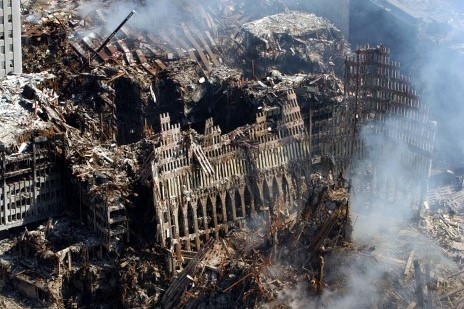
The following images come from a group of high resolution photos I have found depicting the debris in the aftermath at Ground Zero. You will see lots of exterior columns and interior columns… you will see the pulverized concrete dust by the tons… and you will see the aluminum cladding that made of the exterior surface of the buildings and lots of steel rebar that had been inside the concrete floors…
What I dare you to find is ONE… just ONE truss. Just ONE of the 23,000+ steel trusses that fell to the ground that day and COULDN’T have been pulverized by the falling debris. The photos are all high res so I invite you to click on them and explore to your hearts content.
Now remember what the webbing (tension and compression) from the trusses look like. They have the tight angles, in a repeating pattern, over a long span. Don’t be confused by the rebar that was in the concrete floors. What you see to the right of Mr. Sonnenfeld is rebar.
I have personally been over and over these photos and many others. I have yet to find one single truss. Not one.
23,000 trusses in the Ground Zero debris, and NOT ONE is visible in the photos? Does that seem odd to anyone else? Of course it does.
But just because they aren’t visible, doesn’t mean they aren’t THERE.
Forth and final part: What are the “Tons” of “iron rich spheres“
Ever since the beginning of the investigation into the events of 911 almost every single ‘official” and unofficial report has mentioned the discovery of the “iron rich spheres” found in the dust collected from Ground Zero.
The RJ Lee report and the FEMA report as well as the investigative work of Steven Jones and others all make mention of these mysterious metal spheres mixed in with the pulverized concrete dust. This is what they look like.
The important thing here is the language they use to describe these “spheres’ found in in the dust. “Iron rich” implys that they are iron, but they are also made up of other metals and alloys, and of course… carbon.
Why is this important? Because “steel” is made up of mainly IRON mixed in with small amounts of carbon and, depending on the type of steel, other elements. Steel itself is “iron rich”. The structural steel of the trusses… is itself “iron rich”.
The thermite that others have been considering as the source of these spheres creates molten iron… not molten iron and carbon. Plus the shear volume of the spheres found in the dust (at one time suggested by Jones to be about 10 tons) suggests that they must have come from a structural element of the towers themselves.
The trusses.
At the moment of detonation, a high explosive, strong enough to pulverize the concrete floors, would also have to burn hot enough to instantly melt the trusses themselves thus creating the microscopic “iron rich” spheres found by FEMA, RJ Lee, and Steven Jones. But also it would explain the “molten metal” that burned in the debris pile for weeks after 9/11.
There is only ONE high explosive used in the demolition industry capable of that kind of combined result: PETN.
Curiously, each and every single investigation that has been done on the “collapse” of the Twin Towers, RJ Lee, FEMA, NIST, and even the Jones/Harrit paper, has gone out of their way to make the statement that they DID NOT test for residual trace elements of conventional explosives in the debris from Ground Zero.
Conclusion: The official explanation for the collapse of the towers cannot be accurate.
There is no amount of pressure that could possibly have been present in the collapse of the Twin Towers that would explain the pulverization of the trusses into the steel micro-spheres found in the dust at Ground Zero.
At the moment of collapse, those trusses were in the buildings and judging from the visual evidence of the photos afterward, they were not after the buildings came down.
If the pulverization of the floors couldn’t have rendered the trusses into micro-spheres of “iron rich” droplets, what in fact did do it?
As is often the case, the simplest explanation is often the most accurate.
Test the remaining evidence from Ground Zero for trace elements of explosive materials commonly used in the demolition industry with special attention given to PETN and RDX.
The photographs don’t lie. They are a living record of the crime of 911. And from them we can and will finally prove, beyond any reasonable doubt, that the official story of what happened that day cannot be accurate.
Sometimes what isn’t visible at a crime scene is just as important as what is.