

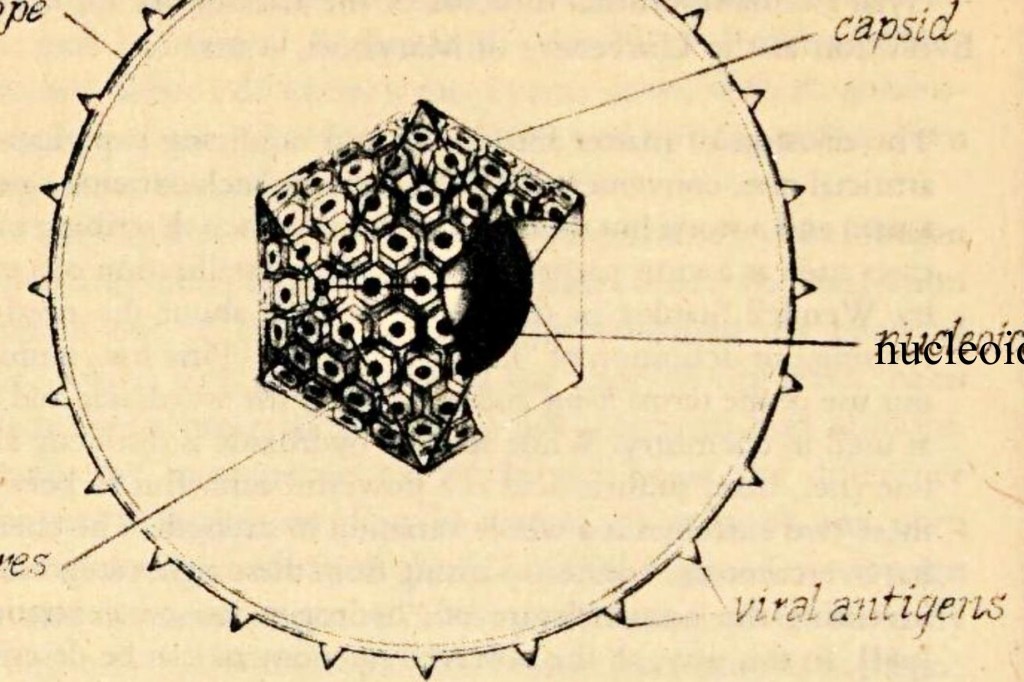
In this post, I will be quoting from ‘Chronic Fatigue Syndrome: The Hidden Epidemic’ (1992) by Jesse A. Stoff. “It’s probably not the traditional EBV,” theorizes Dr. Anthony Komaroff, chief of internal medicine at Peter Bent Brigham and Women’s Hospital in Boston. “It could be a new mutant strain of EBV or it could be a whole new virus that somehow reawakens old EBV dormant in the patient’s system. In fact, there is a suspect: human B-lymphotropic virus (HBLV, now known as human herpes virus 6), first identified in late 1986. Like EBV and chicken pox, it is in the herpes family of viruses, and it invades B cells, just as EBV does. HBLV could be making people sick all by itself and, in the process, reawakening dormant EBV.” I remember being diagnosed as having mononucleosis during my freshman year in college. It was no big deal. A little tiredness. Some aches in the legs. It spread from clique to clique. We jokingly called it the “kissing sickness.” But what made it come back years later, and with such terrific force? It’s fascinating to think about, when I look back from a vantage point of recovered health. I mentioned in the preceding pages that one of my most painful experiences with EBV was a surge of arthritis. I had the arthritis before the virus bloomed out of control in my blood; it is now known that an EBV bloom will aggravate a preexisting chronic condition, such as arthritis. And here’s the fascinating part: the form of arthritis I suffered from has been diagnosed as ankylosing spondylitis, characterized by a hardening of the ligaments and tendons that bind the vertebrae together. There is apparently nothing new about this condition; I’ve seen dinosaur spines that exhibit the same characteristics. (Poor Omithomius, did he do as I once did in New Zealand – find an active volcano and settle into a hot mud pool for relief?) There is a genetic marker for this disease, and my white blood cells do indeed carry the marker. Until recently, no one had any idea how this genetic trait was expressed, or why many people who carried the ankylosing spondylitis gene complex never developed the disease. Now it begins to look as if the coevolution of viruses and humans may be responsible. The genetic marker, known as the HLA-B27 haplotype, contains six consecutive ammo acids identical to a sequence in a protein of the Klebsiella pneumoniae bacterium. Somewhere among the countless million forebears whose blood runs in my veins, something truly remarkable happened. A virus must have snipped off and carried away a little string of DNA belonging to a K. pneumoniae bacterium. This is one thing viruses are very good at: stealing away bits of heredity and redepositing it where it does not belong. Viruses are the worst gossips in the world. Through them, every living thing on this planet is shedding little snippets of DNA, much as a cat sheds hair. With such grace did a virus enter one of my ancestors, carrying a stolen K. pneumoniae genome in tow. It turned my ancestor’s body into a virus factory, making replicas of itself and of its new-found K. pneumoniae genome, too. Before the infection passed, one of the replicants chanced upon a nucleus that was destined to become a sperm or egg and there deposited the bacterial gene, tagging it to the DNA of the yet unborn. Once so tagged, the change could be passed on indefinitely. The world seems to tilt irrationally as I look at my hand, as the concept of “the stranger within” shifts from symbol and myth to a dawning reality, as I realize that my DNA is not entirely my own, that I am not fully “human.” How many years have passed since an ancestral chromosome was transformed into something part human, part bacterium? A thousand? A million? I will probably never know. What I do know is that I came down with K. pneumoniae symptoms during the winter of 1976, and by May arthritis was gnawing at the base of my spine. Once exposed to K. pneumoniae, my immune system began producing antibodies against it. In very short order, the bacterium was hunted out of existence. But there remained my bacterial genome, which had, probably from the time of my birth, been manufacturing a bacterial protein in my ligaments and tendons. Apparently my immune system no longer knew the difference between me and the invading bacterium. It mistook my own sequence of amino acids from the HLA-B27 region for a foreign antigen and mounted an assault on the part of me that was not truly me. It began as a slow erosion of the connective tissue in my spine and deteriorated from that point to a general feeling of achiness, inflammation, fever, and fatigue. In time, as my immune system became more and more confused, the Epstein-Barr virus – the most commonplace of all viruses known to reside in human blood – reawakened. As EBV further weakened my body, further confused my immune defenses, a sort of kindling temperature was reached, a flash point at which EBV quickened to the tempo of ankylosing spondylitis. The resulting surge of inflammation weakened me still further, made my blood even more hospitable to EBV. The whole process became cyclic and self-sustaining, like a snake connected head to tail. The study of viruses is more fascinating than most science fiction. Left on its own, completely out of contact with living creatures, the Epstein-Barr virus is inanimate, as silent and lifeless as a mineral – which, perhaps, it is. Close up, the hexagons and triangles that comprise its shell look like clusters of crystals. But they are very strange crystals. They are chains of hydrocarbons, and they have been seeded by DNA. Cyril Ponnamperuma, director of the Laboratory for Chemical Evolution at the University of Maryland, warns: “The division of matter into living and nonliving is perhaps an artificial one, convenient for distinguishing such extreme cases as a man and a stone but quite inappropriate when describing other cases such as a virus particle. Indeed, the crystallization of a virus by Wendell Stanley in the 1960s brought about the need for revising our definition of “life” and ”living.” Pirie has compared our use of the terms living and nonliving to the words acid and base as used in chemistry. While sodium hydroxide is distinctly alkaline [i.e., base] sulfuric acid is a powerful acid. But in between these two extremes is a whole variation in strength. The chemist has overcome the confusion arising from these rigid categories by inventing the nomenclature of “hydrogen ion concentration” [pH]. In this way, all the observed phenomena can be described in terms of one quantity. We may have to invent a similar quantity to avoid any vagueness that might arise in applying the term “life” to borderline cases such as the virus.” Once it is brought into contact with human B cells, EBV comes “alive.” The outer shell (or capsid) of the virus is shaped like a geodesic sphere and is composed of hollow, proteinaceous hexagons called capsomeres. The capsomeres are arranged into hexagonal arrays, giving the surface of the geodesic sphere a honeycombed appearance. The Epstein-Barr virus is unimaginably minute. Because the virus is actually smaller than the wavelengths of light, it lives in a world without color; everything is black and white. And yet it displays extraordinary detail, geometrically complex and perfect, like a Herkimer diamond. That it is dangerous only adds spice to its beauty. Its capsomeres fit receptors on the membrane of the B cell, fusing with them as if the B cell were a loading dock built for its exclusive use. Once inside the host B cell, EBV sheds its capsomeres and eventually grabs control of the cell’s DNA, reprogramming it to make copies of the virus with a speed and sophistication even Xerox would envy. (Alternatively, the viral DNA can persist in a dormant state, awaiting the division and replication of the host cell, which will duplicate the EBV genes, too.) As hordes of new virus particles emerge from the cell nucleus into the cytoplasm, they begin to pile up against the inner surface of the cell membrane, through which they are eventually extruded. In this process, the newly formed viral capsids are coated with a protective envelope manufactured from stolen pieces of cell membrane. The break-out of new virus particles – indeed, the mere synthesis of such components as the viral capsid antigen (or viral capsid protein) – kills the B cell. Combating the virus is part of what makes EBV sufferers – or even common cold sufferers – feel sick. The fatigue, fever, and achiness are not a result of a few infected cells dying. You feel awful because your body is mass producing antibodies and/or secreting mucus at an abnormally rapid pace. Persistent infection shifts the body into maximum overdrive, triggering such complications as chronic inflammation. No, the virus does not always harm you directly. Sometimes it is subtle and severe. Sometimes it deceives your own body into wearing itself down. Virus, the ancient enemy. During the course of its evolution, the Epstein-Barr virus has established a nearly perfect parasitic relationship with humans. An imperfect parasite, such as the more recently evolved AIDS virus, is too new to the game and kills its host. No competent viral strategist would dream of a 100 percent kill rate. Were a strain of AIDS to emerge that could spread more easily (and, given a reservoir of millions infected with this most rapidly mutating of all known viruses, that is not entirely out of the question), and assuming no viable treatment, humanity might disappear in a single generation, utterly and without descendants. So too would the AIDS virus. A perfect parasite, such as the Epstein-Barr virus, ensures the survival of both parasite and host. In most cases, EBV knows when to stop. The host generally survives infection, and infectious virus particles are thereafter released periodically into the saliva, facilitating its spread to every new generation of uninfected hosts. During the Stone Age, and the Wood Age before it, introduction to EBV probably took place when a person was very young, which is what happens in many undeveloped parts of the world today where sanitation is often primitive. When EBV strikes young children, only rarely does it cause significant illness. No one understands why this age-based selectivity occurs. With the improved hygiene standards of developed countries, first contact with EBV is usually put off until adolescence – but then at a price. In adolescence and early adulthood EBV infection is often expressed as mononucleosis. In the United States and Japan, between 35 and 80 percent of the freshmen entering college test positive to EBV antibodies. Ten to 15 percent of those uninfected will contract the virus during freshman year, another 10 to 15 percent during sophomore year, a like percentage during junior year, and so on and so on until, by the age thirty, at least 97 percent will test positive. Sixty percent of these belatedly infected individuals will become ill, often with great detriment to their academic and professional careers. Interest in this viral syndrome dates back to 1889, when Dr. E. Pfeiffer described what he called a “glandular fever,” which included a variety of disorders closely resembling acute EBV disease. To this day in the medical literature, the syndrome is occasionally referred to as Pfeiffer’s disease. Since the 1920s, it has been known as infectious mononucleosis, so named because of an associated lymphocyte (white blood cell) with a peculiar morphology. The disease is also characterized by a marked increase in white blood cells and in many respects exhibits properties of a “self-limiting leukemia.” In leukemia, the overproduction of cells in the bone marrow (where B lymphocytes originate) and thymus (where T lymphocytes are manufactured) mushrooms out of control. However, patients with mononucleosis generally recover, and the abnormal proliferation of white blood cells eventually subsides. In a tissue culture, normal healthy B cells are unable to grow and multiply. As a rule, they die off about three weeks after being transferred to a petri dish. By contrast, “sick” B cells – those infected with EBV – blossom into ever-expanding colonies. They will grow for years in a petri dish, like tumor cells, and for similar reasons. The sick, “immortalized” cells simply don’t know when to stop growing. In people with infectious mononucleosis, one B cell in five thousand is transformed into an abnormal lymphocyte capable of growing indefinitely in culture. In healthy individuals with dormant EBV infections, only one lymphocyte in ten million is transformed. EBV’s participation in the genesis of cancers seems clear, for the proliferation of immortalized mutant cells is cancer, by sheer definition. In 1958 Dr. Denis Burkitt of Makerere University in Uganda discovered an unusual lymphoma (a cancer of the immune system). It seemed to strike initially in the head and neck. In one patient, the malignant growth doubled in size every two days, distorting the face until it resembled a mass of balloons with eyes. It metastasized rapidly – and lethally – to other parts of the body. By 1964 the condition bore the name Burkitt’s lymphoma. That was the year M. Anthony Epstein, B. G. Achong, and Y. M. BarrImage of London’s Middlesex Hospital began studying Burkitt’s lymphoma cells under an electron microscope. Within the cells they found virus particles, which they named (as you’ve probably guessed by this point) Epstein-Barr virus. We now know that it belongs to the herpes family of viruses, characterized by a double strand of DNA and an ability to lie in wait – forever – in those it infects. The family includes the genital herpes virus, the chicken pox virus, and cytomegalovirus (also known as CMV). In 1983 four members of one California family – two cousins, a daughter of one of the cousins, and a sister-in-law of the second – learned they had contracted the rarely encountered Burkitt’s lymphoma. The facts surrounding the case are compelling, yet difficult to interpret. The four had been visited a year earlier by a South African aunt who was touring the United States. They recalled that the aunt had suffered from a sore throat, fatigue, and other EBV-like symptoms. Blood tests showed that at least one of the four victims had experienced a recent EBV infection (one died before her blood could be tested). Genetic origins of the cancer can be ruled out because not all of the victims are blood relatives. Dr. Joseph Pagano of the University of North Carolina feels that “EBV and/or some other virus is a more likely explanation [for the cancer cluster] than any other. Is it possible, then, that we are looking at a contagious cancer? Can that be true?” Examination of African populations has shown that EBV antibodies are present in the blood of all children suffering from Burkitt’s lymphoma; they are also in the blood of nearly all healthy African children under age four. The difference is in the antibody titers. In those children expressing lymphoma (approximately one case in ten thousand children per year) the titers for the viral capsid antigen (and for other viral proteins) are well over 80, at least ten times higher than the titers of healthy children. Clearly, the lymphoma children are responding abnormally to the virus and, as Epstein and Barr found, Burkitt’s lymphoma in Africa is strongly associated with the virus that bears their names. But is association enough to conclude cause and effect? Ninety-two percent of critically ill patients with certain lymphomas are now known to exhibit abnormally high EBV antibody titers. Their bodies have actually become virus-replicating machines.”

