

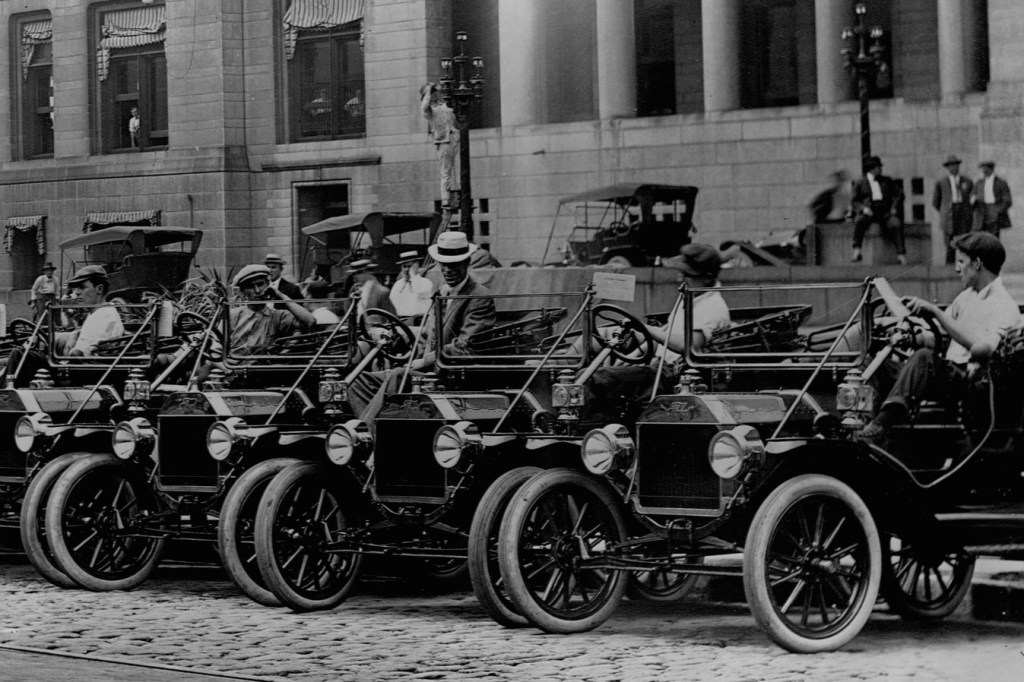
In this post, I will quote from ‘Paths of Fire: An Anthropologist’s Inquiry into Western Technology’ (1996) by Robert McCormick Adams. I think that I finished reading this book almost a year ago. Obviously, I won’t be quoting everything from the book on my blog, but I did highlight many pages from it, surprisingly more than I thought I would because the book hasn’t become one of my favorites. Still, I did find slightly more than half of the information in it to be interesting. The book isn’t available on Google Books, unfortunately. I was able to buy it in very good condition at a used books store. Since it was published in 1996, my copy of the book is already thirty years old. It’s far from the oldest book that I own. “At least up until World War II, the refinement of techniques of mass production was probably the most significant American contribution to industrial technology. It was not an unalloyed new discovery, of course; major technological breakthroughs seldom are. Fundamental to it were all of the slowly and dearly won lessons of “armory practice” that eventually gave substance to the American system of manufacture. Then those lessons had to be re-adapted or learned anew by companies needing to demonstrate their competitiveness in order to obtain access to capital markets, as well as to meet the test of the market for their products. But with due regard for its lengthy evolutionary origins, mass production was still a development that was immediately hailed as revolutionary upon its first, full appearance at the Ford Motor Company. And since then it has been consistently and universally recognized as one of the main pillars of effective industrial practice. Only a wide-ranging economic, social, and cultural history could do justice to the way mass production has continued to unfold over the last ninety years or so. Moreover, it is only part – although a major part of the dramatic expansions of scale and reductions of cost clearing the way for the flood of new consumer products that have, over roughly the same period of time, found mass markets and led to the creation of whole industries. A suitably balanced – let alone full account of these developments would detract from this book’s principal concern with the major characteristics of technological advance, and would in any case quickly outweigh the longer-term themes on which it concentrates. From this point forward, therefore, attention will be limited to only a few of the most salient features of technological advance and the industrial products or processes embodying them. But by any reckoning, the automobile belongs at or near the head of the list. In terms of the ensemble of fabricating and assembling methods involved in its manufacture, the automobile was in most respects a linear descendant of approaches developed for other, newly devised consumer durables for which there proved to be heavy and increasing demand. The line of that descent, modified along the way to take account of the vastly greater complexity of the product, is the overly narrow technological theme on which considerations of space force me to concentrate. But the automobile was also the triggering mechanism for a revolutionary economic and social transformation. Virtually every pattern of American life has come to be built around the automobile as a mode of indefinitely flexible, individualized transportation – and, indeed, of self-expression. It would be difficult to overestimate the number of subsidiary, component, and service industries that have the automobile at or near their center. The automobile has been accurately described as European by invention and American by adoption. Its early development, beginning in the 1890s, was directed exclusively at a small elite market. The key initial advances in small internal engines were made to meet this very limited demand, taking advantage of better-developed European roads. But beginning little more than a decade later in the United States, and taking advantage of its existing infrastructure of industrial technology better able to sustain mass production of complex machinery, the automobile became the material manifestation of an entirely different vision of economical mass transportation. James Vance has identified what he describes as a series of “great ratchets” in American automobile ownership, linking them to phases of improvement and extension in American city streets and rural highways. Licensed automobile ownership rose from seventy-eight thousand in 1905 to one million in 1912, ten million in 1921, and thirty million in 1937. The earliest phase saw only limited improvement of facilities; the concerted effort on roads began later. But it did also see the introduction of easily serviced, reliable, reasonably powerful, and above all economical vehicles designed to operate even on an unimproved road system. Paramount among them was the Ford Model T, which unquestionably provided the primary stimulus leading to the development of the entire interdependent automobile system. To understand the full magnitude of the transformation it effected, we need to return to the gradually expanding implementation of the American system of manufacture that led the way to it. Cyrus McCormick, the dominant figure, has a largely undeserved reputation for having taken early leadership in introducing the American system, particularly for substituting special-purpose machinery for hand labor and for producing truly interchangeable parts, into the manufacture of reapers and other agricultural equipment. McCormick farm equipment had a solid reputation for basic design and quality, buttressed by success in competitive tests. But as already noted, the company’s success was largely based for many years on its prowess in marketing. Only in the early 1880s, thirty years after he is commonly reputed to have done so, did McCormick finally hire personnel who could bring his mode of manufacturing up to the standard of the national armories where mass production methods had first been demonstrated. Treadle-powered sewing machines, introduced in the early 1850s, made an earlier and more substantial, but nevertheless still qualified, technological contribution in terms of interchangeability of parts. Once again, marketing prowess had much to do with their vast popular success. Almost at the outset of their appearance, the applicability of armory practice – the most fully developed form of the American system – was quickly demonstrated by a few manufacturers. On the other hand, the Singer Manufacturing Company, before long coming to dominate the industry, continued to rely for many years on “what contemporaries called the European approach to manufacture – skilled workers using general-purpose machine tools and extensive hand labor.” Finally, as annual production approached a half-million units in the early 1880s, more or less contemporaneously with McCormick, the company recognized the necessity of adopting the production of fully interchangeable parts as a goal. But as David Hounshell, the leading student of this transition, goes on to record in detail, “to the dismay of many, Singer’s production experts found that such a goal was not easy to achieve. Indeed, manuscript records end before there is clear evidence that Singer realized its goal”. Bicycle manufacture proved to be a more significant intervening step along the uphill climb to the successful mass production of automobiles. Armory practice was introduced and perfected for a rapidly growing market, in what was viewed at the time as its first widespread adoption. Then midwestern producers during the 1880s and 1890s pioneered in the stamping of bicycle parts out of sheet steel, a technique initially regarded as “cheap and sorry” by contemporaries although later it proved to be vital in automobile manufacture. And valuable experience was gained in the production and utilization of ball bearings and other high-precision parts where ruggedness and durability were essential. The introduction of Ford’s Model T in 1908 represented a new synthesis of manufacturing practices. Well-established lessons of armory practice and pressed-steel construction played their part. Now, however, they were embedded in a more comprehensive approach that extended from radical improvements in manufacturing technology to vehicle design, and even to a heightened sensitivity to marketing requirements. In manufacturing, there were innovations like multiple machining and new assembly methods, with conveyor systems becoming ubiquitous as labor-savers. These and other new concepts “remained the industry standard for decades… The spark advance and the torque tube, for example, marked a mating of technologies – electrical control concepts to the thermodynamics of engine design – that advanced and displaced the conventions of carriage makers… The market implications of the innovations of this period are well illustrated in the case of… vanadium steel alloy… [Its application] in engines and chassis components was an important part of the development of a lightweight vehicle. When Ford and his engineers found an alloy that afforded three times the design strength of traditional materials… they were released from many old constraints that had been adopted from carriage technologies.” As Hounshell notes, Ford production men, given free rein to experiment, were responsible for “a surprising rate of scrapping processes and machine tools,” but more importantly “added fresh thinking about work sequences, tool design, and controlling the pace of work.” At the time, as in hindsight, it seemed that the Ford Motor Company did not want to make money as much as it wanted to build cars.” The automobile industry provides an instructive illustration of an internal dynamic in the production of complex machinery. Technological improvements in one area can stimulate and interact with others, thus tending to preserve a kind of self-generating momentum. While these findings of Nathan Rosenberg seem to implicate technology as a kind of “prime mover,” it clearly is so only in a very circumscribed sense and setting. Machine tool features and techniques, for example, not only were developed in response to automobile production requirements but began to borrow and embody innovations introduced for the automobiles themselves. The introduction of the moving assembly line, developed initially for the assembly of magnetos, was perhaps Ford’s decisive innovation. An accompanying measure, successfully compensating for the increased stress the line placed upon the labor force, was the unprecedented incentive of the five-dollar day. In early 1913, first adopting the objective of reaching a mass market, assembly of a Model T required twelve hours and twenty-eight minutes; little more than a year later this had been reduced to an hour and a half. By 1920, in consequence, half of the automobiles in all the world were Model T’s. In its heyday, steeply reduced purchase costs as well as escalating sales mark the success of what has been rightly described as a lever to move the world. Ford’s reliance on time and motion studies to analyze work flow patterns and establish standardized work routines clearly was integral to the radical economies that were introduced into the production process. In these respects, the approach closely resembles the doctrines of “Taylorism,” made widely influential at the time by Frederick W. Taylor. But there were also fundamental differences, and it is the differences that help to explain why mass production is now worldwide in scope while Taylorism has essentially disappeared from view: “The Ford approach was to eliminate labor by machinery, not, as the Taylorites customarily did, to take a given production process and improve the efficiency of the workers through time and motion study and a differential piece-rate system of payment (or some such work incentive). Taylor took production as a given and sought revisions in labor processes and organization of work; Ford engineers mechanized work processes and found workers to feed and tend their machines.” All of the most essential principles of mass production are exemplified by the installation of the Ford assembly line. Little would be gained by describing its later diffusion and refinements. With the onset of the 1929 depression, in any case, the mass consumer purchasing power needed to sustain high and growing levels of mass production suffered serious and sustained losses. Assembly lines crept back to life again beginning in the later 1930s. But they did not once again fully express the levels of output of complex machinery of which mass production methods were capable, or the speed with which those levels could be reached, until the country was faced with urgent military necessities as a consequence of World War II. The earliest full development of the principles of mass production is probably the most salient U.S. contribution to industrialization. As noted, principles of standardization of labor inputs and components, emphasis on the employment of special-purpose machinery, and the maintenance of a high and uniform rate of throughput had their origins well back in the nineteenth century. They were brought together in a remarkable way during the first few decades of the twentieth. Although modified in some important ways that will be discussed in the following chapter, they remain generally intact and viable today. However, this should not be taken to imply that mass production principles were, or ever could be, applicable in every setting. Large-scale, mass production enterprises form only one end of a very diverse continuum, and this was especially true in the earlier decades of the twentieth century. Nor were all of the enterprises distributed closer to the other end of the continuum weak and struggling. In fact, some of them made significant contributions of their own to advancing technological frontiers. A wide array of products and types of markets simply continued to be best fitted for approaches that are in many senses an antithesis of mass production. Among these were batch work, specialty production involving continuing adaptations and excellence of design, and products requiring a highly skilled, versatile, and motivated work force ready to respond to time-critical, diverse orders with primarily general-purpose machinery. Locomotives, ships, turbines and generators, machine tools, paper and woodworking machinery, mining equipment, castings, fashion apparel, jewelry, and furniture all are good examples, and “all helped define American technical prowess.” Baldwin paid its locomotive workers far higher than European wages, for example, but the worker-years required for building its products were only half those of its European competitors. Philip Scranton, who has devoted careful study to this industrial niche, does not minimize the harshly uncertain environments within which such firms had to operate: “Unlike their throughput counterparts, batch firms could never sustain the illusion that they could control their market environments, manage technological change, and use formal rationality to make decisions. Theirs was a world of decision making under uncertainty, of extravagantly imperfect information, and of contingencies that pulled them beyond the boundaries of the firm.” Yet for a considerable time they contributed significantly to the historical process by which American industry achieved world dominance. Many of the firms occupying this difficult niche not only survived but grew until the Great Depression of the 1930s. Subsequently many of them, or at any rate their functions, were absorbed into more broadly constituted corporate entities. But whether under one consolidated corporate roof or many independent ones, the diversity of manufacturing approaches they practiced remains alive and well today.”

