Last year, Koch Industries was the second largest, privately held company in the United States. This year it will be the largest; with its acquisition of glassmaker, Guardian Industries, its revenue will surpass agricultural giant Cargill for the number one spot.
Trump’s first year in office has been marked by almost a complete lack of major legislation. The exception was the Tax Cuts and Jobs Act of 2017, the massive corporate tax bill sold to the public as a job creation measure. The bill permanently dropped the corporate tax rate from 35 to 21 percent and temporarily implemented modest tax relief for the middle class.
The Koch brothers made securing the massive tax cuts for themselves and their corporation their top priority for their sprawling political network in 2017, as internal documents revealed. The Kochs’ Americans for Prosperity astroturf group lobbied hard for the bill and spent some $20 million on ads spinning the bill and pressuring recalcitrant politicians.
Tim Phillips, president of Americans for Prosperity, said the tax plan is “about to ignite a new era of growth, and we’re going to make sure that Americans understand how they and their community stand to benefit.”
But as the Center for Media and Democracy reported last week, many companies simply pocketed the cash. Instead of creating jobs, they created layoffs. CMD detailed nine American Legislative Exchange Council (ALEC) companies that implemented layoffs, and ALEC’s private sector board chair, Koch Industries, is no exception.
RAKING IN THE KOCH CASH, LAYING OFF MORE WORKERS
Koch Industries is a privately held company, but it is expected to rake in between $1 billion and $1.4 billion a year due to the tax cuts.
Last year, the Koch brothers made a $650 million investment in Meredith Corp. to help the publishing giant complete its purchase of Time magazine. Now Meredith is announcing the layoff of 1,200 employees for 2018, with cuts at Time, Sports Illustrated, Money, and other subsidiaries, along with closing its office center in Tampa, laying off 500 employees.
Other Koch subsidiaries have announced layoffs as well:
In November, already knowing there would be some tax cuts, Koch announced that its Georgia-Pacific facility in Camas, Washington, operating for 134 years, would close with the loss of 300 jobs. Koch bought the paper and pulp company in 2005.
In April, Koch announced it would cut 25 jobs from its gypsum plant in Marysville, Kansas. A Koch spokesperson, Julie Davis, who apparently got to keep her job, said, “This is no reflection on the employees. When the market improves we’d certainly encourage those folks to come back.” She did not say when that would happen.
Koch Industries has its own commodities trading company, and it has announced layoffs in that subsidiary.
Invista, Koch’s fiber company, laid off 52 employees at its Athens, Georgia, plant ten days before Congress passed the tax cut bill.
The estimated $1 billion in tax cuts for Koch this year surely could have covered the cost of keeping some of these workers as the company goes through a temporary downturn in sales of some of its products.
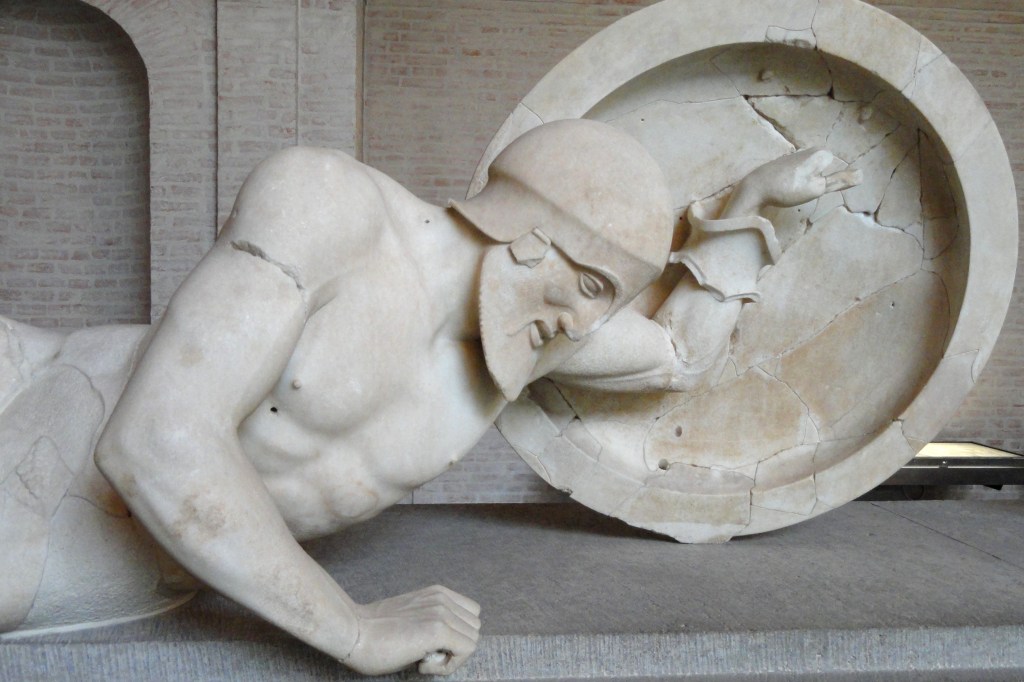
Sculpture of Laomedon, a Trojan king, son of Ilus and thus nephew of Ganymede and Assaracus
It’s that time again, the time for updates, since enough time has passed. First of all, people asked me to give my opinion on the summer films of this year, and I’m not against doing this. How good are the films that have been released this summer? I’m now ready to give my take. I must admit that I’ve seen only several films this summer, and most of them were made by the The Walt Disney Company. But the ones that I did see didn’t really disappoint me. Toy Story 4 is the best film that I saw. This film had a long development period because of the departure of John Lasseter from Pixar Animation Studios. I read about this in Animation Magazine. Because of this, and because of the fact that the film is yet another sequel to Toy Story (1995), I had the feeling that Toy Story 4 might be somewhat disappointing. But this film surprised me when I saw it because it’s not only the best Pixar film since Incredibles 2 (2018). It’s also one of the best Pixar films of this decade. In my opinion, the director, Josh Cooley, delivered the goods. The characters have never looked better. The voice work is excellent. The humor is frequent. And we get to find out new things about Woody and the gang. It’s true that the film is formulaic, and it’s yet another sequel from Pixar, but, when the film is this good, I don’t feel like complaining. Still, I didn’t enjoy seeing Toy Story 4 as much as I enjoyed seeing Incredibles 2. Incredibles 2 is, in my opinion, the best Pixar film of this decade, even surpassing Inside Out (2015) and Finding Dory (2016) in terms of craftsmanship. I went to see it more than once in a cinema. Can you believe that Incredibles 2 could have been even better if Brad Bird and Pixar had been given more time to make it? The film is almost perfect as it is, but it could have been even better. The only thing that weighs it down is the lack of a truly memorable villain. But, otherwise, the film is perfect, in my opinion. Thank goodness that films like this can still be made from time to time in Hollywood. Bird deserved to win a second Oscar for his work, but, because of political reasons and because he already has one Oscar, the Oscar for Best Animated Feature was instead awarded to the filmmakers of Spider-Man: Into The Spider-Verse (2018). By the way, I finally figured out why Into The Spider-Verse isn’t an entirely satisfying film. Miles Morales, the new Spider-Man, is supposed to be the main character. But he spends almost the entire film either being a sidekick to Peter B. Parker or acting as comic relief. Only at the end of the film does he get to do something on his own, but, by that time, it’s too late for any character development for him. Therefore, Into The Spider-Verse lacks a fully developed protagonist. The animation style is also something that I find to be not entirely to my liking. It makes the film seem like a gimmick at times. Anyway, I’ve already posted my review of Into The Spider-Verse on my blog, and I don’t have to go into it in more detail. By the way, if you like the animation style of the film, I can recommend getting the art book ‘Spider-Man: Into the Spider-Verse – The Art of the Movie’. The only other film that I fully enjoyed seeing this summer in a cinema is Spider-Man: Far From Home. It’s yet another example of Marvel’s domination of the superhero genre in film form. Marvel continues to put the other Hollywood studios to shame. Even the recently released Shazam!, which is thought of by some people as the best DC film of recent years, doesn’t come close to the best Marvel films. I mean, really, is it that hard to make a good action film these days? I guess that it is, especially one with plenty of special-effects. Instead of lively, enjoyable flicks, we often get dour, distasteful flicks like Venom (2018), The Amazing Spider-Man 2 (2014), or Batman v Superman: Dawn Of Justice (2016) from the other studios. How depressing. It seems that the only film form in Hollywood that has consistently delivered good films in the last decade is computer animation. In my opinion, Far From Home doesn’t rank among Marvel’s best, but it’s still a good flick. Tom Holland is definitely the best on-screen Peter Parker so far. So, there you go. I enjoyed seeing two films in a theater this summer, and both of them are films from Disney. I guess this means that this summer has been disappointing when it comes to new Hollywood films. But there are other new films that I found to be… passable, though not fully enjoyable. They are Annabelle Comes Home, Detective Pikachu, Missing Link, The Angry Birds Movie 2, Pet Sematary, The Secret Life Of Pets 2, Aladdin, Us, Hobbs & Shaw, How To Train Your Dragon: The Hidden World, and Alita: Battle Angel. I saw almost all of these films long after they were released in theaters. I decided not to include The Lion King among these “just fine” flicks because seeing it felt strange to me. Firstly, this film was made entirely using computers. There are no human actors or real locations. But the film was still made to look as realistic as possible. Maybe this means that it can’t really be called an animated film, or maybe it can. It’s almost a scene for scene copy of the original 1994 film. This means that there’s nothing original about it except for the way it was made. The animals, since they were made to look as real as possible, aren’t as expressive as in the original animated film. In addition to all of this, I saw the original animated film only a few days before I went to see the remake in a theater. All of this added together made the film a strange and unenjoyable experience for me. Still, Pumbaa did fart once. But let’s move away from this somewhat depressing picture and focus on something else. The people that follow my blog should know that most of the films that I see aren’t new Hollywood films. If it’s a Hollywood film, it’s most likely one from the 1980s or it’s a so-called classic Hollywood film. Many films from Hollywood’s Golden Age really are a pleasure to watch for me. These films are well-acted and optimistic. By the way, if you’ve read the science fiction novel Titan by John Varley, you should know that Gaea, the old alien being that Cirocco meets at the end of the story, is obsessed with watching films from Hollywood’s Golden Age. I’m currently reading the book ‘Majestic Hollywood: The Greatest Films of 1939’ by Mark A. Vieira. The CIA’s Wikipedia even has a page dedicated to “Classical Hollywood cinema”. Here it is:
It seems that after this so-called Golden Age of Hollywood the only advances that have been made in the USA were in the fields of special-effects and computer animation. There were no cinematic advances in Western Europe at that time because industrial capitalism had become highly institutionalized in Western Europe by that time and thus provided little or no progress. Simultaneously, while these minor advances were happening, major elements of cinema like acting, music, and screenplays have been slowly getting worse in the USA. Hence, there’s all of the talk in the media about how influential George Lucas has been, and about what an icon he is, after the release of Star Wars (1977). I personally have nothing against this. Lucas is objectively an influential filmmaker, he doesn’t go around saying offensive things, and he deserves most of the praise that he gets. I very much like his films The Empire Strikes Back (1980) and Return of the Jedi (1983). I also don’t have a hatred for his prequel trilogy. The same goes for Steven Spielberg. Spielberg, for example, still manages to make good films. Lincoln (2012) and Ready Player One (2018) are some of the best films of this decade. Lucas and Spielberg did manage to make the turd that is Indiana Jones and the Kingdom of the Crystal Skull (2008), but I haven’t seen Lucas’s special editions of the original Star Wars trilogy. The films that I have in my collection are the original, unaltered VHS versions of the trilogy. Therefore, I don’t have a hatred for Lucas. If Lucas had been responsible for an additional bad film like 300 (2006) or Batman v Superman: Dawn of Justice (2016), I’d have a reason to dislike him. The shame for making these two turds goes instead to the director Zack Snyder. Snyder’s 300 is a bucket of filth that somehow manages to get praised by brainless Americans and by some bought and paid for professional film critics. Sure, 300 isn’t the only bucket of filth that has been made in Hollywood in the last two decades. There have been many such buckets of filth. But I think that 300 is the film that is most representative of all of this filth. 300 is much louder, much more distasteful, and much more historically inaccurate than The 300 Spartans (1962), which is actually a fine film that’s worth seeing. In addition, I noticed that it promotes militarism and oligarchical rule. Sparta, the Greek city-state whose citizens and customs are portrayed as being worthy of imitation in the film, had oligarchical and militaristic rule. But Classical Athens, the Greek city-state whose citizens are portrayed as weak and ineffective in the film, had democratic rule. In fact, Athens is the birthplace of democracy and the model of democracy. It also became the most prosperous Greek city-state after the Greco-Persian Wars. Now, if you want to know what a real democracy should be like, you should read some history books about Classical Athens or at least look at the Wikipedia page about Fifth-century Athens. It’s quite different from the so-called democracy that exists in the USA. In addition, I recommend reading Carroll Quigley’s books ‘The Evolution of Civilizations: An Introduction to Historical Analysis’ (1961) and ‘Weapons Systems and Political Stability: A History’ (1983), which provide even more useful information and conclusions about Ancient Greece. I think that this is important because most people these days don’t know what democracy is supposed to be like, partly because of the fact that they get a bad education in school. This is why some middle class people fall for oligarchical swindles like libertarianism and why other middle class people think that democracy is a failure and thus become irrational pro-fascists. The overwhelming majority of Americans, for example, don’t care about democracy. They don’t even know what it is. What they do care about is the empire that the USA possesses. Therefore, when you criticize the American political system, they respond in a calm and apathetic manner. But, when you criticize the American empire and overseas operations, they respond in a heated and confrontational manner (even in a psychotic manner). The same goes for class structure in the USA. This is the case because they’ve been taught to think like this by the American ruling class. They’ve been taught to think that they have a right to trample on others and to stick their noses in every crack. But, when it comes to democracy and their economic rights under capitalism, they take a conservative and unconcerned position. This isn’t true for all Americans, but it’s undoubtedly true for most Americans.
Granville Square is a prominent tower located at 200 Granville Street in Downtown Vancouver’s Financial District. Completed in 1973, it stands at 142 m or 30 storeys high, making it one of the tallest buildings in the city. The tower and its plaza are located atop the tracks of the Canadian Pacific Railway, and adjacent to Waterfront Station (formerly the CPR station).
Originally built by Marathon Realty to house the headquarters of Canadian Pacific, the building was occupied by The Vancouver Sun and The Province on the ground floor and some upper floors until 2017 (it is now located at 2985 Virtual Way at Broadway Tech Centre in Vancouver); while Vision Critical occupies the mezzanine. On top of the building is the Vancouver Harbour Control Tower for the float planes landing and taking off on the Burrard Inlet. This control tower is the tallest in the world.
The tower was the only completed part of the original, Project 200, which got its name from the 200 million dollar investment needed from the federal government. The project included a forest of office, hotel, and residential towers, laid over the CP train tracks. But its best known for its “Waterfront Freeway” a proposed freeway with ramps leading to parking garages under the office buildings, before the freeway heads under the “Brockton Point tunnel to the North Shore.
The project didn’t go ahead because of lack of funding, and grassroots opposition
Colliers International occupies four floors and is located in the building since 1973. The current owner of the building is Cadillac Fairview.
YouTube stands accused of censorship, following the company’s decision to bar former Congressman Ron Paul and his online news program from receiving advertising revenue for a number of videos which Paul recently posted.
No detective can solve a crime without carefully and objectively studying the evidence. Likewise, no one can know what actually occurred in history without studying, in an objective manner, the relevant primary sources – the evidence. I have spent decades in studying the primary sources concerning many specific events of the Stalin period. Mark Tauger has studied the primary sources on Soviet agriculture for more than 25 years.
Louis Proyect has not done this. Consequently he has no chance of discovering the truth, or of recognizing it when he sees it. He is inevitably doomed to “believe” whatever fits his preconceived ideological bias, and to reject everything else. This is fatal to any attempt to learn what really happened.
Louis Proyect’s attack on me and on Mark Tauger (“What Caused the Holodomor?” Cp March 24, 1971) is ideology masquerading as history. It is replete with falsehoods. I’ll concentrate on the lies Proyect tells about me and my research. I hope that Mark Tauger will respond to Proyect’s ignorant accusations against his research.
Proyect begins his article by stating: “Furr’s political life revolves around celebrating Stalin’s greatest achievements—such as they were.” This is false. My goal is not to “celebrate” Stalin, or anyone or anything. In my research I aim to discover the truth about Soviet history of the 1930s, using the best primary-source evidence and maintaining scrupulous objectivity.
I agree with historian Geoffrey Roberts when he says:
In the last 15 years or so an enormous amount of new material on Stalin … has become available from Russian archives. I should make clear that as a historian I have a strong orientation to telling the truth about the past, no matter how uncomfortable or unpalatable the conclusions may be. … I don’t think there is a dilemma: you just tell the truth as you see it.
The common or “mainstream” view of Stalin as a bloodthirsty tyrant is a product of two sources: Trotsky’s writings of the 1930s and Nikita Khrushchev’s “Secret Speech” to the XX Party Congress in February, 1956. This canonical history of the Stalin period – the version we have all learned — is completely false. We can see this now thanks mainly to two sets of archival discoveries: the gradual publication of thousands of archival documents from formerly secret Soviet archives since the end of the USSR in 1991; and the opening of the Leon Trotsky Archive at Harvard in 1980 and, secondarily, of the Trotsky Archive at the Hoover Institution (from where I have just returned).
Khrushchev Lied
In its impact on world history Khrushchev’s “Secret Speech” is the most influential speech of the 20th century. In it Khrushchev painted Stalin as a bloodthirsty tyrant guilty of a reign of terror lasting more than two decades.
After the 22nd Party Congress of 1961, where Khrushchev and his men attacked Stalin with even more venom, many Soviet historians elaborated Khrushchev’s lies. These falsehoods were repeated by Cold War anticommunists like Robert Conquest. They also entered “left” discourse through the works of Trotskyists and anarchists and of “pro-Moscow” communists.
Khrushchev’s lies were amplified during Mikhail Gorbachev’s and Boris Eltsin’s time by professional Soviet, then Russian, historians. Gorbachev orchestrated an avalanche of anticommunist falsehoods that provided the ideological smokescreen for the return to exploitative practices within the USSR and ultimately for the abandonment of socialist reforms and a return to predatory capitalism.
During 2005-2006 I researched and wrote the book Khrushchev Lied. In my book I identify 61 accusations that Khrushchev made against either Stalin or, in a few cases, Beria. I then studied each one of them in the light of evidence available from former Soviet archives. To my own surprise I found that 60 of the 61 accusations are provably, demonstrably false.
The fact that Khrushchev could falsify everything and get away with it for over 50 years suggests that we should look carefully at other supposed “crimes” of Stalin and of the USSR during his time.
Trotsky’s ‘Amalgams’
From 1980 till the early 1990s Pierre Broué, the foremost Trotskyist historian of his day, and Arch Getty, a prominent American expert in Soviet history, discovered that Trotsky had lied, repeatedly and about many issues, in his public statements and writings in the 1930s. In my book Trotsky’s ‘Amalgams’ (2015) I discussed the implications of these lies by Trotsky and of some additional lies of his that I discovered myself. They completely invalidate the “Dewey Commission,” to whom Trotsky lied shamelessly and repeatedly, as well as Trotsky’s denials in the Red Book and elsewhere of the charges leveled against him in the First and Second Moscow Trials.
Challenging the “Anti-Stalin Paradigm”
I have not reached these conclusions out of any desire to “apologize” for – let alone “celebrate” — the policies of Stalin or the Soviet government. I believe these to be the only objective conclusions possible based on the available evidence.
The conclusions I have reached about the history of the Soviet Union during the Stalin period are unacceptable to people who, like Proyect, are motivated by prior ideological commitments rather than by a determination to discover the truth “and let the chips fall where they will.”
The “anti-Stalin paradigm” is hegemonic in the field of Soviet history, where it is literally “taboo” to question, let alone disprove as I do, the Trotsky-Khrushchev-Cold War falsehoods about Stalin and the Stalin period. Those in this field who do not cut their research to fit the Procrustean bed of the “anti-Stalin paradigm” will find it hard if not impossible to publish in “mainstream” journals and by academic publishers. I am fortunate: I teach English literature and do not need to publish in these “authoritative” but ideologically compromised vehicles.
Those who, like Proyect, are motivated not to discover the truth but to shore up their ideological prejudices think that everybody must be doing likewise. Therefore Proyect argues not from evidence, but by guilt by association, name-dropping, insult, and lies.
A few examples:
Guilt by association: Proyect claims that I am “like” Roland Boer, Roger Annis, and Sigizmund Mironin.
Name-dropping: Davies and Wheatcroft are well-known and disagree with Tauger, so – somehow – they are “the most authoritative,” “right” while Tauger is “wrong.”
Insult: Tauger is complicit in “turning a victim into a criminal.”
Proyect: “…it seems reasonable that Stalin was forced to unleash a brutal repression in the early 30s to prevent Hitler from invading Russia—or something like that.” In reality neither I nor Tauger say anything of the kind.
Lies: Proyect quotes a passage from Tauger’s research about the Irish potato famine and then accuses Tauger of wanting to exculpate the British:
“The British government responsible? No, we can’t have that.”
But the very next sentence in Tauger’s article reads:
“Without denying that the British government mishandled the crisis…”
Proyect is a prisoner of the historical paradigm that controls his view of Soviet history. A few examples:
Proyect persists in using the term “Holodomor.” He does not inform Cp readers that Davies and Wheatcroft, whose work he recommends, reject both the term “Holodomor” and the concept in the very book Proyect recommends!
Proyect: “…no matter that Lenin called for his [Stalin’s] removal from party leadership from his death-bed.”
But, thanks to careful research by Valentin Sakharov of Moscow State University, even “mainstream” researchers know that this note, like “Lenin’s Testament,” is probably a forgery:
There is no stenographic original of the “Ilich letter about the [general] secretary.” In the journal of Lenin’s activities kept by the secretarial staff there is no mention of any such “Ilich letter.” … not a single source corroborates the content of the January 4 dictation. Also curious is the fact that Zinoviev had not been made privy to the “Ilich letter about the [general] secretary” in late May, along with the evaluations of six regime personnel. The new typescript emerged only in June. (Stephen Kotkin, Stalin 505)
Proyect: “Largely because of his bureaucratic control and the rapid influx of self-seeking elements into the party, Stalin could crush the opposition…”
However, in his 1973 work Bukharin and the Bolshevik Revolution Stephen Cohen wrote:
But machine politics alone did not account for Stalin’s triumph. … within this select oligarchy, Stalin’s bureaucratic power was considerably less imposing…. By April 1929, these influentials had chosen Stalin and formed his essential majority in the high leadership. They did so, it seems clear, less because of his bureaucratic power than because they preferred his leadership and politics. (327)
Proyect: “Stalin’s forced march did not discriminate between rich and poor peasants.”
But in 1983 James Mace, a champion of the Ukrainian Nationalist fascist collaborators, wrote about the role of “committees of poor peasants,” komitety nezamozhnykh selian, in supporting collectivization. There is much other evidence of peasant support for collectivization.
Conclusion
Correctly understood, history is the attempt to use well-known methods of primary-source research in an objective manner, in order to arrive at accurate – truthful — statements about the past. Very often the result is disillusioning to those who cling to false ideological constructs, even when those constructs constitute the “mainstream” of politicized historiography.
No one who does not try to discover the truth and then tell it without fear or favor, is worthy to be called a historian, regardless of how famous, honored, or “authoritative” he or she may appear to be.
Distortions and lies about Soviet history of the Stalin period predominate everywhere, including Ukraine, Russia, and in the West. These lies mainly consist in repeating Trotskyist and Khrushchevite lies, in defiance or in willful ignorance of the primary-source evidence now available.
The newly-available evidence from archival sources necessitates a complete rewriting of Soviet history of the Stalin period and a complete revision of Stalin’s own role. This exciting yet demanding prospect is of great importance to all who wish to learn from the errors, as well as from the successes, of the Bolsheviks, the pioneers of the communist movement of the 20th century.